
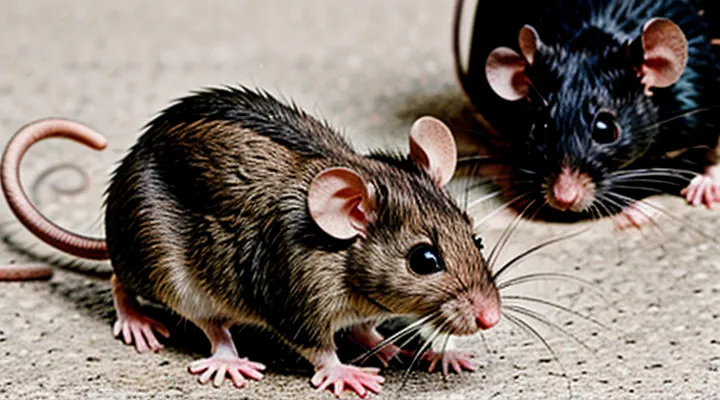
Physical Characteristics
Length and Proportion
Body to Tail Ratio
The body‑to‑tail ratio quantifies the proportion of torso length to tail length, providing a clear metric for comparing tail morphology between small rodents.
Typical adult mouse measurements:
- Body length ≈ 6 – 10 cm
- Tail length ≈ 6 – 9 cm
- Ratio (body : tail) ≈ 1 : 1.0 – 1.5
Typical adult rat measurements:
- Body length ≈ 20 – 25 cm
- Tail length ≈ 18 – 25 cm
- Ratio (body : tail) ≈ 1 : 0.9 – 1.0
Mice exhibit a higher tail‑to‑body proportion; the tail often equals or exceeds body length. Rats display a more balanced proportion, with tails slightly shorter than or comparable to body length. Consequently, the body‑to‑tail ratio serves as a reliable indicator of the distinct tail development patterns observed in these two species.
Tail Segment Count
The caudal skeleton of a mouse consists of a relatively short series of vertebrae, usually numbering between 19 and 20. Each vertebra is small, allowing the tail to be flexible while providing sufficient support for balance and thermoregulation.
In contrast, a rat’s tail contains a longer vertebral column, typically comprising 30 to 40 caudal vertebrae. The increased segment count contributes to a greater overall length, enhancing the tail’s role in locomotion, climbing, and environmental sensing.
Key distinctions in segment count:
- Mouse: 19 – 20 caudal vertebrae
- Rat: 30 – 40 caudal vertebrae
The higher number of segments in rats results in a proportionally longer and more muscular tail, whereas the mouse tail, with fewer segments, remains shorter and finer. Both species display species‑specific adaptations reflected in the vertebral count, which directly influences tail morphology and function.
Texture and Covering
Hairiness and Scales
The tail covering of small rodents differs markedly in two primary aspects: hairiness and scales.
Mouse tails exhibit dense, fine fur that extends across the entire length. The hair shafts are short, providing a soft, pliable surface. This covering contributes to thermoregulation by trapping a thin layer of air close to the skin. The underlying epidermis bears small, overlapping scales that are barely perceptible beneath the fur.
Rat tails are predominantly naked, with hair confined to the distal tip. The proximal portion lacks visible fur, exposing a thick band of keratinized scales. These scales are larger and more robust than those found on mouse tails, forming a rough, protective sheath. The reduced hairiness limits insulation, while the prominent scales enhance grip and durability.
Key contrasting features:
- Hair distribution: uniform in mice, limited to tip in rats.
- Scale prominence: subtle under mouse fur, pronounced and continuous in rats.
- Scale size: small and fine on mice, large and coarse on rats.
- Functional emphasis: insulation in mice, mechanical protection in rats.
The divergent adaptations reflect ecological niches: dense fur supports the mouse’s need for temperature control, whereas extensive scales favor the rat’s requirement for a resilient, tactile tail used for climbing and balance.
Skin Appearance
The skin of a mouse tail differs markedly from that of a rat tail in several observable characteristics.
- Mouse tail skin is thin, translucent, and largely devoid of hair. The epidermal layer consists of a single layer of keratinocytes, resulting in a smooth surface that reveals underlying vasculature.
- Rat tail skin is thicker, opaque, and covered with a dense coat of short hairs. The epidermis includes multiple stratified layers, producing a rougher texture and a more robust protective barrier.
Coloration provides another point of contrast. Mouse tails typically exhibit a uniform pink hue, reflecting minimal pigment deposition. Rat tails display a darker, brownish coloration, with pigment cells distributed throughout the dermal layer.
The presence of scales also varies. Mouse tail skin contains fine, overlapping scales that contribute to flexibility. In rat tails, scales are larger and more pronounced, offering increased resistance to abrasion.
These distinctions affect tactile perception, susceptibility to injury, and adaptive functions related to thermoregulation.
Flexibility and Musculature
Range of Motion
The caudal vertebrae of mice and rats differ markedly in articulation geometry, producing distinct limits of flexion, extension, and lateral bending. Muscular attachment sites on the mouse tail are positioned more proximally, allowing a greater angular displacement of the distal segments during rapid maneuvering. In rats, elongated vertebral processes and denser connective tissue restrict the maximal angular range but increase structural stability under load.
Key anatomical factors influencing mobility:
- Vertebral joint orientation: mouse joints exhibit a wider sagittal angle, rat joints are more vertically aligned.
- Musculature distribution: mouse tail muscles are concentrated near the base, rat muscles extend along the length of the tail.
- Ligamentous elasticity: mouse interspinous ligaments possess higher compliance, rat ligaments demonstrate increased tensile strength.
Functional consequences of these mechanical distinctions include divergent roles in balance control, substrate navigation, and grooming efficiency. Mice achieve tighter turns and quicker tail repositioning, while rats rely on a sturdier tail for anchoring and weight support during climbing. The range of motion therefore reflects evolutionary adaptation to differing ecological niches.
Strength and Grip
Mouse tails are relatively fragile, with low tensile strength that limits their ability to support weight or resist pulling forces. Rat tails exhibit substantially higher tensile strength, enabling them to sustain greater loads without tearing.
Grip capability differs markedly between the two species. The mouse tail surface is smooth and lacks substantial musculature, providing minimal friction for grasping objects. In contrast, the rat tail possesses thicker skin, denser connective tissue, and a more pronounced musculature sheath, all of which increase friction and allow the animal to wrap the tail around objects for stability.
Key comparative points:
- Tensile strength: mouse ≈ low; rat ≈ high.
- Surface texture: mouse ≈ smooth; rat ≈ textured, thicker.
- Musculature: mouse ≈ minimal; rat ≈ well‑developed.
- Functional grip: mouse ≈ limited; rat ≈ effective for anchoring.
These structural variations directly influence each species’ ability to use the tail for support, climbing, and manipulation of the environment.
Functional Distinctions
Thermoregulation
Heat Dissipation in Rats
Rats rely on their tails as a primary organ for thermal regulation. The elongated, hair‑free surface provides a high conduit for heat exchange with the environment. Vascular networks within the tail contain numerous arteriovenous anastomoses that can rapidly adjust blood flow, directing warm blood away from the core when ambient temperature rises and conserving heat when it falls. This vasomotor control is mediated by sympathetic innervation, allowing precise modulation of peripheral perfusion.
Key physiological mechanisms of heat dissipation in rats include:
- Cutaneous vasodilation – expansion of blood vessels in the tail skin increases convective and radiative heat loss.
- Evaporative cooling – moisture on the tail surface accelerates heat removal through evaporation, especially under high humidity.
- Increased surface‑area‑to‑volume ratio – the tail’s slender geometry maximizes exposure to ambient air, enhancing conductive heat transfer.
- Behavioral positioning – rats often expose their tails to airflow or place them against cooler substrates to augment thermal exchange.
Compared with murine counterparts, rat tails exhibit a larger diameter and richer vascular plexus, resulting in greater capacity for heat dissipation. The enhanced blood flow capacity allows rats to maintain core temperature stability during intense activity or in warm habitats, whereas mice rely more heavily on whole‑body shivering and limited tail vasomotion. Consequently, tail morphology directly influences each species’ thermoregulatory efficiency.
Role in Mice
The tail of a mouse fulfills several physiological and behavioral functions that distinguish it from the longer, more muscular appendage of a rat. Its relatively slender structure supports activities that are specific to the mouse’s size and ecological niche.
- Provides balance during rapid locomotion and vertical climbing; the tail acts as a counter‑weight that stabilizes the body.
- Assists in thermoregulation; blood vessels within the tail surface allow heat dissipation when ambient temperature rises and vasoconstriction conserves warmth in colder conditions.
- Serves as a sensory organ; mechanoreceptors detect airflow and tactile stimuli, informing the animal of nearby predators or obstacles.
- Stores a modest amount of adipose tissue; this reserve contributes to energy balance during periods of limited food availability.
- Enables communication; tail posture and movement convey social signals such as alarm or territorial displays.
In contrast, a rat’s tail exhibits greater thickness and a higher proportion of muscular tissue, which enhances its capacity for vigorous swimming and provides a more robust platform for thermoregulatory heat exchange. The mouse tail, by virtue of its reduced mass and heightened flexibility, favors precise maneuverability and rapid sensory feedback rather than the strength‑oriented functions seen in larger rodents.
Balance and Locomotion
Counterbalance Function
The tail of each small rodent serves as a dynamic counterweight that stabilizes the body during rapid locomotion and vertical climbing. Muscular tension and skeletal rigidity enable the appendage to generate torque opposite to the movement of the fore‑ and hind‑limbs, thereby reducing angular deviation and preventing loss of balance.
In mice, the caudal vertebrae are numerous and relatively short, producing a flexible yet lightweight structure. The high density of intervertebral joints permits rapid curvature adjustments, allowing the tail to act as an agile lever that compensates for sudden directional changes. The musculature is oriented to produce swift dorsoventral bends, which directly counteract the inertial forces generated by the animal’s quick sprints.
Rats possess longer, more robust tails with fewer, larger vertebrae. This morphology yields greater stiffness and increased mass, enhancing the tail’s capacity to offset the higher momentum associated with the species’ larger body size. The muscular arrangement favors sustained lateral extension rather than rapid flexion, providing a steady counterbalancing force during prolonged climbs and heavy loads.
Key distinctions in counterbalance function:
- Flexibility: mouse tail – high; rat tail – moderate.
- Mass contribution: mouse tail – low; rat tail – substantial.
- Primary motion: mouse tail – rapid bends; rat tail – steady extensions.
- Stabilization effect: mouse tail – quick corrective torque; rat tail – continuous load bearing.
These anatomical and mechanical variations explain why each species relies on a tail optimized for its specific locomotor demands.
Climbing and Gripping
Mouse tails are relatively short, covered with fine hair, and lack significant muscular control. The limited length and sparse musculature restrict the tail’s ability to generate force, resulting in a primary function of balance rather than active gripping. During vertical navigation, mice rely on their limbs and claws; the tail serves as a passive stabilizer, providing minimal contribution to climbing efficiency.
Rat tails are markedly longer and possess a dense array of longitudinal muscles. This muscular development enables active flexion and extension, allowing the tail to wrap around supports and generate measurable grip force. The increased surface area, combined with a rougher scale pattern, improves friction against substrates, enhancing the rat’s capacity to ascend vertical structures while maintaining equilibrium.
Key functional contrasts:
- Length: mouse tail ≈ 7 cm; rat tail ≈ 15 cm, facilitating greater reach for rats.
- Musculature: mouse tail contains limited contractile tissue; rat tail exhibits well‑developed longitudinal muscles for controlled movement.
- Grip strength: mouse tail contributes negligible force; rat tail can exert up to 0.2 N, sufficient for temporary anchorage.
- Surface texture: mouse tail hair provides low friction; rat tail scales increase contact friction, aiding adhesion.
Communication and Social Behavior
Tail Postures in Rats
Rats display a limited range of tail postures that reflect physiological state and environmental demands. When relaxed, the tail remains loosely coiled against the body, minimizing exposure and conserving heat. In contrast, an elevated, straight tail indicates alertness or exploratory behavior, facilitating balance during rapid locomotion. A tightly wrapped tail around the torso often accompanies defensive stances, reducing the risk of injury to a vulnerable appendage.
Key postural categories include:
- Relaxed coil – tail loosely draped, low muscle tension, typical during rest or grooming.
- Elevated stretch – tail extended upward, increased muscle tone, associated with heightened sensory scanning.
- Protective wrap – tail tightly encircles the hindquarters, observed during threat perception or social aggression.
- Vibratory flick – rapid, low‑amplitude oscillations, employed for communication and tactile feedback.
Physiological correlates align with autonomic regulation. Elevated postures correspond with sympathetic activation, raising peripheral blood flow to the tail for thermoregulation. Protective wraps coincide with parasympathetic dominance, limiting blood loss and shielding the tail from predators. Vibratory flicks generate mechanosensory cues that influence conspecific behavior, reinforcing social hierarchy.
Comparative observations reveal that mouse tails, being thinner and more flexible, exhibit a broader spectrum of subtle curls and twitches, whereas rat tails prioritize robust postures for balance and defense. The distinct postural repertoire underscores divergent ecological niches and locomotor strategies.
Subtle Cues in Mice
Mice display a range of minute tail characteristics that help differentiate them from rats. The tail serves as a sensory organ, a balance aid, and a thermoregulatory surface, each element reflecting species‑specific adaptations.
Key subtle cues in mouse tails include:
- Length proportion – the tail typically measures 70–100 % of the body length, whereas rat tails exceed body length.
- Scale pattern – dorsal scales are smaller and more uniform, providing a smoother texture.
- Fur coverage – a fine, sparse coat covers the distal third, contrasting with the denser, continuous fur of rat tails.
- Vibrissae placement – a few short whisker-like hairs appear near the tip, enhancing tactile perception.
- Scent glands – lateral anal glands release low‑volume pheromones, influencing social communication.
- Blood vessel arrangement – a dense capillary network near the surface facilitates rapid heat exchange, supporting the mouse’s higher metabolic rate.
These attributes collectively create a tail profile that is more delicate, flexible, and responsive to environmental cues than that of its larger rodent counterpart.
Predatory Evasion
Autotomy (Tail Dropping) in Mice
Autotomy in mice refers to the voluntary shedding of the distal portion of the tail when subjected to traumatic stress. The process is mediated by specialized fracture planes within the vertebrae and a rapid contraction of caudal musculature that seals the wound, preventing excessive hemorrhage.
The physiological cascade initiates with activation of nociceptive afferents, leading to release of catecholamines and local vasoconstriction. Muscular sphincters contract within seconds, while the vertebral fracture plane permits clean separation without damaging surrounding tissues. Regeneration follows a predictable timeline: epidermal closure occurs within 24 hours, cartilage and bone remodeling progresses over several weeks, and full tail length restoration may require months.
Ecologically, tail shedding serves as a predator‑avoidance mechanism. The detached tail continues to twitch, distracting the attacker and allowing the mouse to escape. Energy expenditure for regeneration is offset by increased survival probability in environments where predation pressure is high.
Key distinctions from rat tail responses include:
- Mice possess pre‑formed fracture zones; rats lack comparable structures, resulting in limited shedding capability.
- Regeneration rate in mice exceeds that of rats, with faster re‑epithelialization and bone deposition.
- Mechanical strength of mouse tail tissue after regeneration remains comparable to original, whereas rat tail repair often yields reduced tensile strength.
Understanding mouse autotomy clarifies broader comparative studies of rodent caudal adaptations and informs experimental designs that rely on tail handling or injury models.
Rat Tail as a Weapon/Defense
Rats possess a robust, tapering tail supported by dense connective tissue and a well‑developed musculature. The muscular sheath enables rapid lateral sweeps that can deter small predators or competing conspecifics. The tail’s length, often exceeding 25 cm in adult specimens, provides leverage for forceful whipping motions, delivering impact energy comparable to that of a small baton.
Sensory receptors embedded in the tail’s skin detect tactile stimuli and temperature changes, allowing immediate reaction to approaching threats. When a predator contacts the tail, reflexive contraction produces a sudden, sharp movement that can startle the attacker and create an opportunity for escape.
Specialized sebaceous glands line the ventral surface of the tail, secreting a musk rich in pheromonal compounds. Release of this odor during a defensive display signals the presence of a dominant individual and can discourage intrusion by conspecific rivals or predatory mammals.
Key defensive attributes of the rat tail:
- Muscular whip capable of rapid, forceful strikes.
- Length and flexibility providing extended reach.
- Dense innervation for rapid threat detection.
- Scent glands that emit deterrent odor when disturbed.
In contrast, mouse tails are slender, lack substantial musculature, and contain fewer sensory receptors, limiting their utility as a defensive apparatus. Consequently, rats rely more heavily on tail‑mediated actions for protection, while mice depend primarily on agility and burrowing behavior.