
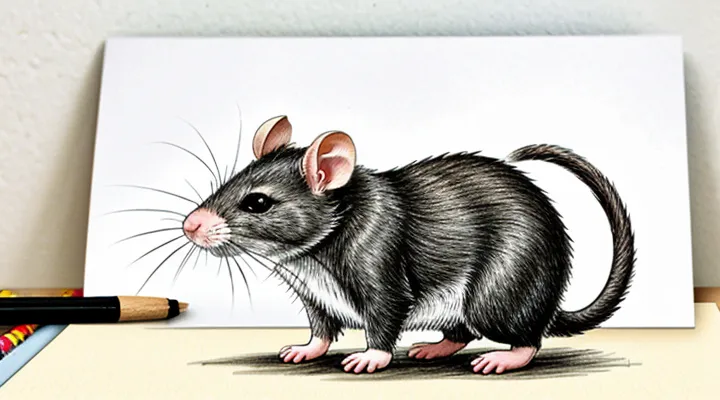
The Allure of Rats in Art
Why Draw Rats?
Beyond the Stereotype
The image of a rat often carries negative connotations, yet its depiction in art can challenge those assumptions. By presenting the creature with softness, curiosity, and charm, an artist invites viewers to reconsider preconceived notions and to recognize the rat’s capacity for personality and aesthetic appeal.
Such reinterpretations serve several functions. They:
- Highlight the rat’s expressive potential through line, shading, and composition.
- Encourage audiences to explore empathy toward overlooked subjects.
- Demonstrate how unconventional motifs can enrich visual storytelling.
When the rat is rendered with attention to detail and affection, the work transcends stereotype, offering a fresh perspective that expands the visual vocabulary available to creators seeking inspiration beyond conventional subjects. «The rat becomes a symbol of resilience and creativity, inviting artists to explore new narrative possibilities.»
Expressing Personality and Emotion
A charming rodent illustration offers a direct channel for artists to project distinct personality traits and emotional states. The subject’s small size and recognizable features enable precise manipulation of visual cues that signal mood and character.
Key visual components that shape perception include:
- Posture: a slouched pose suggests timidity, while an upright stance conveys confidence.
- Facial expression: widened eyes and an up‑turned mouth generate joy; narrowed eyes and a down‑turned mouth evoke sadness or suspicion.
- Color palette: warm hues such as soft oranges and pinks amplify friendliness; cool blues and muted grays hint at melancholy or detachment.
- Line quality: thick, rounded strokes reinforce playfulness; thin, angular lines introduce tension or nervousness.
Techniques for embedding personality and emotion:
- Exaggerate defining traits—enlarge ears for curiosity, shrink whiskers for shyness.
- Contrast light and shadow to highlight inner tension or calm.
- Incorporate subtle accessories, like a tiny scarf or a held object, to suggest backstory.
- Vary spacing between the figure and surrounding elements to control intimacy with the viewer.
When executed deliberately, a cute rat drawing engages audiences through immediate empathy. Viewers recognize familiar emotional signals, interpret narrative possibilities, and connect personally with the artwork. This connection transforms a simple sketch into a compelling storytelling device.
Finding Your Muse: Inspiration for Cute Rat Drawings
Observing Real Rats
Anatomy and Proportions
Understanding the skeletal framework of a small rodent is essential for creating an appealing illustration. The skull is compact, with a rounded cranium that occupies roughly one‑third of the total head length. The snout extends forward about half the head length, ending in a delicate tip. Large, forward‑facing eyes sit on the sides of the cranium, each eye diameter approximating one‑eighth of the head width. Ears are proportionally small, positioned near the top of the head, and measure about one‑fifth of the head length.
Key proportional relationships:
- Head length : body length ≈ 1 : 2.5
- Body length : tail length ≈ 1 : 1.2
- Front leg length (from shoulder to paw) ≈ 0.6 × body length
- Hind leg length (from hip to paw) ≈ 0.8 × body length
- Tail thickness at base ≈ 0.1 × body width, tapering to a fine point
Accurate placement of limbs follows the natural gait of the animal. Front limbs emerge near the midpoint of the chest, while hind limbs attach slightly behind the pelvis. When depicting a seated pose, the hind limbs fold beneath the body, creating a visible angle of roughly 120 degrees at the knee joint. The tail, often curved for expressive effect, should maintain smooth curvature without abrupt angles.
Common pitfalls include exaggerating the head relative to the body, which disrupts the perception of cuteness, and neglecting the subtle curvature of the spine, resulting in a stiff silhouette. Maintaining the outlined ratios while adjusting for stylization yields a balanced and endearing representation of the creature. «A proportionate foundation enables expressive variation without sacrificing recognizability».
Gestures and Poses
When rendering an endearing rodent, the choice of gesture determines the emotional impact. A quick, fluid line captures spontaneity, while a deliberate, weighted pose conveys stability. Artists should study the natural range of a rat’s movements—curved spine, flicking whiskers, and agile hind‑leg thrusts—to translate vitality onto paper.
Key considerations for effective poses include:
- Line of action – a sweeping curve that guides the eye from head through tail; establishes rhythm and balances composition.
- Weight distribution – positioning of fore‑ and hind‑limbs to suggest grounding or levitation; subtle shifts convey tension or relaxation.
- Exaggeration – amplifying characteristic gestures, such as a raised tail or a cheeky ear tilt, enhances charm without sacrificing anatomical plausibility.
- Silhouette clarity – ensuring the outline remains recognizable at a glance; a distinct profile aids instant identification and visual appeal.
Dynamic sketches benefit from timed studies. Short, thirty‑second gesture drawings force the artist to capture the essence of motion before details intervene. Repeating these rapid poses builds a mental library of expressive stances, ready for integration into polished illustrations.
Incorporating reference material—photographs, videos, or live observation—provides accurate anatomy while allowing creative liberties. Combining authentic movement with stylized exaggeration yields a compelling, cute rat illustration that resonates with viewers and serves as a reliable source of inspiration for creators.
Exploring Artistic Styles
Cartoon and Whimsical
The cartoon approach to drawing a rat emphasizes simplified anatomy, bold line work, and exaggerated proportions that convey immediacy and visual clarity. Stylized ears, oversized eyes, and a compact body shape create a recognisable silhouette that functions well in small formats and digital thumbnails. The technique relies on consistent line weight and minimal shading to maintain a clean, graphic appearance.
Whimsical interpretation introduces playful posture, imaginative environments, and expressive facial gestures that suggest personality beyond the animal’s natural behavior. Elements such as oversized accessories, surreal backgrounds, or exaggerated motion lines contribute to a sense of fun and narrative potential. The combination of lighthearted subject matter with stylized form invites viewers to engage emotionally with the illustration.
Practical considerations for artists include:
- Establish a clear silhouette before adding detail; a strong outline supports both cartoon and whimsical aspects.
- Use a limited palette of saturated colors to enhance visual impact while preserving readability.
- Apply exaggerated gestures, such as a tilted head or a dynamic leap, to convey motion and humor.
- Incorporate decorative motifs—bow ties, tiny hats, or floating objects—to reinforce the whimsical tone.
- Keep shading minimal; employ flat tones or subtle gradients to maintain the graphic quality inherent in the style.
By integrating the structural clarity of «Cartoon» with the imaginative flair of «Whimsical», artists achieve a versatile illustration that serves both branding and storytelling purposes. The resulting rat character remains instantly recognizable while offering ample space for creative expansion.
Realistic and Detailed
Realistic and detailed representations of an endearing rodent offer valuable guidance for creators seeking to enhance their portfolio with lifelike charm. Precise anatomical study forms the foundation; accurate proportions of the head, torso, and limbs ensure credibility while preserving the creature’s inherent cuteness. Texture rendering, achieved through layered hatching or digital brushes, conveys the softness of fur and the subtle sheen of whiskers, adding depth to the composition. Controlled shading, employing a limited value scale, highlights the curvature of the body and creates a three‑dimensional effect without overwhelming the delicate subject. A restrained color palette, typically featuring muted earth tones accented by gentle pinks or whites, maintains visual harmony and reinforces realism.
Key considerations for achieving a convincing and appealing rat illustration:
- Anatomical reference: skeletal and muscular charts, photographic studies, and live observation.
- Fur technique: short, overlapping strokes; variation in pressure to simulate thickness.
- Light source consistency: single direction to maintain coherent shadows and highlights.
- Detail hierarchy: focus on eyes, nose, and paws while simplifying background elements.
- Medium selection: fine‑point pens for line work, soft‑edge markers for gradients, or high‑resolution brushes in digital software.
By integrating these elements, artists can produce a realistic, intricately detailed rat drawing that serves both as a study in precision and as an inspirational example for further creative endeavors.
Leveraging Reference Materials
Photography and Video
Photography and video provide visual references that capture the texture, posture, and environment of small mammals, offering artists concrete material for creating endearing rodent illustrations. High‑resolution images reveal fur patterns and lighting nuances, while moving footage displays subtle gestures and behavioral cues that static sketches may overlook.
Practical applications include:
- Collecting close‑up shots of whisker movement to inform line work and shading.
- Recording playful interactions to inspire dynamic composition and narrative context.
- Using macro lenses to isolate details, enabling precise replication of fur direction and color gradients.
- Extracting still frames from video loops for reference grids, ensuring accurate proportion and perspective.
Integrating these media into the creative process enhances realism and emotional resonance, supporting the development of compelling, whimsical rat drawings that engage viewers.
Other Artists’ Works
Studying the output of fellow creators reveals techniques applicable to the endearing rodent illustration, clarifying line treatment, texture, and composition.
Key contributors whose portfolios inform this subject include:
- Junichi Nakahara – works such as «Little Mouse in the Garden» demonstrate delicate line work that balances whimsy with anatomical accuracy.
- Beatrix Potter – the illustration «The Tale of the Mouse» showcases expressive poses and subtle shading that enhance character personality.
- Yoshitomo Nara – pieces like «Mouse with Sunglasses» employ bold outlines and simplified forms, offering a modern, graphic approach.
- Mary Blair – the painting «Playful Critter» illustrates vibrant color palettes that can be adapted to small-scale rodent studies.
- Katsushika Hokusai – the woodblock print «Mice in the Moonlight» provides insight into dynamic negative space and traditional Japanese composition.
These examples supply practical references for artists seeking to refine their portrayal of charming rats, encouraging adaptation of line precision, tonal contrast, and stylized color schemes.
Techniques for Capturing Cuteness
Emphasizing Features
Large Eyes and Small Noses
Large eyes give a rat illustration an immediate sense of innocence and approachability. By enlarging the ocular area, the artist creates a focal point that draws the viewer’s attention and conveys emotion without relying on facial expression. The proportion of the eye to the head, typically ranging from one‑third to one‑half of the skull’s width, aligns with the visual language of many beloved cartoon mammals and reinforces a friendly aesthetic.
Small noses balance the exaggerated eyes, preventing the face from appearing overly cluttered. A diminutive nose reduces visual weight, allowing the eyes to dominate the composition. Maintaining a nose length of no more than one‑quarter of the eye diameter preserves the delicate hierarchy of features and supports the overall cuteness factor.
Practical considerations for rendering these traits:
- Place the eye centers on an imaginary horizontal line that bisects the head; this ensures symmetry and consistent spacing.
- Use simple shapes—circles or ovals—for the eyes, then add a reflective highlight to suggest moisture and life.
- Render the nose as a tiny triangle or a softened curve, positioned just below the eye line and slightly offset toward the facial midline.
- Apply gentle shading around the nose to create depth without detracting from the eye prominence.
- Keep the overall head shape rounded; sharp angles conflict with the gentle impression created by large eyes and small noses.
When these proportions are applied consistently, rat drawings achieve a charming, approachable quality that resonates with audiences seeking whimsical animal art. The combination of oversized eyes and modest noses becomes a reliable visual shorthand for endearing character design.
Soft Fur and Rounded Forms
Soft fur and rounded forms define the visual appeal of endearing rodent illustrations, guiding artists toward a friendly and approachable aesthetic. The tactile illusion of fur emerges through delicate line density, gradual tonal shifts, and strategic use of cross‑hatching. Light strokes follow the natural flow of hair, while darker layers accumulate at shadowed areas, creating a plush surface that suggests warmth without relying on color saturation alone.
Rounded forms simplify anatomy, emphasizing the curvature of the head, cheeks, and body to evoke a sense of cuddliness. By exaggerating circular contours—such as a broad, circular cranium and a plump, oval torso—artists accentuate the rat’s playful character. The reduction of sharp angles prevents visual tension, allowing the viewer’s eye to glide smoothly across the composition.
Practical guidance for rendering these qualities:
- Begin with a light sketch of basic circles to establish head, torso, and limb placement.
- Apply fine, tapered lines that follow the direction of imagined hair growth; increase line thickness toward shadowed regions.
- Integrate subtle shading gradients using a soft graphite or charcoal, preserving a smooth transition between light and dark.
- Refine edges with gentle curves, avoiding angular strokes that could disrupt the overall softness.
Employing these techniques ensures that the rendered rat maintains a comforting presence, encouraging artists to explore similar approaches in their own whimsical creations. «Softness is conveyed through subtle gradations, while rounded silhouettes reinforce the notion of approachability».
Creating Engaging Compositions
Interacting with Objects
A charming rodent sketch gains depth when the subject engages with surrounding items. The interaction creates a narrative that guides the viewer’s eye and conveys personality without relying on facial expression alone.
Typical modes of engagement include grasping a pencil, perched on a teacup, or nibbling a piece of cheese. Each action suggests a relationship between the animal and its environment, turning ordinary objects into storytelling devices.
When planning such scenes, consider three technical aspects. First, proportion: the rat’s size must remain believable relative to the object, preserving the illusion of a small creature. Second, texture: rendering fur against smooth surfaces highlights contrast and reinforces tactile realism. Third, perspective: positioning objects at varying depths adds spatial hierarchy, allowing the rat to occupy foreground, midground, or background as needed.
Practical guidelines for the creator:
- Measure the object’s dimensions before sketching; use a reference grid to maintain consistent scale.
- Apply a limited palette to differentiate material qualities; muted tones for background items keep focus on the rat.
- Employ overlapping lines to suggest occlusion, ensuring the rat appears to interact naturally with the object’s contours.
- Introduce subtle shadows beneath contact points; this anchors the figure and enhances three‑dimensional perception.
Effective object interaction transforms a simple illustration into a lively vignette. By integrating scale, texture, and perspective, the artwork invites viewers to explore the scene, fostering a stronger emotional connection with the whimsical character.
Expressing Playfulness
Playful energy transforms a simple rodent sketch into a compelling visual cue for creators. A drawing that radiates spontaneity invites viewers to engage emotionally, encouraging artists to explore dynamic storytelling through a small, endearing subject.
Key visual strategies reinforce this quality. Exaggerated body language—arched backs, mid‑air leaps, and tilted heads—creates a sense of motion. Bright, saturated hues contrast with soft, muted backgrounds, directing attention toward the focal point. Loose, flowing line work captures fleeting gestures, while occasional sketchy strokes suggest movement beyond the static frame.
Practical techniques for embedding playfulness:
- Curved posture that implies a bounce or tumble.
- Wide‑eyed expression with upturned eyebrows, emphasizing curiosity.
- Interaction with everyday objects—cheese wedges, yarn balls, miniature toys—to suggest narrative potential.
- Asymmetrical composition that leaves space for imagined continuation beyond the page.
Applying these elements consistently yields illustrations that not only charm but also serve as a reliable source of inspiration for artists seeking to convey lighthearted vigor.
Color and Shading Choices
Warm Tones and Highlights
Warm tones bring a sense of comfort and vitality to an adorable rodent illustration, allowing the subject to resonate with viewers on an emotional level. Soft reds, muted oranges, and gentle yellows create a cohesive atmosphere that highlights the creature’s playful character while maintaining visual harmony.
Highlights function as focal points that define form and suggest three‑dimensionality. Lighter hues applied to the tip of the nose, the curve of the ear, and the glint in the eyes separate the figure from the background and emphasize texture. Subtle gradations from warm base colors to brighter accents produce depth without overwhelming the composition.
Practical considerations for integrating warm tones and highlights:
- Select a limited palette of warm hues; limit the number of colors to three or four to preserve unity.
- Apply a mid‑tone as the foundation for the fur, then layer progressively lighter tones along the natural curvature of the body.
- Reserve the brightest highlights for reflective surfaces such as the eyes and wet nose, using a small, precise brush to avoid harsh edges.
- Blend shadows with cooler complements of the chosen warm palette to reinforce volume while retaining overall warmth.
Consistent use of these techniques results in a charming rat drawing that captures both the subject’s innocence and the artist’s skillful handling of color dynamics.
Enhancing Depth and Texture
Enhancing depth and texture in a charming rodent illustration demands precise control of line, value, and surface treatment. Mastery of these elements elevates a simple sketch into a compelling visual narrative that resonates with artists seeking fresh inspiration.
Effective shading relies on systematic application of tonal variations. Cross‑hatching creates dense shadows, while lighter hatching suggests form under soft illumination. Stippling introduces granular texture, particularly useful for fur rendering. Gradual transition from dark to light establishes three‑dimensional volume without excessive detail.
Line weight modulation contributes to spatial hierarchy. Thick outlines define primary contours; progressively thinner strokes delineate secondary features and background elements. Consistent variation guides the viewer’s eye, reinforcing depth cues.
Layered media amplify tactile quality. Transparent washes of watercolor or diluted digital brushes allow underlying sketches to emerge through successive layers, producing a luminous effect. Opaque glazes applied selectively reinforce highlights and accentuate texture on the rat’s whiskers, tail, and surrounding objects.
Background treatment anchors the subject within a believable space. Incorporating subtle perspective lines, gradient atmospherics, and muted tonal fields prevents the figure from appearing flat. Minimalist settings, such as a simple tabletop or a stylized garden, provide contextual depth while preserving focus on the animal.
Key techniques for depth and texture:
- Cross‑hatching and stippling for nuanced shading
- Variable line weight to separate foreground from background
- Transparent washes combined with opaque glazes for layered richness
- Gradient backgrounds and perspective cues to situate the figure
Applying these methods consistently yields a richly textured rat drawing that serves as a reliable reference for artists exploring whimsical animal subjects.
Overcoming Challenges in Rat Art
Dispelling Misconceptions
Portraying Cleanliness and Intelligence
Depicting a rat with an emphasis on cleanliness and intelligence requires deliberate visual cues that convey hygiene and mental acuity without compromising cuteness. A smooth, well‑groomed fur texture, achieved through fine, consistent line work, signals a tidy appearance. Light, reflective highlights on the coat suggest a polished surface, reinforcing the notion of neatness.
Facial expression plays a central role in communicating intellect. Narrowed, slightly upward‑tilted eyes convey curiosity and focus, while a modest, upward‑curved mouth suggests confidence. Adding subtle details such as a small, open book or a neatly arranged pile of tools near the character reinforces the theme of cleverness.
Practical techniques for artists:
- Use clean, crisp outlines; avoid overlapping strokes that create visual clutter.
- Apply a limited, muted color palette with occasional bright accents to draw attention to focal points.
- Incorporate symmetrical elements, such as balanced whisker placement, to enhance the perception of order.
- Render background elements—e.g., a tidy workbench or a spotless floor—using minimalistic shapes to support the central motif.
Overall composition should maintain a harmonious balance between adorable aesthetics and the portrayal of disciplined, intelligent behavior, allowing viewers to instantly recognize both qualities in the illustration.
Building Empathy Through Art
A whimsical rat illustration offers a tangible entry point for exploring emotional connection through visual art. By focusing on an endearing subject, creators invite viewers to recognize vulnerability and personality in an unexpected creature, prompting a shift from detached observation to personal resonance.
The process of rendering a small mammal with expressive details cultivates empathy in several measurable ways:
- Emphasis on eyes and posture highlights inner states, encouraging the audience to infer feelings.
- Inclusion of relatable environments, such as a cozy corner or a shared kitchen, bridges the gap between human experience and animal life.
- Repetition of gentle lines and soft shading reinforces a sense of kindness, reinforcing the viewer’s compassionate response.
Artists who integrate such motifs into their practice develop heightened sensitivity to subtle emotional cues. Repeated engagement with compassionate portrayals refines the ability to translate nuanced affect into visual language, a skill transferable to broader thematic work.
Educational programs that feature the charming rodent sketch as a case study report increased willingness among participants to discuss personal emotions. The visual anchor simplifies abstract concepts, allowing learners to articulate empathy without reliance on verbal explanation. This demonstrates the utility of a simple, appealing subject as a catalyst for deeper interpersonal understanding.
Refining Your Skills
Practice and Experimentation
Practice and experimentation are essential for mastering the charming rat illustration that many artists use as a source of creative motivation. Repeated sketching of the animal’s anatomy builds muscle memory, while deliberate variation in line weight, posture, and perspective expands visual vocabulary. Incorporating studies of real rodents, photographs, and anatomical diagrams provides accurate reference material and encourages observation skills.
Key strategies for systematic exploration include:
- Selecting diverse media (pencil, ink, digital brush) and recording outcomes to compare texture and tonal range.
- Altering scale, from miniature thumbnail studies to large‑format compositions, to assess how detail and gesture shift with size.
- Introducing unconventional color palettes, such as complementary or analogous schemes, to test emotional impact.
- Applying constraint‑based exercises, for example limiting each drawing to a single line or a fixed number of strokes, to stimulate problem‑solving.
Evaluation of each experiment should rely on objective criteria: proportion accuracy, line clarity, and consistency of style across iterations. Documenting findings in a visual journal creates a reference archive that supports ongoing refinement and informs future projects centered on the endearing rat motif.
Seeking Feedback and Growth
The pursuit of constructive criticism sharpens technical proficiency and deepens conceptual clarity in the creation of whimsical rat sketches. Systematic feedback loops reveal unnoticed compositional imbalances, line weight inconsistencies, and color harmony issues that impede artistic development.
Effective strategies include:
- Presenting finished studies to peer review groups and documenting each comment verbatim.
- Requesting targeted critiques on specific elements such as gesture, texture, and emotional expression.
- Comparing external assessments with personal objectives to identify alignment gaps.
- Integrating suggested revisions into successive drafts, noting measurable improvements after each iteration.
Regularly updating a visual journal with annotated versions of the rat illustration provides a chronological record of progress. Cross‑referencing this archive with industry standards highlights emerging strengths and persistent weaknesses, guiding deliberate practice.
Engagement with online forums dedicated to animal illustration expands exposure to diverse aesthetic perspectives. Participation in critique threads, where comments appear within French quotation marks (« »), reinforces professional discourse and encourages reciprocal feedback.
By treating each critique as data rather than opinion, the artist transforms subjective remarks into actionable steps, fostering continuous growth and refining the unique charm of the rodent motif.