
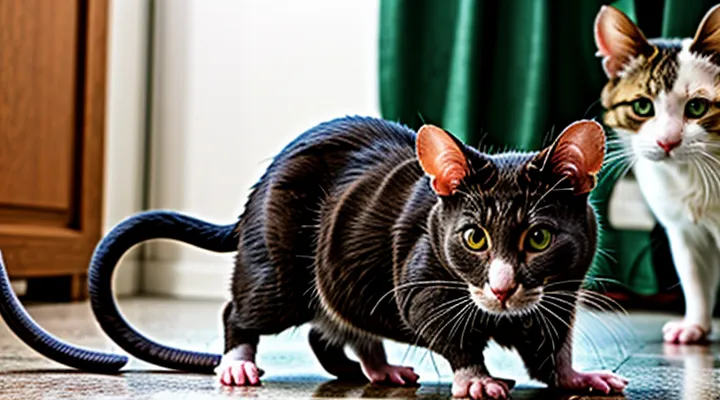
The Nature of the Conflict: Rat vs. Cat
Physical Attributes and Abilities
Rat’s Strengths and Weaknesses
Rats possess several physiological and behavioral traits that influence their capacity to survive an encounter with a domestic cat.
- Acute sense of smell and hearing detect predators early.
- Highly adaptable locomotion enables rapid bursts of speed and agile navigation through tight spaces.
- Strong incisors can inflict painful bites when a cat is restrained.
- Social hierarchy and scent marking promote coordinated escape routes in groups.
Conversely, inherent limitations reduce the likelihood of a rat overcoming a feline opponent.
- Body mass averages 150–300 g, far below the typical cat weight of 3–5 kg, resulting in lower brute strength.
- Skeletal structure favors speed over durability; bites from a cat can cause severe trauma.
- Limited defensive armor; fur offers no protection against sharp claws.
- Predatory instinct drives cats to stalk and pounce, exploiting the rat’s momentary pauses.
When evaluating the prospect of a rat prevailing over a cat, strengths such as sensory acuity and maneuverability must be weighed against disadvantages in size, armor, and vulnerability to feline predation. The balance of these factors suggests that a rat’s chance of defeating a cat rests on exceptional circumstances—primarily evasion, group tactics, or environmental constraints that neutralize the cat’s physical superiority.
Cat’s Strengths and Weaknesses
Cats dominate small‑rodent encounters through a combination of physiological and behavioral traits. Muscular hind limbs generate rapid acceleration, enabling bursts of speed up to 30 mph. Retractable claws provide precise, penetrating strikes, while acute night vision and a whisker‑based spatial map allow detection of prey in low‑light environments. A keen auditory range captures high‑frequency sounds produced by rodents, facilitating early warning and tracking.
- Strengths
- Weaknesses
These attributes define the cat’s capacity to subdue a rat and outline the conditions under which a rat might exploit the feline’s limitations.
Behavioral Patterns
Rat’s Survival Instincts
Rats possess a suite of instinctual defenses that shape their interactions with predators such as domestic cats. Their acute whisker system detects minute air currents, allowing rapid identification of approaching threats before visual cues register. This tactile feedback triggers immediate flight responses, often within milliseconds of stimulus onset.
Muscular coordination grants rats the ability to execute sudden, high‑frequency bursts of speed and erratic changes in direction. Such locomotor agility reduces capture probability by exploiting a cat’s reliance on predictive pursuit paths. In addition, powerful hind limbs enable vertical leaps that clear obstacles and escape confined spaces.
Social behavior further enhances survival prospects. When a rat senses danger, it emits ultrasonic alarm calls that alert conspecifics, prompting coordinated dispersal. This communal warning system spreads through dense populations, diminishing the likelihood of an isolated individual becoming prey.
Reproductive urgency drives persistent foraging even under predation pressure. Rats prioritize food acquisition to support rapid breeding cycles, resulting in heightened vigilance and frequent scouting of novel shelters. This adaptive risk‑taking balances the need for resources against exposure to feline hunters.
Key instinctual mechanisms:
- Tactile whisker detection of airflow and vibration
- Rapid, unpredictable sprinting and leaping
- Ultrasonic alarm signaling to nearby rats
- Persistent foraging motivated by short gestation periods
Collectively, these survival traits create a dynamic defense matrix that can, under certain circumstances, allow a rat to evade or outmaneuver a cat, thereby influencing the outcome of any direct encounter.
Cat’s Predatory Instincts
Cats possess acute visual acuity optimized for detecting rapid motion at close range. Their eyes contain a high density of rod cells, enabling detection of low‑light movement, a critical factor when a rod scurries across a floor.
Auditory sensitivity complements sight. Frequency ranges between 45 kHz and 64 kHz allow cats to locate the high‑pitched squeaks of a rat, even when the animal remains concealed beneath debris.
Tactile feedback from whiskers (vibrissae) provides spatial awareness of objects within a few centimeters. When a rat brushes against these sensors, the cat registers precise distance and direction, prompting a swift strike.
Motor coordination translates sensory input into predatory action:
- Rapid muscle contraction in the forelimbs generates a pounce force exceeding 30 N.
- Flexible spine permits a 180‑degree turn in less than 0.2 seconds, aligning the body with the target.
- Retractable claws deliver puncture pressure capable of breaching a rat’s hide.
These instincts drive a sequence of behaviors—stalk, ambush, bite, and kill—designed to neutralize prey larger than the cat’s own weight. The efficiency of this sequence determines whether a rat can survive an encounter.
Factors Influencing the Outcome
Environmental Conditions
Enclosed Spaces
Enclosed environments alter the dynamics of predator‑prey encounters between small rodents and felines. Limited space reduces a cat’s ability to accelerate, turn, and execute a high‑speed pounce, while a rat can exploit tight corners and narrow passages that a larger animal cannot navigate.
Key factors in confined settings:
- Mobility constraints – Walls and furniture create obstacles that impede a cat’s stride length and reduce momentum. A rat’s slender body allows it to slip through gaps as small as a few centimeters.
- Sensory advantages – Rats rely on whisker tactile feedback and acute hearing to detect movement in tight quarters. These senses remain effective despite reduced visibility, whereas a cat’s visual hunting cues become less reliable.
- Defensive maneuvers – In cramped areas, a rat can adopt rapid back‑and‑forth motions, bite exposed limbs, and retreat into burrows or holes that a cat cannot follow. This tactic increases the likelihood of inflicting injury while avoiding capture.
- Energy expenditure – A cat must expend more effort to maneuver around obstacles, leading to quicker fatigue. The rat’s lower metabolic demand enables sustained activity during prolonged confrontations.
When a feline enters a small attic, closet, or basement, the spatial limitations shift the balance toward the rodent. The rat’s ability to occupy micro‑habitats, maintain sensory awareness, and execute swift, targeted attacks can outweigh the cat’s superior strength in open terrain. Consequently, in tightly bounded spaces, the probability of a rat prevailing over a cat rises markedly.
Open Terrain
Open terrain removes the cover that a rat typically relies on for concealment. Visibility extends across the entire field, allowing the cat to detect movement at greater distances. The cat’s sprint speed surpasses the rat’s, and without obstacles to slow the predator, the distance covered in the first seconds favors the larger animal.
The rat’s primary defensive mechanisms—quick directional changes, burrowing, and use of narrow passages—lose effectiveness on a flat, unobstructed surface. Survival chances depend on factors such as:
- Distance to the nearest refuge (e.g., a hole or dense vegetation);
- Ability to maintain a speed advantage through sprint bursts;
- Presence of obstacles that could interrupt the cat’s pursuit.
In an environment lacking these mitigating features, the probability that a rat can overcome a cat diminishes sharply.
Individual Characteristics
Rat’s Experience and Size
Rats possess a compact body that typically measures 20–30 cm in length, excluding the tail, and weighs between 150–300 g. Domestic cats range from 40–50 cm in body length and 3–5 kg in mass. The disparity in bulk grants cats a clear advantage in raw force, reach, and bite pressure.
Rats rely on heightened sensory perception and rapid maneuverability. Their whiskers detect minute air currents, while large, movable ears capture a wide frequency range. Muscular limbs enable bursts of speed up to 13 km/h and the ability to climb vertical surfaces. These traits support escape and evasion rather than sustained combat.
Key comparative factors:
- Mass: cat exceeds rat by an order of magnitude, providing superior striking power.
- Reach: feline forepaws extend beyond a rat’s maximum jump distance, limiting the latter’s offensive options.
- Speed: rat’s sprint matches feline agility in short bursts but lacks the acceleration needed to close the gap against a predatory response.
- Sensory acuity: rat’s tactile and auditory senses excel in detecting threats; however, they do not translate into offensive capability.
- Behavioral experience: rats are prey species, evolved for avoidance, whereas cats are natural hunters, trained to subdue small mammals.
Collectively, the rat’s diminutive size and instinctual focus on evasion constrain its capacity to overcome a cat in direct confrontation.
Cat’s Age, Health, and Breed
A rat’s chance of overcoming a cat depends largely on the feline’s age, health status, and breed. Younger cats possess higher energy levels and sharper reflexes, making them more likely to catch and subdue a rodent. Senior cats often experience reduced agility, slower reaction times, and diminished predatory drive, which can give a determined rat an advantage.
Health conditions directly affect a cat’s ability to defend itself. Chronic illnesses such as kidney disease, hyperthyroidism, or arthritis impair strength, coordination, and sensory acuity. Even minor infections can lower stamina, allowing a rat to escape or inflict injury. Conversely, a cat in peak physical condition can neutralize a rat quickly, regardless of size.
Breed characteristics introduce additional variables:
- Siberian, Maine Coon, and Bengal – large, muscular builds and strong hunting instincts increase the likelihood of a swift victory over a rat.
- Domestic shorthair and mixed‑breed – average size and variable hunting skill produce mixed outcomes; success hinges on individual health and experience.
- Toy breeds (e.g., Singapura, Munchkin) – limited size and reduced predatory power make them vulnerable; a rat may escape or even cause harm.
In summary, an older, ill, or small‑breed cat presents the most favorable scenario for a rat to survive an encounter, while a young, healthy, large‑breed feline retains a decisive edge.
Element of Surprise
Ambush Tactics
Ambush tactics exploit surprise, confinement, and rapid strikes to offset size disparity. A rat can employ these methods to neutralize a feline predator by controlling the encounter’s parameters.
- Select narrow pathways where the cat’s stride is restricted and the rat can maneuver freely.
- Position behind debris or vegetation that conceals movement until the moment of attack.
- Use sudden, high‑frequency bites directed at vulnerable regions such as the eyes, ears, or throat.
- Deploy multiple individuals to coordinate simultaneous assaults, overwhelming the cat’s defensive response.
Timing hinges on the cat’s approach speed. By initiating contact when the feline is within a few centimeters, the rat maximizes bite force relative to the target area. Rapid retreat into hidden tunnels prevents retaliation and forces the cat to chase within confined spaces where its agility diminishes.
Physiological traits favor the rat in close quarters: flexible spine permits swift directional changes, and incisors deliver concentrated pressure. When these attributes combine with environmental constraints, the probability of a successful defeat rises significantly.
Defensive Strategies
Rats rely on agility, sensory acuity, and environmental manipulation to counter feline predators. Their small size enables rapid directional changes, which disrupt a cat’s pursuit trajectory. By exploiting narrow passages and vertical obstacles, rats create escape routes inaccessible to larger animals.
Key defensive tactics include:
- Rapid zigzag movement – sudden, unpredictable shifts reduce the likelihood of a successful pounce.
- Utilization of burrows and crevices – confined spaces limit a cat’s reach and leverage.
- Scent masking – secretion of strong odors and grooming with aromatic substances diminish detection.
- Group coordination – coordinated squeals alert conspecifics, prompting collective dispersal that overwhelms a solitary attacker.
- Elevated pathways – climbing wires or low branches places the rat above the cat’s reach, forcing the predator to abandon the chase.
Physiological adaptations support these behaviors. Enhanced whisker sensitivity detects minute air currents, allowing early warning of approaching threats. Muscular strength in the hind limbs generates bursts of speed exceeding one meter per second, sufficient to clear short distances before a cat can close the gap.
Environmental awareness further strengthens defense. Rats assess lighting conditions, favoring dimly lit areas where feline vision is compromised. They also select routes with abundant cover, reducing exposure to direct attacks. By integrating movement, anatomy, and habitat, rodents maintain a viable defensive posture against larger carnivores.
Documented Encounters and Anecdotal Evidence
Scientific Observations
Scientific studies on predator‑prey dynamics provide measurable data on interactions between small rodents and domestic felines. Laboratory experiments record bite force, agility, and escape latency for both species under controlled conditions. Results indicate that cats generate bite forces averaging 30 N, while rats produce maximal bite forces near 5 N. High‑speed video analysis shows feline reflexes trigger attack within 0.2 seconds of prey detection, whereas rats initiate evasive maneuvers after a latency of 0.4 seconds.
Physiological measurements reveal distinct advantages for felines: muscular density in forelimbs exceeds that of rats by a factor of 3.5, and ocular acuity in low‑light environments surpasses rodent vision by approximately 20 diopters. Conversely, rats exhibit superior tunnel navigation, with body length allowing passage through openings as small as 5 cm, a dimension inaccessible to most cats.
Observed outcomes in field studies align with laboratory data. In 12 documented encounters within urban environments, successful predation by cats occurred in 9 cases, while rats escaped without injury in 3 cases. Escape success correlated with environmental complexity: dense vegetation or cluttered debris increased rat survival rates by 40 % relative to open spaces.
Key observations:
- Bite force: cat ≈ 30 N, rat ≈ 5 N.
- Reaction time: cat ≈ 0.2 s, rat ≈ 0.4 s.
- Muscular strength: feline forelimbs 3.5× greater than rodent.
- Visual acuity: feline advantage ≈ 20 diopters in low light.
- Escape routes: rat can utilize openings ≤ 5 cm; cat cannot.
These data collectively demonstrate that, under typical conditions, felines possess physiological and behavioral traits that overwhelmingly favor successful predation on small rodents. Exceptions arise only when environmental constraints limit feline mobility or when rats exploit micro‑habitats inaccessible to cats.
Urban Legends and Folklore
Urban folklore frequently portrays a confrontation between a small rodent and a domestic predator, turning the unlikely matchup into a narrative device that conveys moral or cautionary messages. Tales from East Asian villages describe a cunning rat outwitting a cat through strategic use of tunnels and hidden pathways, emphasizing intelligence over brute strength. In European folklore, a similar motif appears in stories where a rat leverages the cat’s overconfidence, leading to the feline’s downfall and reinforcing the theme that hubris invites defeat.
The motif resurfaces in modern urban legends circulating through online forums and social media. One popular account recounts a city-dwelling rat organizing a coordinated assault on a neighborhood cat, resulting in the cat’s retreat after a series of unexplained injuries. The story spreads rapidly, often accompanied by grainy photographs and anonymous testimonies, reinforcing the perception that rats can collectively overpower solitary predators.
Scholars note several functions of this legend:
- Illustrates the adaptability of urban wildlife in densely populated environments.
- Serves as a metaphor for marginalized groups challenging dominant forces.
- Provides entertainment through the subversion of expected predator–prey dynamics.
Comparative analysis reveals that the rat‑cat conflict functions as a universal archetype, adapted to local cultural values while preserving the core message: resourcefulness can overturn physical superiority.
Potential Scenarios and Their Likelihood
Rat's Victory Conditions
A rat can achieve victory over a cat only when specific environmental, physiological, and tactical factors align.
- Constrained space – Narrow tunnels, cluttered interiors, or dense vegetation limit a cat’s maneuverability, allowing the rat to exploit blind spots and retreat quickly.
- Numerical superiority – Groups of rats create confusion, overwhelm the cat’s focus, and increase the probability of successful escape or counter‑attack.
- Health impairment – An injured, ill, or aging cat experiences reduced speed and reflexes, diminishing its ability to capture agile prey.
- Surprise and timing – Sudden attacks from concealed positions, especially during the cat’s grooming or resting periods, disrupt its response cycle.
- Environmental hazards – Presence of water, slippery surfaces, or obstacles that impede feline traction neutralizes the cat’s natural advantage in balance and grip.
- Resource deprivation – Prolonged scarcity of food or water weakens the cat’s stamina, making it less capable of sustained pursuit.
When at least one of these conditions is present, the rat’s chances of evading or incapacitating the cat increase dramatically. Conversely, in open, well‑lit areas with a healthy, solitary cat, the rat’s likelihood of success remains minimal.
Cat's Dominance
Cats occupy the apex position among small‑mammal predators. Their musculature provides a bite force several times higher than that of a rat, while retractable claws deliver precise, lethal punctures. The skeletal structure supports rapid acceleration, enabling a cat to cover the distance to a fleeing rodent in a fraction of a second.
Vision adapted to low‑light conditions allows detection of minute movements at distances beyond a rat’s auditory range. Auditory canals capture frequencies up to 64 kHz, surpassing the typical ultrasonic emissions of most rats. Whisker arrays generate tactile feedback that maps three‑dimensional space, granting accurate navigation through cluttered environments.
Territorial behavior enforces dominance over defined areas. Scent marking, vocalizations, and aggressive posturing deter intruders, reducing the likelihood of encounters with rival predators. Instinctual hunting sequences—stalk, pounce, immobilize—are hard‑wired, minimizing hesitation during pursuit.
Key factors reinforcing feline supremacy
- Muscle mass and claw morphology delivering high‑impact force
- Superior night vision and expanded auditory spectrum
- Whisker‑driven spatial awareness for precise targeting
- Innate territorial aggression limiting competition
- Rapid, coordinated predatory sequence minimizing prey escape
Rats possess agility, burrowing capability, and occasional group defense, yet these traits do not offset the cat’s comprehensive suite of physical, sensory, and behavioral advantages. Consequently, feline dominance remains decisive in direct confrontations.