
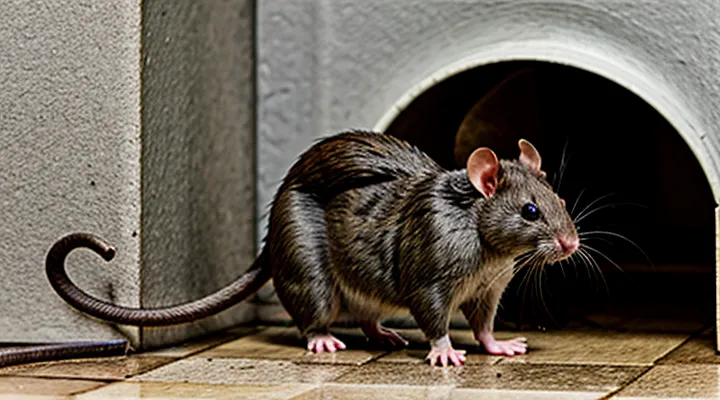
The Anatomy of a Rat's Tail
External Characteristics
Rats possess a long, hair‑covered tail that extends the body’s length by roughly 20–30 cm, matching or exceeding their torso. The skin is thin and highly vascularized, allowing rapid heat exchange; blood vessels can dilate or constrict to dissipate or retain warmth, which stabilizes body temperature in fluctuating environments. The tail’s surface is lined with mechanoreceptors that detect airflow and surface texture, providing continuous tactile feedback.
- Flexibility: Over 180 ° of motion at the base enables swift adjustments during climbing or rapid directional changes.
- Balance: The tail acts as a counter‑weight, shifting the center of gravity to maintain equilibrium on narrow ledges and vertical surfaces.
- Thermoregulation: Vascular control modulates heat loss, preventing overheating during intense activity and conserving warmth in cold conditions.
- Sensory input: Vibrissae and skin receptors transmit environmental cues, enhancing spatial awareness and predator detection.
Internal Structure
Vertebrae
Rats possess a series of caudal vertebrae that extend the spinal column beyond the pelvis, forming a flexible, muscular tail. Each caudal vertebra consists of a centrum, neural arch, and processes that anchor muscles and ligaments, allowing precise control of tail movement.
The tail’s vertebral structure contributes directly to several functional advantages:
- Balance control – rapid adjustments of tail position counteract shifts in the center of gravity during climbing or rapid turns.
- Locomotor agility – coordinated vertebral articulation enables the tail to act as a rudder, improving maneuverability on narrow surfaces.
- Thermoregulation – blood vessels within the vertebrae and surrounding tissue facilitate heat exchange, helping maintain body temperature.
- Communication – subtle tail motions, governed by vertebral flexion, convey social signals within colonies.
These capabilities explain the biological necessity of the tail in rats, linking vertebral anatomy to survival and reproductive success. The integration of caudal vertebrae with muscular and nervous systems creates a multifunctional organ essential for the species’ adaptive behavior.
Muscles and Tendons
The tail of a rat functions as a versatile locomotive and sensory organ, and its performance depends on a specialized muscular‑tendinous system. The axial musculature runs longitudinally along the vertebral column of the tail, generating contractile force that bends, twists, and stabilizes the appendage. These muscles attach to the caudal vertebrae via short, robust tendons that transmit tension efficiently, allowing rapid adjustments during climbing or swimming.
Tendons in the rat tail exhibit a high degree of elasticity, storing kinetic energy during forward thrust and releasing it to aid in swift directional changes. Their collagen fibers align parallel to the direction of force, minimizing strain while maximizing load‑bearing capacity. This arrangement permits the tail to serve as a counterbalance during rapid accelerations and as a propulsive paddle in aquatic environments.
The interaction between muscle fibers and tendon sheaths ensures precise control of tail posture. Motor neurons innervate the axial muscles, delivering graded signals that modulate tension. Tendon sheaths contain lubricating synovial fluid, reducing friction and preserving smooth gliding during repeated movements.
Key functional outcomes of this muscular‑tendinous architecture include:
- Enhanced balance while navigating narrow ledges or vertical surfaces.
- Augmented thrust during swimming, extending overall locomotor efficiency.
- Immediate tactile feedback through mechanoreceptors embedded in tendon sheaths, supporting environmental awareness.
Collectively, the tail’s muscle‑tendon complex supplies the mechanical power and sensory input required for the rat’s survival strategies, confirming the tail’s indispensable role in the animal’s adaptive repertoire.
Blood Vessels and Nerves
Blood flow through the tail’s arterial network supplies oxygen and nutrients to the distal tissues, enabling thermoregulation and rapid heat exchange. Vascular channels expand and contract in response to ambient temperature, allowing rats to dissipate excess heat or conserve warmth without altering core body temperature.
Sensory innervation runs along the tail’s longitudinal nerves, providing continuous feedback on environmental stimuli. These nerves detect pressure, vibration, and temperature changes, informing the animal of obstacles, predators, or suitable surfaces for climbing. The integration of vascular and neural signals supports balance and locomotion, especially when the tail serves as a counter‑balance during rapid movements.
- Arterial dilation adjusts surface temperature for heat loss.
- Venous constriction reduces blood loss during injury.
- Peripheral nerves relay tactile and thermal information.
- Neural pathways coordinate tail positioning with body posture.
Thermoregulation
Heat Dissipation
Rats rely on their tails to regulate body temperature by transferring excess heat from the core to the environment. The tail’s skin contains a dense network of arterioles and venules that can dilate or constrict, adjusting blood flow according to ambient temperature. When ambient conditions are warm, vasodilation increases blood volume in the tail, allowing heat to leave the bloodstream through the thin skin.
The tail’s elongated shape provides a large surface area relative to its mass, enhancing convective and radiative heat loss. Air movement across the tail surface removes heat more efficiently than the body’s bulk tissue, which is insulated by fur. The thin epidermis and sparse fur on the tail further reduce thermal resistance.
Key physiological effects of tail‑mediated heat dissipation include:
- Lowered core temperature during periods of high metabolic activity.
- Maintenance of optimal enzyme function across body tissues.
- Prevention of hyperthermia during prolonged exposure to elevated ambient temperatures.
Experimental observations show that rats with shortened or occluded tails exhibit higher core temperatures and reduced endurance in warm environments, confirming the tail’s role in thermal balance.
Cold Environment Adaptation
Rats retain tails primarily for physiological regulation, and in low‑temperature habitats the organ becomes essential for maintaining core temperature. The tail’s extensive network of blood vessels functions as a heat‑exchange surface; vasoconstriction reduces blood flow to the extremity, conserving warmth, while periodic vasodilation releases excess heat when ambient conditions improve. This dynamic control minimizes energy expenditure required for internal heating.
Thermal insulation is enhanced by the tail’s thin layer of subcutaneous fat and keratinized skin, which together reduce conductive heat loss. The elongated shape increases surface‑to‑volume ratio, allowing rapid adjustments in heat transfer without compromising locomotion or balance.
Key cold‑adaptation mechanisms include:
- Counter‑current heat exchange: arterial blood warms returning venous blood, preserving core temperature.
- Adjustable blood flow: sympathetic regulation narrows or widens peripheral vessels in response to ambient temperature shifts.
- Insulative tissue: localized adipose deposits and dense fur provide a barrier against cold.
- Behavioral positioning: rats can curl the tail against the body, further decreasing exposed surface area during rest.
These physiological and behavioral traits illustrate why the tail remains a critical structure for rats thriving in frigid environments.
Balance and Agility
Counterbalance for Movement
Climbing and Jumping
Rats rely on their tails for balance while navigating vertical surfaces. The tail acts as a counterweight, allowing precise adjustments of the body’s center of gravity during ascent. Muscular control of the tail provides rapid feedback, enabling the animal to maintain stability on narrow ledges and rough bark.
During jumps, the tail functions as a rudder. By extending or retracting the tail, rats can alter aerodynamic drag and steer mid‑air, directing the landing spot with accuracy. This capability reduces the risk of injury and improves access to food sources located above ground level.
Key contributions of the tail to climbing and jumping:
- Counterbalancing torque on vertical climbs
- Real‑time sensory feedback for posture correction
- Directional control during aerial maneuvers
- Impact damping on landing surfaces
Running and Walking
Rats rely on their tails for precise locomotion. The elongated, flexible appendage acts as a counterweight, allowing rapid adjustments to the body’s center of mass during high‑speed runs. When a rat accelerates, the tail swings opposite to the direction of motion, reducing rotational inertia and preventing unwanted yaw.
During walking, the tail serves as a tactile probe and stabilizer. Contact with the substrate supplies real‑time feedback about surface texture and inclination, enabling the animal to modify stride length and foot placement without visual input. Simultaneously, the tail’s lateral movements dampen side‑to‑side oscillations, maintaining a straight trajectory.
Key locomotor benefits of the rat’s tail include:
- Balance correction during sudden directional changes.
- Reduction of energy expenditure by minimizing angular momentum.
- Continuous environmental sensing for safe footfall.
- Support of symmetrical gait patterns across uneven terrain.
Absence of a tail would impair these mechanisms, leading to slower speeds, increased slip risk, and higher metabolic costs during routine movement.
Stabilization for Posture
Rats possess a muscular, flexible tail that functions as a dynamic stabilizer during locomotion. The tail extends the body’s mass distribution posteriorly, creating a counterbalancing torque that reduces pitch and roll deviations while the animal navigates uneven surfaces or climbs vertical structures.
- Generates opposing force to forelimb thrust, maintaining horizontal orientation.
- Supplies proprioceptive input through mechanoreceptors, informing the central nervous system about tail position and movement.
- Adjusts angular momentum during rapid turns, preventing overshoot and loss of direction.
- Supports vertical ascent by acting as a brace against the substrate, allowing precise placement of hind limbs.
Tail length and muscular control have been refined through natural selection to match the demands of arboreal and ground habitats. Species inhabiting complex three‑dimensional environments exhibit longer, more robust tails, reflecting a direct correlation between tail morphology and postural stability.
Experimental removal or immobilization of the tail results in measurable deficits: increased slip frequency on inclined planes, higher incidence of falls during rapid acceleration, and altered gait patterns characterized by reduced stride length. These outcomes confirm that the tail contributes essential biomechanical and sensory mechanisms required for maintaining equilibrium.
Communication and Social Behavior
Tail Postures and Signals
Rats employ a range of tail positions to convey information about their internal state and external environment. The tail functions as a dynamic visual organ, transmitting signals that other rats interpret without auditory or olfactory cues.
Common postures include:
- Elevated, straight tail – indicates alertness and readiness to explore or flee.
- Horizontal, relaxed tail – reflects a calm, non‑aggressive condition.
- Rapid, side‑to‑side flicking – signals irritation, impending aggression, or territorial defense.
- Curling around the body – denotes contentment, often observed during grooming or resting.
- Tucked under the body – appears during fear or submission, reducing visibility to predators.
During social encounters, these signals regulate hierarchy. Dominant individuals frequently display an elevated tail while subordinate rats adopt a tucked posture. Aggressive confrontations are preceded by vigorous tail flicks, which serve as warning displays that can prevent physical conflict. Conversely, a relaxed tail during mating rituals signals receptivity and reduces tension between partners.
Predator presence triggers a stereotyped sequence: the tail lifts, stiffens, and may sway laterally, enhancing the rat’s silhouette against the ground. This movement alerts conspecifics to danger and coordinates collective escape. The same posture also improves aerodynamic stability, allowing rapid directional changes while fleeing.
Tail postures intersect with other physiological roles. Thermoregulatory vasodilation manifests as a loosely coiled tail in warm conditions, while vasoconstriction produces a tight, erect tail in cold environments. Although primarily a temperature control mechanism, the resulting visual change simultaneously informs nearby rats of environmental stress.
Overall, tail configurations constitute a concise, reliable communication system that underpins social organization, predator avoidance, and environmental adaptation in rats.
Tactile Interaction
Rats rely on their tails for continuous tactile feedback during movement and interaction with the environment. The tail surface is densely packed with mechanoreceptors that detect pressure, vibration, and shear forces, allowing the animal to monitor substrate texture and contact points without visual input.
The sensory apparatus includes Merkel cells, Ruffini endings, and rapidly adapting hair follicle receptors. These structures convert mechanical deformation into neural signals transmitted via the spinal cord to somatosensory cortex. The tail’s length and flexibility increase the spatial range over which these signals are gathered, extending the rat’s perceptual field beyond the reach of its whiskers.
Empirical observations demonstrate several tactile functions:
- Detection of ground irregularities while running, reducing slip risk.
- Assessment of narrow passages by probing with tail tip, enabling precise navigation.
- Coordination of grooming movements; tail contact provides reference points for limb placement.
- Transmission of social touch during conspecific encounters, facilitating hierarchy establishment and bonding.
These capabilities influence experimental design in neuroscience research. Removing or impairing the tail alters performance in maze tasks, obstacle courses, and social interaction assays, underscoring the tail’s contribution to tactile perception. Maintaining tail integrity is therefore a critical factor in preserving natural behavior and ensuring data validity.
Sensory Functions
Touch and Exploration
Rats rely on their tails as an extension of the somatosensory system, allowing them to gather tactile information while navigating confined spaces. The tail’s surface is covered with dense arrays of mechanoreceptors that detect pressure, vibration, and texture, supplementing the sensory input from whiskers and forepaws.
Key functions of the tail in tactile exploration include:
- Detecting obstacles and gaps before the body reaches them.
- Providing feedback on surface compliance, which informs grip adjustments.
- Assisting in balance by transmitting subtle shifts in body posture to the central nervous system.
Experimental studies show that rats with shortened or removed tails exhibit reduced efficiency in maze navigation, increased collision with barriers, and altered foraging patterns. These observations underscore the tail’s role as a critical sensory organ that enhances environmental assessment and adaptive behavior.
Environmental Awareness
Rats possess tails that serve specific physiological and ecological functions directly linked to environmental awareness. The tail acts as a thermoregulatory organ, dissipating heat in warm habitats and conserving warmth in cooler settings, allowing rats to occupy diverse microclimates without altering surrounding temperature regimes. Tail length provides balance during arboreal navigation, enabling efficient foraging on vertical surfaces and reducing ground disturbance. Consequently, rat activity contributes to seed dispersal and soil aeration while minimizing habitat degradation.
Key functions of the tail include:
- Heat exchange regulation, supporting stable body temperature across variable climates.
- Counter‑balance for agile movement, decreasing reliance on ground pathways.
- Signal transmission for social interactions, influencing population density and resource distribution.
These functions illustrate how the anatomical feature of the tail aligns with broader ecological processes, reinforcing the importance of recognizing animal adaptations in environmental management strategies.
Evolutionary Significance
Survival Advantage
Rats’ tails provide several concrete survival benefits that directly affect their ability to navigate, regulate temperature, and avoid predation.
The elongated, flexible appendage functions as a counterbalance during rapid locomotion. By adjusting tail position, rats maintain equilibrium on narrow surfaces, such as wires and pipe interiors, enabling efficient movement through complex environments. This balance capability reduces the risk of falls and conserves energy that would otherwise be spent on recovery.
Thermoregulation is achieved through a dense network of blood vessels within the tail. When ambient temperatures rise, vasodilation in the tail increases heat loss, preventing overheating during active periods. Conversely, vasoconstriction conserves heat in colder conditions, supporting metabolic stability.
The tail also serves as a communication tool. Subtle movements convey social signals to conspecifics, reducing aggressive encounters and facilitating group cohesion. This non‑vocal signaling lowers stress levels and minimizes energy expenditure linked to conflict.
Additional advantages include:
- Storage of fat reserves for periods of scarce food.
- Enhanced tactile perception at the extremity, aiding in obstacle detection.
- Ability to detach (autotomy) in extreme predation scenarios, allowing escape while the detached tail continues to distract the predator.
Collectively, these functions demonstrate that the rat tail is a multifaceted adaptation essential for individual fitness and species persistence.
Adaptations to Habitat
Rats possess tails that directly support their survival in diverse environments. The elongated appendage functions as a multifunctional adaptation, enabling efficient exploitation of habitats ranging from dense burrows to open rooftops.
- Balance and agility – The tail acts as a counterweight during rapid climbs on vertical surfaces, allowing precise maneuvering without loss of stability.
- Thermoregulation – Vascularized skin along the tail dissipates excess heat in warm climates and conserves warmth when exposed to cold air, maintaining core temperature without additional metabolic cost.
- Spatial orientation – Sensory receptors detect airflow and vibrations, providing real‑time feedback that guides navigation through narrow tunnels and cluttered spaces.
- Communication – Tail movements convey threat or submission signals to conspecifics, reducing the need for vocalization in noisy urban settings.
- Fat storage – In some species, the tail stores lipids that can be mobilized during periods of food scarcity, extending survivability when resources are limited.
These adaptations collectively illustrate how the rat’s tail enhances locomotor performance, physiological regulation, and social interaction, thereby increasing fitness across a broad spectrum of habitats.