
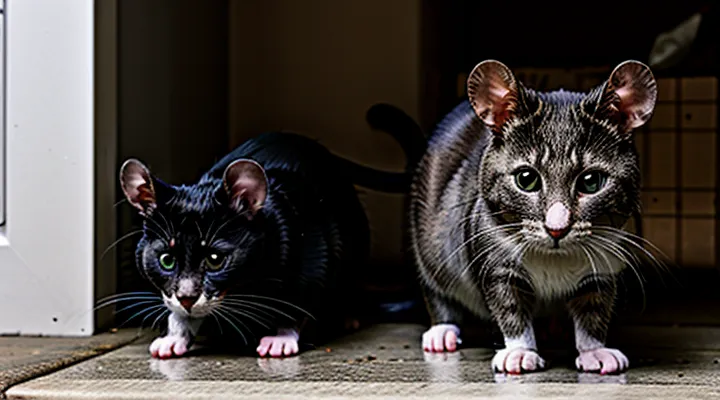
The Intrinsic Nature of Fear
Evolutionary Roots
Predator-Prey Dynamics
Rats exhibit avoidance behavior toward felines because cats represent a primary predator in their ecological niche. This relationship follows classic predator‑prey dynamics: predators impose selective pressure that shapes prey sensory and motor responses, while prey adaptations influence predator hunting efficiency.
Key factors driving rat fear of cats include:
- Acute visual detection of feline silhouette and movement patterns, which trigger innate alarm circuits.
- Auditory cues such as low‑frequency purrs and rapid footfalls, processed by the rat’s superior auditory system.
- Olfactory signals, notably feline urine and scent glands, that activate avoidance pathways in the rat’s brain.
- Learned associations from repeated encounters, reinforcing the perception of cats as lethal threats.
The cumulative effect of these cues results in heightened vigilance, reduced foraging time, and swift retreat to secure burrows, thereby increasing rat survival odds while limiting cat hunting success. This feedback loop maintains the balance between the two species across diverse habitats.
Innate Responses
Rats exhibit a rapid, involuntary avoidance of felines that stems from hard‑wired neural circuits. Evolutionary pressure has favored individuals that detect predator cues early and flee, increasing survival rates across generations.
The innate response relies on several physiological components:
- Olfactory receptors tuned to feline pheromones and urine metabolites.
- Visual pathways that recognize the characteristic shape and movement patterns of cats.
- Auditory sensitivity to high‑frequency vocalizations and footfalls produced by predators.
- The amygdala’s immediate activation, triggering a cascade of autonomic reactions (elevated heart rate, release of adrenaline, muscle tension).
These mechanisms operate without prior learning. Laboratory studies show that naïve laboratory rats, never exposed to cats, still display avoidance behaviors when presented with cat scent or recorded vocalizations. The response latency measures in milliseconds, indicating a reflex rather than a conditioned reaction.
Neurochemical analysis reveals that exposure to cat cues elevates corticosterone levels, reinforcing the stress response. Simultaneously, the hypothalamic‑pituitary‑adrenal axis prepares the animal for rapid escape, suppressing non‑essential functions such as digestion.
Collectively, the innate sensory detection, rapid central processing, and hormonal mobilization constitute a self‑contained defensive system. This system explains why rats instinctively fear cats, even in the absence of direct experience.
Olfactory Cues and Chemical Signals
The Scent of a Predator
Cat Odor Compounds
Rats exhibit strong avoidance of felines because they can detect specific volatile compounds emitted by cats. These chemicals serve as reliable indicators of predator presence and trigger innate defensive responses.
- Felinine (C₅H₁₁NO₂S): sulfur‑containing molecule produced in the cat’s scent glands; contributes to the characteristic “cat smell.”
- 2‑Mercaptoacetate: low‑molecular‑weight thiol released from urine and feces; highly volatile, detectable at parts‑per‑billion concentrations.
- Dimethyl sulfide and dimethyl disulfide: by‑products of fatty acid metabolism; intensify the overall odor profile.
- Phenylacetyl‑glycine: nitrogenous compound present in cat secretions; adds a pungent note detectable by rodent olfactory receptors.
- Short‑chain fatty acids (e.g., acetic, propionic acid): present in skin oils; augment the scent signature.
Rats possess a dense array of olfactory receptors tuned to these substances. Exposure to even minimal concentrations elicits increased vigilance, rapid escape, and suppression of foraging activity. The detection threshold for felinine, for example, lies below 10 ppb, ensuring that rats respond before direct contact with a predator. Consequently, the presence of cat odor compounds constitutes a primary cue that shapes rat behavior in environments shared with felines.
Rodent Olfactory Perception
Rats detect cats primarily through scent. Their olfactory epithelium contains receptors tuned to volatile compounds emitted by felines, such as felinine, a sulfur‑rich molecule found in cat urine and glandular secretions. When these chemicals bind to the rodent’s odorant receptors, neural circuits in the olfactory bulb relay alarm signals to the amygdala, triggering avoidance behavior.
Key aspects of rodent olfactory perception relevant to cat avoidance include:
- High sensitivity to low‑concentration kairomones, allowing detection of predators at a distance of several meters.
- Rapid signal transduction via G‑protein‑coupled receptors, producing immediate behavioral responses.
- Integration of olfactory input with auditory and tactile cues in the superior colliculus, enhancing threat assessment.
Experimental studies show that disrupting the main olfactory bulb eliminates the innate fear response to cat odor, confirming that the smell of felines is the primary driver of rat escape and hiding strategies.
Pheromonal Responses in Rats
Alarm Pheromones
Alarm pheromones are volatile chemicals emitted by rats when they encounter a threat. The release occurs within seconds of detecting a predator, creating an airborne signal that spreads throughout the immediate environment.
Other rats detect these compounds through the main olfactory epithelium and the vomeronasal organ. The sensory input triggers a rapid cascade of neural activity that translates into heightened alertness and immediate behavioral adjustments.
A cat’s presence constitutes a primary stimulus for alarm‑pheromone emission. The predator’s movement, scent, and visual profile activate the rat’s fear circuitry, prompting the release of the chemical warning. The signal informs nearby conspecifics that a feline hunter is nearby, prompting coordinated avoidance.
- Increased vigilance: rats scan the surroundings more frequently.
- Freezing: muscular tension rises, reducing movement to avoid detection.
- Fleeing: rapid locomotion away from the source of the cue.
- Foraging suppression: food intake declines until the threat subsides.
Understanding this mechanism enables targeted pest‑management strategies. Synthetic analogues of rat alarm pheromones can be deployed to induce avoidance behavior, reducing rodent activity in areas where cats are not present or where additional control measures are needed.
Stress Hormones
Rats exposed to feline cues exhibit a rapid activation of the hypothalamic‑pituitary‑adrenal (HPA) axis. The axis releases glucocorticoids, principally corticosterone, which serves as the primary stress hormone in rodents.
- Corticosterone – elevates blood glucose, suppresses non‑essential functions, and modulates memory consolidation of predator encounters.
- Adrenaline (epinephrine) – increases heart rate, augments muscle readiness, and sharpens sensory perception.
- Norepinephrine – enhances alertness, directs attention to olfactory and auditory signals of danger.
These hormones produce physiological changes that translate into observable anti‑predator behavior. Elevated corticosterone reduces exploratory drive, prompting rats to remain motionless or retreat to concealed spaces. Simultaneously, adrenaline and norepinephrine boost locomotor vigor, enabling swift escape when a cat is detected.
The combined hormonal response heightens threat detection, consolidates fear memory, and sustains avoidance patterns. Consequently, the presence of a cat triggers a cascade of endocrine events that reinforce the rat’s instinctive aversion to felines.
Auditory and Visual Stimuli
Sounds of the Hunt
Feline Vocalizations
Cats emit a range of sounds that signal danger to rodents. High‑frequency hisses, sharp yowls, and sudden growls travel efficiently through cluttered environments, alerting rats to an approaching predator. These vocalizations trigger the rats’ auditory alarm system, which processes rapid, irregular tones as immediate threats.
- Hissing: broadband, low‑amplitude noise that conveys aggression; rats respond with freezing or rapid retreat.
- Yowling: prolonged, variable‑frequency calls that indicate territorial intrusion; induces heightened vigilance and escape behavior.
- Growling: deep, resonant pulses that suggest imminent attack; provokes immediate flight responses.
The auditory cues combine with visual and olfactory signals, reinforcing the rats’ instinctive avoidance of felines. Consequently, feline vocalizations serve as an early warning mechanism that amplifies rats’ fear and drives them to seek shelter.
Rustling and Movement
Rats react to the subtle sounds and motions produced by cats. The slightest rustle of fur or shift in posture creates vibrations that travel through the floor and air. These cues trigger the rat’s auditory and tactile systems, which are tuned to detect predators at a distance.
The rat’s sensory apparatus processes the following signals:
- Low‑frequency rustling generated by a cat’s fur brushing against surfaces.
- Rapid, irregular movements that alter airflow patterns.
- Minute tremors transmitted through the substrate when a cat steps or prowls.
When these stimuli are detected, the rat’s brain initiates an immediate escape response. Neural pathways link the sensory input to motor circuits that produce sprinting, freezing, or zigzag navigation. The speed of the reaction correlates with the intensity of the rustling and the magnitude of the movement.
Research shows that rats can distinguish between the rustle of a cat’s coat and other environmental noises. Experiments using playback recordings demonstrate that rats exhibit heightened vigilance and increased locomotor activity only when exposed to feline‑specific rustling patterns. This specificity confirms that the acoustic and kinetic signatures of cats constitute a primary threat cue for rodents.
Visual Recognition of Threats
Cat Silhouettes
Rats rely on visual cues to identify predators, and the outline of a cat provides a rapid, reliable signal of danger. The silhouette conveys essential information without requiring detailed observation of fur color or facial features.
- Broad, triangular head shape suggests a carnivorous threat.
- Upright ears form a distinctive profile that rats associate with acute hearing.
- Curved back and elongated tail create a recognizable body contour.
- Low, poised stance indicates readiness to pounce.
These elements combine into a pattern that triggers innate avoidance responses. Laboratory studies show that rats exposed to static cat silhouettes exhibit increased freezing and reduced foraging, even when the image lacks motion or scent cues. The effect persists across species of rodents, confirming that the visual profile alone activates neural pathways linked to fear and escape.
Neurophysiological recordings reveal heightened activity in the superior colliculus and amygdala when rats view cat outlines. The superior colliculus processes shape and motion, while the amygdala assigns emotional valence. The rapid transmission of silhouette information enables rats to initiate evasive behavior before the predator can act.
In natural settings, shadows cast by cats during low light further amplify the threat. Silhouetted movement across surfaces creates high-contrast flashes that are easily detected by the rat’s dichromatic vision. The resulting visual alarm system operates independently of auditory or olfactory signals, providing a redundant defense mechanism.
Overall, the distinctive contour of a feline functions as a potent visual deterrent, prompting immediate avoidance in rats and contributing to their survival strategy against predation.
Predator Eyes
Cats possess forward‑facing eyes that create a narrow binocular field, allowing precise depth perception. The overlap of visual fields enables the detection of small, fast‑moving objects such as rodents, and the high density of retinal ganglion cells in the central retina enhances resolution for objects within a few meters.
The feline eye contains a tapetum lucidum, a reflective layer that amplifies low‑light signals. This adaptation grants cats superior vision in dim conditions, a time when rats are most active. When a rat perceives the sudden glint of reflected light, the visual cue signals a potential predator.
Additional visual cues reinforce fear:
- Vertical slit pupils that contract rapidly, indicating a ready‑to‑pounce state.
- Slow, deliberate head movements that align the eyes directly on the target, reducing ambiguity.
- High contrast between the cat’s dark silhouette and surrounding environment, emphasizing motion.
Rats’ visual system is tuned to detect looming stimuli. A rapid expansion of an object’s image on the retina triggers the “looming response,” a neural circuit that initiates escape behavior. The combination of a cat’s bright eyes, reflective shine, and forward gaze produces a looming pattern that activates this circuit, causing immediate flight.
Therefore, the specific characteristics of feline ocular anatomy generate visual signals that rats have evolved to interpret as imminent danger, prompting avoidance and escape responses.
Learned Avoidance Behaviors
Observational Learning
Social Transmission of Fear
Rats develop avoidance of felines through indirect learning rather than solely from personal encounters. When a rat observes a conspecific reacting fearfully to a cat, it acquires the same response without direct threat exposure. This process relies on visual cues, auditory signals, and chemical messengers that convey danger information across the group.
Key mechanisms of fear transmission include:
- Observational learning: A rat watches another’s startled escape or freezing behavior and imitates it.
- Alarm pheromones: Stressed rats release volatile compounds that trigger heightened alertness in nearby individuals.
- Auditory alerts: High‑frequency squeaks emitted during predator encounters serve as warning calls for peers.
Experimental evidence shows that naïve rats placed with experienced, fear‑conditioned partners adopt avoidance patterns within minutes. The learned response persists even after the original demonstrator is removed, indicating that fear memory can be socially encoded and retained.
Consequently, the spread of predator‑related anxiety among rodent populations does not require each individual to experience the threat directly. Social channels amplify the protective effect, creating a collective aversion that enhances survival against feline predators.
Parental Guidance
Parental guidance in rodents functions as the primary conduit for transmitting predator‑avoidance information to offspring. Female rats expose neonates to environmental cues that shape neural circuits responsible for detecting threats.
Mothers employ several specific strategies:
- Olfactory imprinting: exposure to cat scent during early development triggers heightened sensitivity to feline odorants.
- Auditory conditioning: distress vocalizations produced when a mother encounters a cat become associated with danger, prompting pups to adopt avoidance behaviors.
- Physical restraint: mothers physically block access to areas where feline presence is detected, reinforcing spatial avoidance.
- Pheromonal signaling: stress‑induced pheromones released during cat encounters alert littermates to the presence of a predator.
These mechanisms generate a robust, learned aversion that integrates with innate fear responses. Consequently, juvenile rats emerge with an entrenched wariness of felines, reducing the likelihood of fatal encounters. The combined effect of maternal instruction and genetic predisposition ensures that fear of cats persists across generations.
Aversive Conditioning
Negative Reinforcement
Rats exhibit strong avoidance of felines because encounters with cats produce an aversive stimulus—immediate danger. When a rat retreats or hides, the threat disappears, and the unpleasant condition is removed. This removal reinforces the escape behavior, making it more likely to occur in future cat‑related situations.
Negative reinforcement operates through the following steps:
- Presence of a predator creates a painful or stressful state for the rat.
- The rat performs an action (e.g., fleeing, freezing, seeking shelter).
- The action terminates the stressful state, eliminating the aversive stimulus.
- The termination of stress strengthens the action, increasing the probability of rapid avoidance when similar cues appear.
In laboratory observations, rats exposed to feline odor or visual cues quickly learn to withdraw from the source. The learned withdrawal persists even after the cat is no longer present, demonstrating that the behavior was shaped by the removal of the threatening stimulus rather than by reward. Consequently, negative reinforcement provides a direct explanatory framework for the persistent fear of cats in rodent populations.
Survival Instincts
Rats exhibit an innate aversion toward felines, driven by survival instincts that have been refined through millennia of predator–prey interactions. These instincts trigger rapid assessment of danger and immediate defensive actions.
Sensory systems enable rats to detect cats before direct contact. Olfactory receptors identify feline scent markers; auditory organs perceive low‑frequency rustling characteristic of a cat’s movement; visual fields recognize the distinctive silhouette and eye shine of a predator. Detection thresholds are low, allowing response within fractions of a second.
Evolutionary pressure favors individuals that react swiftly to feline cues. Those that freeze, flee, or emit alarm signals are more likely to survive and reproduce, reinforcing neural pathways that associate cat‑related stimuli with threat. Over generations, this selective process entrenches a hardwired fear response.
Typical rat reactions include:
- Immediate cessation of foraging and adoption of a still posture.
- Rapid retreat along pre‑mapped escape routes.
- Emission of high‑frequency vocalizations that alert conspecifics.
- Increased reliance on burrow entrances and concealed pathways.
These behaviors illustrate how survival instincts shape the rat’s consistent avoidance of cat predators.
The Impact on Rat Populations
Behavioral Adaptations
Habitat Selection
Rats choose living sites that reduce exposure to feline predators. The selection process prioritizes physical barriers, limited visibility, and distance from known cat routes. By occupying burrows, dense vegetation, or cluttered structures, rodents create environments where predators cannot easily maneuver or see them.
Key factors influencing rat habitat choice include:
- Presence of solid cover such as soil, debris, or building materials.
- Low traffic corridors that cats seldom use.
- Proximity to reliable food sources that do not attract cats.
- Structural complexity that offers multiple escape pathways.
When a potential site lacks sufficient concealment, rats abandon it in favor of locations offering greater protection. This behavior aligns with survival strategies observed across rodent species facing similar predation pressures.
The cumulative effect of these preferences shapes urban and rural rodent distributions, concentrating populations in areas where cats are less active or where environmental features impede hunting efficiency.
Nocturnal Activity
Rats are primarily nocturnal, foraging and nesting during darkness when visual detection is limited. Cats, however, retain acute low‑light vision and heightened auditory sensitivity, allowing them to locate moving prey even in dim conditions. This temporal overlap creates a persistent predation threat that rats must anticipate throughout their active hours.
During night activity, rats exhibit several defensive behaviors:
- Increased reliance on whisker‑mediated tactile cues to detect approaching predators.
- Preference for cluttered, insulated burrows that reduce exposure to feline ambush.
- Elevated vigilance, marked by frequent pauses and rapid directional changes to avoid detection.
These adaptations stem directly from the constant risk posed by felines operating in the same temporal niche. Consequently, the nocturnal lifestyle of rats intensifies their fear of cats, shaping both behavioral patterns and habitat selection.
Physiological Stress Responses
Cortisol Levels
Rats exposed to cat odor or visual cues exhibit a rapid increase in circulating cortisol, the primary glucocorticoid released during acute stress. Blood samples taken within minutes of exposure show concentrations up to three times baseline, confirming activation of the hypothalamic‑pituitary‑adrenal axis.
Elevated cortisol triggers several physiological changes that reinforce avoidance behavior:
- Heightened vigilance in the amygdala amplifies perception of predator cues.
- Suppression of hippocampal activity impairs spatial memory for safe routes, prompting quicker retreat.
- Mobilization of glucose supplies energy for rapid locomotion.
Experimental trials using cortisol‑blocking agents demonstrate a marked reduction in escape responses. Rats administered metyrapone, which inhibits cortisol synthesis, display longer latency before fleeing and spend more time exploring areas previously associated with feline presence. This effect underscores the hormone’s direct contribution to the fear response.
Long‑term exposure to intermittent cat stressors produces chronically elevated cortisol levels, leading to altered weight gain, impaired immune function, and changes in gene expression related to stress resilience. Monitoring cortisol provides a reliable biomarker for assessing the severity of predator‑induced anxiety in rodent models.
Reproductive Suppression
Rats that perceive cats as a lethal threat often exhibit reduced reproductive activity. The presence of feline predators triggers chronic stress, raising corticosterone levels that inhibit the hypothalamic‑pituitary‑gonadal axis. Consequently, estrous cycles become irregular, and ovulation frequency declines.
Key physiological outcomes include:
- Decreased gonadotropin-releasing hormone (GnRH) secretion
- Lower luteinizing hormone (LH) and follicle‑stimulating hormone (FSH) concentrations
- Suppressed testosterone production in males and estradiol in females
These hormonal shifts delay sexual maturation, shorten breeding windows, and reduce litter size. Laboratory observations confirm that rats exposed to cat odor or visual cues produce fewer offspring than control groups, even when direct predation risk is absent.
Behaviorally, heightened vigilance and avoidance of cat‑contaminated areas limit opportunities for mating encounters. The combined effect of endocrine suppression and altered social interaction leads to a measurable decline in population growth among rat communities that coexist with felines.