
Understanding «Large» in Rats
Common Rat Species and Their Sizes
The Brown Rat («Rattus norvegicus»)
The brown rat (Rattus norvegicus) attains a length of 20–25 cm from nose to the base of the tail, with the tail adding another 18–25 cm. Adult weight ranges from 250 g to 500 g, and individuals over 350 g are commonly regarded as large specimens.
External features include:
- Dense, coarse fur ranging from medium to dark brown on the dorsal surface; lighter, almost grayish fur on the ventral side.
- A blunt, broad head with a relatively short snout.
- Large, rounded ears set low on the skull, covered in fine hair.
- Prominent whiskers (vibrissae) extending laterally from the rostrum.
- A thick, scaly tail, slightly shorter than the body, typically dark brown to black.
Skeletal proportions show a robust skull, strong mandibles, and well‑developed forelimbs adapted for digging. Hind limbs are longer, providing powerful propulsion. The hind feet bear four toes with sharp claws, facilitating climbing and sprinting.
Sexual dimorphism is modest; males may exceed females by 10–15 % in body mass, but both sexes share the same coloration and overall morphology when fully grown. In urban and rural environments, large brown rats maintain the described dimensions, with occasional regional variations in fur shade linked to local climate.
The Black Rat («Rattus rattus»)
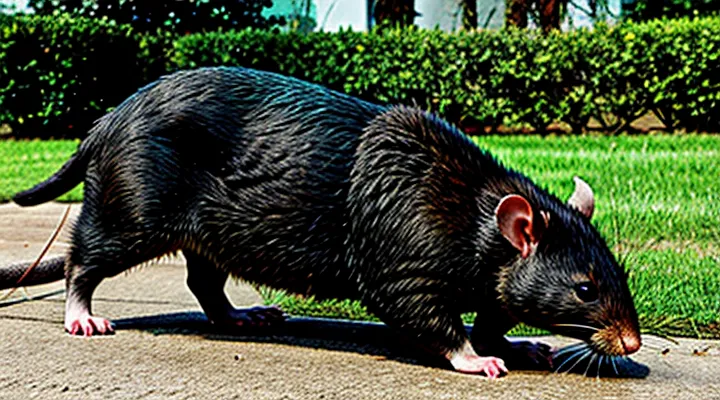
The black rat (Rattus rattus) reaches a considerable size when fully mature. Adults typically weigh 200–300 g, with body lengths of 18–25 cm and tails extending 20–30 cm, giving a total length of up to 55 cm for the largest specimens.
The coat is uniformly dark brown to black, dense and glossy, lacking the lighter dorsal stripe seen in some other rat species. Fur lies close to the skin, covering the head, neck, and limbs. The tail is slender, almost hairless, and proportionally longer than the head‑body length, tapering to a pointed tip. Ears are relatively large, rounded, and covered with fine hair. Whiskers are long, extending several centimeters from the snout, aiding navigation in low‑light environments.
Key morphological traits of a large black rat include:
- Dark, glossy fur without dorsal striping
- Tail length exceeding head‑body length, hairless and tapered
- Prominent, rounded ears with sparse hair
- Long, sensitive whiskers on the rostrum
- Body mass above 200 g, reaching up to 300 g in extreme cases
These characteristics distinguish the black rat from other sizable rodent species and define its appearance at the upper end of the size spectrum.
Key Physical Characteristics of Large Rats
Body Dimensions and Weight
A large rat typically measures 30–45 cm from nose to the base of the tail, with the tail adding an additional 20–30 cm. The combined head‑body and tail length can reach 50–75 cm, placing the animal well above the size of common laboratory or pet rats.
Weight ranges reflect the same scale. Mature specimens commonly fall between 350 g and 800 g, with exceptionally robust individuals exceeding 1 kg. Variation depends on species, diet, and health status.
- Head‑body length: 30–45 cm
- Tail length: 20–30 cm
- Total length: 50–75 cm
- Typical weight: 350–800 g
- Maximum recorded weight: >1 kg
Tail Length and Appearance
Large rats typically possess tails that extend beyond the length of their bodies, often measuring 12–18 inches (30–45 cm) in mature individuals. The tail accounts for roughly 70–80 % of the total body length, providing balance and aiding in thermoregulation.
The tail surface is covered with fine, overlapping scales that give it a smooth, slightly glossy appearance. Scale rows run longitudinally, creating a uniform pattern that distinguishes the tail from the furred torso. The skin underneath is thin and highly vascularized, allowing heat exchange and rapid temperature adjustments.
Key characteristics of the tail include:
- Length proportion: tail exceeds head‑body length by 1.5–2 times.
- Diameter: gradually tapers from a muscular base (≈0.5 in/1.3 cm) to a slender tip (≈0.1 in/0.3 cm).
- Coloration: ranges from pinkish‑red in younger specimens to darker brown or black in older rats, reflecting melanin deposition.
- Texture: scales are soft to the touch but resilient, preventing injury while maintaining flexibility.
These traits collectively define the visual profile of a large rat’s tail, distinguishing it from smaller rodent species and contributing to the animal’s overall silhouette.
Fur Color and Texture
A large rat typically displays a range of fur colors that reflect its species, environment, and genetics. Common shades include:
- Dark brown to almost black, providing camouflage in urban alleys.
- Light gray or silvery, often seen in populations near waterways.
- Reddish‑brown, characteristic of certain wild varieties.
- Patches of white or cream, occasionally appearing as mutations.
The texture of the coat varies with age and health. Juvenile individuals possess soft, fine hair that feels similar to that of a domestic mouse. As the animal matures, the fur becomes coarser and denser, offering protection against abrasions and temperature fluctuations. Healthy adults exhibit a glossy surface, indicating proper oil secretion, while a dull or patchy coat may signal malnutrition or disease.
Head and Snout Shape
A large rat possesses a broad, block‑shaped cranium that tapers slightly toward the muzzle. The skull is robust, with pronounced cheekbones that support strong jaw muscles. The snout extends forward in a relatively straight line, measuring roughly one‑third of the head’s total length; it is wider than that of smaller rodents, giving the animal a blunt appearance.
- Nasal region: flattened, with a short, rounded tip; nostrils are widely spaced to accommodate increased airflow.
- Muzzle profile: low and flat, lacking the pronounced curvature seen in diminutive species.
- Whisker arrangement: dense, long vibrissae emerge from the rostral edge, forming a sensory fringe that spans the full width of the snout.
- Ear placement: ears sit low on the skull, partially concealed by the head’s mass, and are proportionally smaller relative to overall head size.
These characteristics combine to create a head that appears heavy and compact, with a snout that is both broad and blunt, distinguishing sizable rats from their smaller counterparts.
Ear and Eye Proportions
A sizable rat typically measures 30–35 cm from nose to tail base, with a head length of 5–7 cm. The ears extend 1.2–1.5 cm from the base, representing roughly 20–25 % of head length. This proportion exceeds that of common laboratory strains, whose ears average 0.8 cm, about 12–15 % of head size. The ears are positioned low on the skull, angled slightly forward, and covered with sparse, fine hair that does not obscure the underlying cartilage.
The eyes occupy a diameter of 0.8–1.0 cm, equating to 12–15 % of head length and 55–70 % of ear length. Relative to the ear, the eyes appear large, providing a wide field of vision essential for nocturnal activity. The ocular surface is glossy, with a dark pupil that contracts markedly in bright conditions. The distance between the eyes—interocular width—is approximately 1.5 cm, aligning with the middle of the ear span.
Key proportional relationships:
- Ear length ≈ 0.22 × head length
- Eye diameter ≈ 0.14 × head length
- Eye diameter ≈ 0.65 × ear length
- Interocular width ≈ 0.45 × head length
These ratios distinguish a large rat from smaller conspecifics and influence its sensory capabilities.
Differentiating Large Rats from Other Animals
Comparing with Smaller Rodents
Mice vs. Large Rats
Mice and large rats belong to the same family but differ markedly in size, body proportions, and external features. A typical house mouse measures 2–4 inches (5–10 cm) in body length, with a tail roughly equal to the body. In contrast, a sizable rat reaches 8–12 inches (20–30 cm) in body length, and its tail often exceeds the body length, reaching 10–14 inches (25–35 cm).
Key distinguishing characteristics:
- Weight: Mice weigh 0.5–1 oz (15–30 g); large rats weigh 10–16 oz (300–450 g).
- Head shape: Mice have a triangular skull with a pointed snout; rats possess a broader, blockier skull and a blunter snout.
- Ears: Mouse ears are proportionally large, nearly the size of the head; rat ears are smaller relative to head size and sit lower on the skull.
- Eyes: Mice display relatively larger eyes positioned on the sides of the head; rats have smaller eyes set more forward.
- Tail texture: Mouse tails are slender, hairless, and relatively smooth; rat tails are thicker, coarser, and may show visible scales.
- Fur coloration: Both species exhibit a range of colors, but large rats often display a darker dorsal coat with a lighter ventral side, while mice commonly show uniform gray or brown tones.
These morphological differences enable reliable identification of a large rat when compared directly with a mouse.
Voles vs. Large Rats
Large rats and voles share a superficial resemblance but differ markedly in size, body proportions, and pelage. An adult Norway rat (Rattus norvegicus) typically measures 20–25 cm in head‑body length, with a tail of equal length, and weighs 300–500 g. Voles (genus Microtus) reach 10–15 cm in body length, possess a short, hairless tail of 2–5 cm, and weigh no more than 50 g.
Key visual distinctions:
- Body shape – Rats have a robust, cylindrical torso; voles appear more compact with a rounded, almost spherical abdomen.
- Tail – Rat tail is thick, scaly, and proportionally long; vole tail is thin, sparsely furred, and markedly shorter.
- Fur – Rat fur is coarse, often brown or gray, with a distinct dorsal‑ventral color gradient; vole fur is soft, dense, and uniformly brown, gray, or reddish.
- Ears – Rat ears are large, naked, and prominent; vole ears are small, partially covered by fur.
- Snout – Rat snout is blunt and elongated; vole snout is short, tapering sharply toward the mouth.
These characteristics enable reliable identification of a large rat when compared with the considerably smaller vole.
Distinguishing from Similar-Sized Creatures
Opossums vs. Large Rats
A large rat, often represented by species such as the brown rat (Rattus norvegicus) or the giant pouched rat (Cricetomys gambianus), typically measures 30–45 cm in body length, with a tail adding another 20–30 cm. The head is blunt, ears small and hairless, and the fur ranges from brown to gray, dense and smooth. Muscular hind limbs provide powerful climbing and digging ability. Dental structure includes continuously growing incisors that protrude forward, creating a characteristic gnawing silhouette.
An opossum, most commonly the Virginia opossum (Didelphis virginiana), reaches a comparable length of 30–40 cm, but its tail is hairless, prehensile, and lacks the uniform fur of a rat. The head is elongated with a pronounced snout, ears are large and fur‑covered, and the coat varies from gray‑brown to black. Limb proportions favor quadrupedal locomotion and occasional arboreal movement; claws are longer and more curved than the rat’s.
Key visual distinctions:
- Tail: rat – long, uniformly furred, non‑prehensile; opossum – hairless, prehensile, tapered.
- Ears: rat – small, scarcely visible; opossum – large, fur‑covered, prominent.
- Snout: rat – blunt, short; opossum – elongated, pointed.
- Fur texture: rat – smooth, dense; opossum – coarse, variable.
- Claws: rat – short, suited for digging; opossum – longer, adapted for climbing.
Understanding these traits clarifies the appearance of a sizable rodent and differentiates it from a similarly sized marsupial.
Squirrels vs. Large Rats
Large rats can reach body lengths of 20–30 cm, with tails extending another 15–25 cm, and weigh up to 500 g. Their fur is coarse, typically brown or gray, and their ears are small, hairless, and lie close to the skull. Muscular hind limbs support powerful digging and climbing, while their incisors are large, continuously growing, and display a pronounced orange‑yellow hue.
Squirrels share a comparable overall size but differ markedly in anatomy and behavior. Their bodies are slimmer, tails longer and bushier, and fur softer, ranging from reddish to gray tones. Ears are proportionally larger and covered with fine hair. Squirrels possess sharp, curved claws adapted for arboreal locomotion, whereas large rats have flatter claws suited for burrowing and scurrying on ground surfaces.
Key distinguishing characteristics:
- Tail: Rat – thin, hairless, relatively short; Squirrel – long, fluffy, often used for balance.
- Fur texture: Rat – coarse, uniform; Squirrel – soft, with seasonal color variation.
- Ear size: Rat – small, close to head; Squirrel – prominent, tufted with hair.
- Claw shape: Rat – blunt, suited for digging; Squirrel – curved, optimized for gripping bark.
- Behavioral pattern: Rat – nocturnal, ground‑oriented; Squirrel – diurnal, primarily arboreal.
Identification relies on these morphological markers. Observers can separate a large rat from a squirrel by examining tail structure, ear proportion, fur quality, and claw morphology, eliminating confusion even when size ranges overlap.
Muskrats vs. Large Rats
Large rats, such as adult Norway (Rattus norvegicus) or brown rats, reach body lengths of 20–25 cm (8–10 in) and tails of equal length. Weight ranges from 300 g to 500 g. Fur is coarse, coloration varies from brown to black, and the tail is naked, scaly, and proportionally long.
Muskrats (Ondatra zibethicus) grow to body lengths of 25–40 cm (10–16 in) with tails measuring 10–15 cm (4–6 in). Weight typically falls between 500 g and 1 kg. Fur is dense, waterproof, and dark brown; the tail is thick, laterally flattened, and covered with short hair.
Key differences
- Size: Muskrats exceed large rats in overall mass; rats remain lighter.
- Tail shape: Rat tail is slender, naked, and cylindrical; muskrat tail is broad, flattened, and furred.
- Fur texture: Rat fur is coarse and sparse; muskrat fur is plush and water‑repellent.
- Habitat: Rats inhabit urban and agricultural settings; muskrats occupy wetlands, constructing lodges from vegetation.
- Diet: Rats are omnivorous, consuming grains, meat, and waste; muskrats are primarily herbivorous, feeding on aquatic plants and roots.
Factors Influencing Rat Size
Genetics and Breed
Large rats result from specific genetic configurations that promote increased body mass and length. Certain alleles of the growth‑hormone gene (Gh) and insulin‑like growth factor 1 (Igf1) correlate with accelerated somatic growth. Homozygosity for these variants typically yields individuals weighing 600–900 g, compared with the average 300 g of standard laboratory strains.
Breed selection intensifies these effects. Established lines such as “Giant Fancy,” “Columbia Giant,” and “Rex Large” have been maintained through repeated mating of the heaviest offspring. Over successive generations, breeders fix alleles that enhance skeletal robustness, muscular development, and adipose deposition. The resulting phenotypes display:
- Extended head‑to‑tail length (up to 30 cm)
- Broad, densely muscled shoulders
- Thickened cranial vault and enlarged incisors
- Coarse fur with reduced whisker spacing
Mitochondrial DNA contributes to metabolic efficiency, allowing larger individuals to sustain higher basal energy demands. Inbreeding avoidance practices preserve heterozygosity at loci unrelated to size, preventing deleterious recessive traits while maintaining the desired growth profile.
Environmental factors interact with genetics. High‑calorie diets, enriched housing, and temperature control accelerate the expression of size‑related genes, but the underlying genotype determines the ultimate ceiling for growth. Consequently, the most massive rats emerge from a combination of selected breeding lines, targeted genetic markers, and optimized husbandry conditions.
Diet and Nutrition
A rat that reaches an unusually large size depends on a diet that supplies ample calories, balanced protein, and essential micronutrients. Excessive energy intake drives rapid growth, while adequate protein supports muscle development and organ function.
Typical macronutrient ratios for a sizable rodent approximate 18‑20 % protein, 5‑7 % fat, and the remainder as complex carbohydrates. Protein sources must contain all essential amino acids; fat sources should provide omega‑3 and omega‑6 fatty acids in a moderate proportion; carbohydrates should derive from low‑glycemic grains and vegetables to ensure steady glucose supply.
- Commercial rodent pellets formulated for growth (high‑protein, fortified)
- Fresh lean meats such as chicken breast or boiled egg whites
- Cooked legumes (lentils, beans) for additional protein and fiber
- Whole grains (brown rice, oats) for sustained energy
- Fresh vegetables (broccoli, carrots, leafy greens) for vitamins and minerals
- Small amounts of fruit (apple, berries) for natural sugars and antioxidants
- Limited nuts or seeds for healthy fats, introduced gradually to avoid obesity
Hydration is critical; a large rat should have continuous access to clean water, with intake scaling proportionally to body mass. Electrolyte balance requires adequate sodium and potassium, typically met through the natural mineral content of the diet.
Feeding should occur in multiple small portions throughout the day to mimic natural foraging behavior and prevent digestive overload. Consistent provision of nutrient‑dense food correlates directly with the animal’s ability to attain and maintain a substantial physique.
Age and Development
Large rats progress through distinct developmental phases that determine their ultimate size and physical characteristics.
At birth, neonates weigh approximately 5–7 g and possess closed eyes, underdeveloped incisors, and a soft, pink pelage. Within the first two weeks, rapid somatic growth occurs: body mass triples, fur darkens, and the auditory canals open, enabling environmental awareness.
From three to six weeks, juveniles exhibit accelerated skeletal elongation and muscle hypertrophy. Dietary intake rises sharply, and the incisors begin to self‑sharpen through continuous gnawing, establishing the robust dentition typical of mature specimens.
Between two and four months, rats approach adult stature. Individuals destined to become large, such as those of certain laboratory or feral strains, may exceed 500 g and display a broad head, thick neck, and dense, coarse fur. Hormonal regulation—particularly growth hormone and testosterone—peaks during this period, driving further muscle mass and skeletal density.
Beyond six months, growth plate closure limits linear expansion, but body mass can increase through adipose accumulation and muscle development, especially under high‑calorie diets. Lifespan averages 2–3 years in the wild, with senescence marked by reduced activity, graying fur, and diminished reproductive capacity.
Key developmental milestones:
- Neonatal (0–2 weeks): weight 5–7 g, closed eyes, pink fur.
- Juvenile (3–6 weeks): weight 30–80 g, fur darkening, incisors functional.
- Adolescent (2–4 months): weight 200–500 g, rapid muscle growth, head and neck enlargement.
- Adult (6 months+): weight up to 800 g in large individuals, full skeletal maturity, stable coat coloration.
Understanding these stages clarifies how a rat attains the dimensions and appearance associated with the largest members of the species.
Environmental Conditions
Large rodents exhibit distinct physical traits when environmental pressures differ from typical conditions. Temperature extremes influence fur density and coloration; colder climates promote thicker, darker coats, while warmer regions favor shorter, lighter hair. Humidity affects skin condition, with high moisture encouraging a slicker appearance and potential swelling of facial tissues.
Nutrition availability determines body mass and skeletal development. Abundant, high‑calorie sources produce broader chests, enlarged hindquarters, and pronounced heads. Scarcity leads to leaner frames, reduced muscle bulk, and sharper facial features.
Habitat structure shapes locomotor adaptations. Urban settings with narrow passages select for elongated bodies and flexible spines, whereas open fields encourage sturdier builds and stronger limbs for rapid sprinting. Population density drives aggression levels, reflected in scar patterns and reinforced jaw musculature.
Key environmental variables:
- Ambient temperature
- Relative humidity
- Food quality and quantity
- Habitat type (urban, rural, wild)
- Population density
Each factor interacts to modify size, coat, and overall morphology of an oversized rat, producing observable differences across regions.