
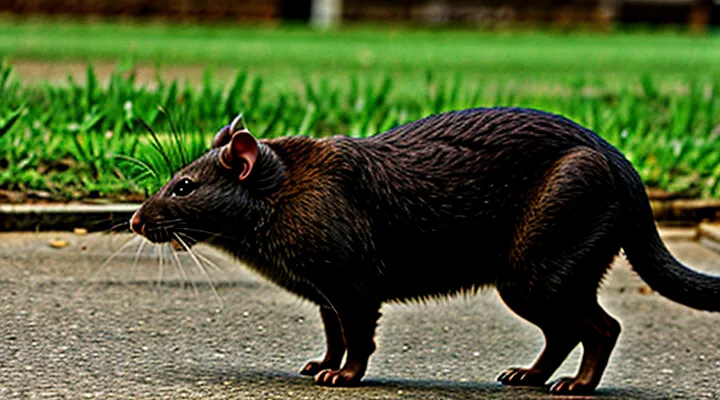
Differentiating «Giant Rats» from True Rats
What Constitutes a «Giant Rat»?
A «Giant Rat» is defined primarily by body mass and length that exceed the normal range of common Rattus species. Typical thresholds are:
- total length (head‑body plus tail) greater than 40 cm;
- body mass above 500 g, with many specimens reaching 1 kg or more.
These dimensions distinguish the animal from standard house rats, whose average length is 20–25 cm and mass 200–300 g.
Taxonomically, the term applies to several rodent species within the genus Rattus and related genera that naturally attain the above size. Notable examples include:
- Rattus norvegicus «brown rat», when individuals grow beyond 600 g;
- Rattus rattus «black rat», in exceptional cases exceeding 500 g;
- Rattus exulans «Polynesian rat», rare large specimens;
- Species of the genus Bandicota, such as Bandicota indica, regularly surpassing 1 kg.
Morphological traits of a «Giant Rat» mirror those of smaller congeners: robust skull, pronounced incisors, and a scaly tail. However, larger individuals display proportionally thicker limbs, increased muscle mass, and a denser fur coat, adaptations that support greater body weight.
Ecologically, giant forms occupy habitats where abundant food resources and limited predation allow sustained growth. Urban environments with abundant waste, agricultural fields with stored grain, and island ecosystems with reduced predator diversity are common settings. Their reproductive cycles remain similar to smaller relatives, but gestation periods may extend by a few days, and litter sizes often increase to accommodate higher energetic demands.
In summary, a «Giant Rat» is a rodent whose size parameters—exceeding 40 cm in total length and 500 g in mass—place it beyond the normal range for typical Rattus species, encompassing several recognized taxa that achieve such dimensions under favorable ecological conditions.
Common Misconceptions and Nomenclature
Large rodents that exceed typical house‑rat dimensions are frequently labeled incorrectly, leading to confusion in both scientific literature and popular media. The term «giant rat» is often applied loosely, obscuring distinctions among species that vary markedly in taxonomy, habitat, and size.
Common misconceptions include:
- The belief that any oversized rat belongs to a single species; in reality, several taxa reach comparable dimensions.
- The assumption that size alone determines danger to humans; disease transmission depends on species‑specific ecology.
- The notion that the name «giant rat» corresponds to a formal taxonomic rank; it is a colloquial descriptor without scientific standing.
Accurate nomenclature relies on established taxonomic conventions. Species commonly mistaken for «giant rats» include:
- Rattus norvegicus (Norway rat), which can attain lengths of up to 40 cm including the tail.
- Rattus rattus (black rat), occasionally reaching similar sizes under favorable conditions.
- Cricetomys gambianus (African giant pouched rat), a distinct genus characterized by large cheek pouches and a body mass exceeding 1 kg.
- Hydromys chrysogaster (Australian water rat), a semi‑aquatic species that grows considerably larger than typical urban rats.
When referencing such rodents, the preferred approach combines the scientific binomial with the accepted common name, e.g., Rattus norvegicus «Norway rat». This practice eliminates ambiguity and aligns discussion with zoological standards.
African Pouched Rats: The Most Recognized «Giant Rats»
Characteristics and Species of Cricetomys
Cricetomys represents the genus most frequently identified when discussing large, rat‑like rodents. Members of this genus are commonly referred to as «African giant pouched rats» and are distinguished by their considerable size and distinctive facial cheek pouches.
Typical adult individuals reach lengths of 40–70 cm, including a tail that may equal the body length. Body mass ranges from 0.9 to 1.4 kg, with some specimens exceeding 2 kg. The coat exhibits a coarse, brown‑gray texture; dorsal fur is darker than the lighter ventral side. Prominent, rounded ears aid auditory perception, while the elongated tail provides balance during arboreal excursions. Cheek pouches expand considerably, enabling transport of food items up to 200 g. Diet consists primarily of seeds, fruits, insects, and occasional small vertebrates. Longevity in captivity approaches 8 years, with slightly shorter spans in the wild.
Recognized species within the genus include:
- Cricetomys gambianus – Gambian pouched rat, widespread across West and Central Africa.
- Cricetomys emini – Emin’s pouched rat, inhabits savanna and woodland regions of East Africa.
- Cricetomys ansorgei – Ansorge’s pouched rat, confined to forested zones of the Congo basin.
Beyond ecological roles as seed dispersers and opportunistic predators, these rodents are employed in scent‑detection programs for tuberculosis, land‑mine identification, and wildlife monitoring, capitalising on their acute olfactory capabilities and trainability.
Their Role in Detection and Research
Giant rats, often referred to as oversized rodents, have been integrated into detection programs due to their acute olfactory capabilities. Their noses detect volatile compounds at concentrations far below human thresholds, enabling early identification of hazardous substances such as explosives, narcotics, and environmental pollutants. Training protocols condition individuals to signal the presence of target odors, allowing rapid deployment in security and disaster‑response scenarios.
In biomedical research, these large rodents provide a valuable model for studying disease mechanisms. Their physiological similarities to smaller laboratory rats, combined with a longer lifespan, facilitate longitudinal investigations of neurodegeneration, metabolic disorders, and infectious diseases. Researchers exploit their size to implant monitoring devices and conduct surgical procedures that would be impractical in smaller species.
Key applications include:
- Detection of trace chemicals in crowded public spaces.
- Monitoring of contaminant levels in agricultural environments.
- Evaluation of novel therapeutic compounds through pharmacokinetic studies.
- Investigation of pathogen transmission dynamics in urban ecosystems.
Other Large Rodent Species Often Labeled as «Giant Rats»
Gambian Pouched Rats and Their Relatives
Gambian pouched rats (Cricetomys gambianus) belong to the subfamily Cricetomyinae, a group distinguished by large cheek pouches and robust bodies. Adult individuals reach lengths of up to 30 cm, with tails adding another 20 cm, and can weigh as much as 1.5 kg, qualifying them as some of the largest murid rodents.
Key relatives include:
- Cricetomys emini – “Eastern giant pouched rat”, slightly smaller, inhabits East African savannas.
- Cricetomys ansorgei – “Southern giant pouched rat”, found in southern tropical forests, noted for a more elongated skull.
- Cricetomys sp. – various undescribed populations across West Africa, exhibiting regional size variations.
These species share traits such as nocturnal activity, omnivorous diets, and social structures composed of small colonies. Their size and intelligence have led to applications in detection work, where trained individuals locate explosives or disease vectors. The term “giant rat” commonly refers to members of this subfamily, reflecting their exceptional dimensions compared with typical rodents.
Bush Rats and Cloud Rats: Diverse Examples
Bush rats represent a group of medium‑sized murids native to Australian woodlands and forests. Species such as the brown bush rat (Rattus fuscipes), the black‑tailed bush rat (Rattus leucopus), and the pale‑furred bush rat (Rattus villosissimus) typically reach body lengths of 15–20 cm, with tails of comparable size. Their fur ranges from brown to gray, and they occupy diverse habitats from lowland scrub to alpine heath. Diet consists primarily of seeds, insects, and fallen fruit, reflecting an omnivorous foraging strategy.
Cloud rats comprise a distinct assemblage of large arboreal rodents found in the Philippines. Members of the genera Phloeomys and Carpomys, including the northern Luzon cloud rat (Phloeomys pallidus) and the dwarf cloud rat (Carpomys melanurus), exhibit body lengths up to 30 cm and tails extending beyond 40 cm. Their dense, silky pelage varies from light gray to deep brown, providing camouflage among cloud‑forest canopies. These species consume leaves, bark, and fruit, playing a role in seed dispersal within their ecosystems.
Key distinctions between the two groups:
- Geographic range: Australian continent versus Philippine islands.
- Habitat preference: Terrestrial underbrush versus high‑altitude forest canopy.
- Size spectrum: Bush rats generally smaller; cloud rats among the largest extant murids.
- Taxonomic affiliation: Bush rats belong to the genus Rattus; cloud rats classified within Phloeomys and Carpomys.
These examples illustrate the breadth of nomenclature applied to unusually large rodents, demonstrating that the term “giant rat” encompasses taxa with divergent evolutionary histories, ecological niches, and morphological adaptations.
Ecological Roles and Habitats of Large Rodents
Distribution Across Continents
Giant rodents, often referred to by regional names such as «giant rats», «cane rats», or «marsh rats», exhibit a distinct biogeographic pattern. Their presence is limited to specific habitats that support the necessary food resources and shelter.
- Asia – Species include the Burmese giant rat (Cricetomys sp.) and the Himalayan giant rat (Rattus andamanensis). Local designations emphasize size, e.g., «Burmese giant rodent».
- Africa – The African giant pouched rat (Cricetomys gambianus) dominates savanna and forest margins. Indigenous terms translate to «large field rat».
- Europe – The European water vole (Arvicola amphibius) occasionally attains giant proportions, known locally as «great water rat».
- North America – The wood rat (Neotoma spp.) reaches considerable size in desert regions, identified as «giant wood rat».
- South America – The capybara (Hydrochoerus hydrochaeris), the world’s largest rodent, is sometimes classified among giant rats, called «giant capybara».
- Australia – The giant white‑tailed rat (Uromys caudimaculatus) inhabits tropical rainforests, commonly termed «giant white‑tailed rat».
Distribution correlates with warm climates, abundant vegetation, and limited predation pressure, resulting in a concentration of giant rodent species in tropical and subtropical zones across these continents.
Impact on Ecosystems
Giant rat species, often referred to by terms such as “megapara” or “colossus rat,” occupy a distinct niche among murid rodents. Their considerable size influences multiple ecological processes.
- Predation pressure on invertebrates and small vertebrates intensifies, altering local prey populations.
- Seed consumption and transport contribute to plant regeneration patterns, especially in disturbed habitats.
- Burrowing activity aerates soil, redistributes organic material, and creates microhabitats for other organisms.
- Pathogen carriage facilitates disease transmission across wildlife and, occasionally, to humans.
These rodents occupy mid‑trophic positions, linking primary producers with higher predators. Their presence can shift energy flow, prompting adjustments in predator foraging behavior and influencing community composition. Soil turnover generated by extensive tunnel networks enhances nutrient cycling, while the physical alteration of vegetation structure can affect microclimate conditions.
Agricultural zones experience heightened crop loss due to foraging, prompting the implementation of control programs that may involve traps, rodenticides, or habitat modification. Such interventions can produce secondary effects, including non‑target species mortality and changes in predator–prey dynamics.
Overall, the ecological imprint of oversized rats extends from direct trophic interactions to indirect modifications of habitat architecture, underscoring their significance within diverse ecosystems.
Human Interaction and Conservation Status
Pest or Ally: Varying Perceptions
Giant rodents, often referred to by scientific names such as Rattus norvegicus (Norway rat) or Rattus rattus (black rat) when reaching unusually large sizes, elicit contrasting assessments across human activities.
Negative perception stems from direct damage to crops, stored goods, and infrastructure. These animals gnaw through wiring, compromise structural integrity, and contaminate food supplies with urine and feces. Their capacity to transmit pathogens—including leptospirosis, hantavirus, and plague—reinforces their classification as undesirable pests.
Positive perception arises from ecological and scientific contributions. Large rats serve as scavengers, accelerating decomposition and reducing organic waste accumulation. Their presence supports predator populations, such as owls and snakes, that help regulate other vermin. In laboratory settings, oversized specimens provide valuable models for studying metabolic disorders, neurobiology, and toxicology, thereby advancing biomedical research.
Adverse impacts
- Crop loss through consumption and burial of seeds
- Structural damage via gnawing of materials
- Disease transmission to humans and livestock
Beneficial roles
- Accelerated waste breakdown and nutrient recycling
- Support for higher trophic levels in food webs
- Utility in scientific experiments and drug testing
Perception of these sizable rodents oscillates between condemnation for their destructive potential and acknowledgment of their functional importance within ecosystems and research domains.
Conservation Efforts for Unique Species
Giant rats represent a distinct group of rodents found on isolated islands and in limited habitats. Their size, ecological niche, and genetic isolation differentiate them from more common murine species, making them priority targets for biodiversity preservation.
Primary threats include rapid deforestation, introduction of predatory mammals, and fragmentation of remaining habitats. Small population numbers amplify vulnerability to stochastic events and genetic bottlenecks.
Current conservation actions focus on three core areas:
- Establishment of legally protected reserves that encompass critical foraging and nesting sites.
- Implementation of captive‑breeding programs designed to maintain genetic diversity and provide individuals for reintroduction.
- Collaboration with local communities to promote sustainable land use practices and reduce conflict with agricultural activities.
Monitoring initiatives employ camera traps, genetic sampling, and population modeling to assess program effectiveness. Data indicate that coordinated habitat protection combined with ex‑situ breeding can stabilize declining populations and, in some cases, initiate modest recoveries. Continuous funding and adaptive management remain essential for long‑term success.