
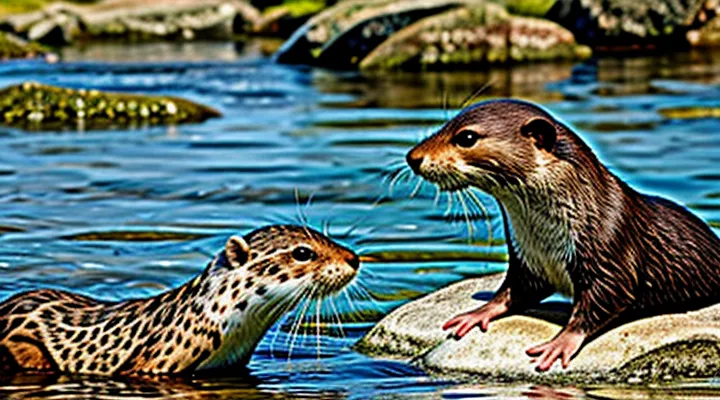
Biological Classification and Lineage
Taxonomic Placement
The water rat belongs to the class Mammalia, order Rodentia, family Muridae, subfamily Hydromyinae, genus Hydromys, with Hydromys chrysogaster as the most widely recognized species. The otter is also a mammal but falls under the order Carnivora, family Mustelidae, subfamily Lutrinae, genus Lutra (Eurasian otter) or Lontra (Neotropical otter), with species such as Lutra lutra and Lontra canadensis.
Both taxa share the following hierarchical levels:
- Kingdom: Animalia
- Phylum: Chordata
- Class: Mammalia
They diverge at the order level, reflecting distinct evolutionary lineages—rodents versus carnivores. Family distinctions further separate their ecological adaptations: Muridae members exhibit gnawing dentition, while Mustelidae species possess carnivorous dentition and semi‑aquatic morphologies.
Key taxonomic contrasts:
- Order: Rodentia (water rat) versus Carnivora (otter)
- Family: Muridae versus Mustelidae
- Subfamily: Hydromyinae versus Lutrinae
The shared class and higher ranks confirm that both animals are placental mammals, yet their placement in separate orders and families underpins the primary biological differences examined in comparative studies.
Evolutionary Divergence
The water rat (Hydromys spp.) and the otter (Lutra spp. and related taxa) belong to distinct mammalian orders—Rodentia and Carnivora—reflecting a deep evolutionary split that predates the emergence of modern placental mammals. Molecular clocks place their common ancestor in the early Cretaceous, approximately 100 million years ago, after which divergent lineages pursued separate adaptive trajectories.
Genetic divergence is evident in mitochondrial DNA sequences, where nucleotide substitution rates differ markedly between the two groups. Rodent-specific retroposon insertions appear in water rat genomes but are absent in otter genomes, confirming independent genomic rearrangements. Nuclear gene analyses further separate the clades, with divergence estimates ranging from 85 to 95 million years.
Morphological divergence aligns with ecological specialization:
- Aquatic locomotion: water rats retain a rodent‑type skeletal framework, featuring a flattened tail and partially webbed hind feet; otters possess a streamlined body, elongated lumbar vertebrae, and a powerful, laterally compressed tail for propulsion.
- Dentition: water rat incisors remain continuously growing, suited for gnawing vegetation and invertebrates; otters exhibit carnivorous dentition with sectorial premolars and robust canines for capturing fish.
- Sensory adaptations: water rat vibrissae are short and oriented for tactile navigation in murky streams; otters have long, highly innervated whiskers and a well‑developed auditory bullae for detecting prey underwater.
Ecological divergence reinforces the genetic and morphological split. Water rats occupy small, fast‑flowing freshwater habitats across Australasia, relying on burrowing and nocturnal foraging. Otters inhabit a broader range of aquatic environments—from temperate rivers to coastal estuaries—exhibiting diurnal activity and social hunting behaviors.
The evolutionary separation of these taxa illustrates how distinct selective pressures—dietary specialization, locomotor demands, and habitat use—drive lineage diversification. Comparative phylogenetic studies continue to refine the timing and mechanisms underlying this divergence, offering insight into mammalian adaptation to aquatic niches.
Key Species Identification
The water rat (genus Nectomys) and the otter (family Lutrinae) can be distinguished by a concise set of morphological and ecological criteria.
- Body size: water rats average 250–350 g, otters range from 1 kg (small species) to over 14 kg (giant otter).
- Fur texture: water rat fur is dense, coarse, and water‑repellent; otter fur is exceptionally thick, oily, and arranged in guard‑hair and under‑coat layers for insulation.
- Tail morphology: water rat tail is long, laterally flattened, and covered with scaly skin; otter tail is muscular, laterally compressed, and fully furred.
- Skull and dentition: water rats possess a short, broad skull with incisors adapted for gnawing; otters have elongated skulls with sharp canines and interlocking carnassial teeth for fish capture.
- Foot structure: water rats have partially webbed hind feet with clawed digits; otters exhibit fully webbed feet and retractable claws.
Habitat preferences further separate the species. Water rats inhabit slow‑moving streams, marshes, and dense riparian vegetation in tropical and subtropical regions of South America. Otters occupy a broader range of freshwater and coastal marine environments worldwide, often favoring open water channels and riverbanks with abundant fish populations.
Behavioral markers reinforce identification. Water rats are primarily nocturnal, construct burrows along water margins, and forage on aquatic insects, crustaceans, and plant material. Otters are diurnal or crepuscular, use dens (holts) near water, and display cooperative hunting techniques for fish and crustaceans.
Geographic distribution provides an additional filter. The genus Nectomys is confined to the Amazon basin and adjacent lowland forests, whereas otter species span from temperate zones in North America and Europe to tropical rivers in Africa and Asia.
By applying the outlined physical measurements, habitat assessment, and behavioral observations, field researchers can reliably differentiate between these two semi‑aquatic mammals.
Comparative Anatomy and Physical Characteristics
Size and Mass Discrepancies
The water rat (Hydromys chrysogaster) exhibits a compact body plan adapted to densely vegetated streams. Adult head‑body length ranges from 220 mm to 280 mm, tail length adds 150 mm to 200 mm, and total mass averages 250 g to 350 g. Females tend toward the lower end of the weight spectrum, while males reach the upper limit.
The Eurasian otter (Lutra lutra) presents a markedly larger form. Head‑body length spans 650 mm to 800 mm, tail length contributes an additional 300 mm to 380 mm, and adult weight varies between 7 kg and 12 kg. Sexual dimorphism is modest; males may exceed females by up to 15 %.
Key contrasts in size and mass:
- Body length: water rat ≈ 0.25 m; otter ≈ 0.75 m.
- Tail length: water rat ≈ 0.18 m; otter ≈ 0.35 m.
- Mass: water rat ≈ 0.3 kg; otter ≈ 9 kg.
- Weight ratio: otter is roughly 30 times heavier than the water rat.
These measurements reflect divergent ecological niches: the water rat relies on maneuverability within narrow channels, whereas the otter exploits larger rivers and coastal zones, where greater size supports stronger swimming thrust and prey capture.
Aquatic Adaptations
Fur Density and Waterproofing
The water rat’s pelage contains approximately 150 – 200 hairs per square centimeter, a density that exceeds the otter’s 100 – 130 hairs per square centimeter. This greater hair count creates a thicker insulating layer, reducing heat loss during prolonged submersion.
Both species rely on specialized oil secretion to maintain waterproofing. The water rat’s sebaceous glands produce a light, low‑viscosity oil that spreads easily over the dense fur, forming a thin barrier that repels water while allowing rapid drying. The otter’s glands generate a richer, more viscous oil, which saturates the coarser guard hairs and provides a durable, water‑tight coating suitable for extended dives.
Key functional contrasts:
-
Fur structure
• Water rat: fine under‑coat with high density, minimal guard hairs.
• Otter: moderate under‑coat supplemented by robust guard hairs, lower overall density. -
Oil composition
• Water rat: low‑viscosity sebum, quick redistribution.
• Otter: high‑viscosity sebum, persistent film. -
Thermal performance
• Water rat: superior insulation in shallow, fast‑moving water.
• Otter: adequate insulation for deep, prolonged immersion. -
Maintenance behavior
• Water rat: frequent grooming to spread oil across dense fur.
• Otter: periodic shaking and rolling to refresh the oil layer on guard hairs.
The combination of denser fur and lighter oil enables the water rat to stay buoyant and warm in turbulent streams, whereas the otter’s coarser coat and thicker oil favor endurance during long underwater foraging. Both adaptations achieve effective waterproofing, yet they employ distinct structural and biochemical strategies.
Limb Structure and Propulsion Methods
The water rat (genus Hydromys) and the otter (family Lutrinae) exhibit distinct limb morphologies that reflect their aquatic lifestyles. The water rat possesses relatively short, robust forelimbs with partially webbed digits; the hind limbs are elongated and feature a pronounced plantar pad that enhances traction on slippery substrates. Muscular attachments are concentrated around the scapulocoracoid region, providing powerful strokes for short bursts of swimming.
The otter’s forelimbs are shorter but highly flexible, each digit ending in a partially retractable claw and a dense set of interdigital membranes. Hind limbs are powerful, with elongated metatarsals and a broad, flattened tail that functions as a primary propulsive surface. The musculature of the otter’s hindquarters is specialized for sustained, high‑speed swimming, with well‑developed gluteal and femoral muscles.
Both species rely on a combination of limb movement and body undulation, yet their propulsion strategies differ:
- Water rat: rapid, alternating fore‑ and hind‑limb paddles generate thrust for maneuverability in shallow streams; tail contributes minimally.
- Otter: synchronized hind‑limb strokes complemented by vigorous tail oscillation produce continuous forward thrust; fore‑limb paddling assists in steering and prey capture.
These anatomical adaptations illustrate convergent evolution toward efficient aquatic locomotion while preserving species‑specific functional specializations.
Snout and Sensory Apparatus
The snout of the semi‑aquatic rodent exhibits a short, blunt profile with a high density of tactile whiskers (vibrissae) that extend laterally. These vibrissae are innervated by mechanoreceptors optimized for detecting water currents and substrate texture, facilitating navigation in murky streams.
The otter’s rostrum is elongated and tapered, supporting a set of robust, water‑repellent whiskers. Each whisker contains a dense array of follicle‑sac complexes, providing acute hydrodynamic sensing that enables rapid prey detection during underwater pursuit.
Both species share several sensory adaptations:
- Highly vascularized nasal mucosa enhances olfactory sensitivity in humid environments.
- Specialized mechanoreceptors on the snout surface detect pressure changes, aiding in the perception of water flow.
- Integration of tactile and olfactory inputs occurs in the brainstem, allowing coordinated responses to prey and obstacles.
Key differences are evident in morphology and function:
- The rodent’s blunt snout favors burrowing and surface foraging; the otter’s streamlined rostrum reduces drag for sustained swimming.
- Otter whiskers are longer and positioned to sample a broader water column, whereas the rodent’s whiskers concentrate near the substrate.
- Olfactory receptors in the otter are tuned to detect fish-derived amino acids, while the rodent’s receptors respond more to terrestrial invertebrate cues.
These distinctions and commonalities illustrate how snout shape and associated sensory structures evolve to meet the divergent ecological demands of each animal.
Dental and Dietary Structures
The water rat (genus Nectomys) possesses incisors that are chisel‑shaped, with enamel extending to the crown, enabling efficient gnawing of vegetation and soft aquatic invertebrates. Premolars and molars are low‑crowned and exhibit a bunodont pattern, suitable for crushing insects and small crustaceans. In contrast, the otter (family Lutrinae) exhibits pronounced, scissor‑like incisors and elongated canines that specialize in seizing fish. Its molars are highly cusped and serrated, reflecting a diet dominated by slippery prey.
Key dental differences:
- Incisor morphology: chisel‑shaped (water rat) vs. elongated, pointed (otter)
- Crown height: low (water rat) vs. high, with pronounced ridges (otter)
- Molar complexity: simple bunodont (water rat) vs. serrated, carnassial‑like (otter)
Both species share adaptations for an aquatic lifestyle. Their mandibular musculature is reinforced to generate rapid bite forces necessary for capturing moving prey. Salivary glands in each produce enzymes that begin protein digestion before ingestion, supporting a diet rich in animal tissue.
Dietary structures correspond directly to dental form. The water rat consumes a mixed diet of aquatic plants, insects, and occasional small vertebrates, relying on its broad chewing surface to process fibrous material. The otter’s gastrointestinal tract is shortened, reflecting rapid transit of high‑protein fish meals, and its stomach secretes strong acid to denature flesh quickly. Consequently, the otter extracts nutrients from a protein‑dense diet, while the water rat balances protein intake with plant-derived carbohydrates.
Ecological Roles and Behavioral Patterns
Habitat Preference and Range
The Australian water rat (Hydromys chrysogaster) occupies freshwater ecosystems that provide abundant vegetation and slow‑moving water. Preference centers on streams, lakes, and wetlands with dense riparian cover, where the species constructs burrows in riverbanks or utilizes fallen logs for shelter.
The Eurasian otter (Lutra lutra) selects similar aquatic environments but demonstrates greater tolerance for brackish and coastal waters. Its habitat includes rivers with clear flow, estuaries, and coastal lagoons that support fish populations. The otter relies on bank-side dens or abandoned burrows for resting and rearing young.
Geographic distribution of the water rat is confined to the Australian continent, extending from northern Queensland through New South Wales to Tasmania. Populations are absent from arid interior regions, reflecting the species’ dependence on permanent water sources.
The otter’s range spans much of Europe, parts of Asia, and northern Africa, reaching into temperate zones and extending to sub‑arctic river systems. Its broad distribution correlates with adaptability to varied climatic conditions and the availability of fish‑rich waterways.
Key points of similarity and difference:
- Both species are semi‑aquatic mammals that require access to water for foraging and reproduction.
- The water rat is limited to freshwater habitats within a single continent, whereas the otter occupies a transcontinental range that includes freshwater, brackish, and coastal environments.
- Burrowing behavior is common to both, yet the water rat constructs permanent riverbank burrows, while the otter more frequently uses temporary dens or repurposes existing cavities.
- Dietary overlap exists in the consumption of aquatic invertebrates, but the otter’s diet is more heavily weighted toward fish, whereas the water rat incorporates a higher proportion of crustaceans and amphibians.
Diet and Foraging Strategies
The water rat (Hydromys chrysogaster) consumes primarily aquatic insects, crustaceans, small fish, and occasional amphibian larvae. Its diet reflects opportunistic exploitation of shallow water habitats where prey density fluctuates with seasonal flow. The otter (Lutrinae spp.) relies on fish as the dominant component, supplemented by crustaceans, mollusks, and occasionally waterfowl or small mammals. Both species exhibit flexibility, shifting prey selection in response to local abundance.
Foraging behavior in the water rat involves nocturnal surface swimming, tactile detection of prey using whiskers, and short diving bouts limited to a few seconds. It frequently forages along riverbanks, probing mud and leaf litter with its forepaws. Otters employ extended underwater pursuit, capable of diving for up to a minute. They use streamlined bodies and powerful hind limbs to chase fish, employing coordinated foot paddling and tail propulsion. Surface hunting and cooperative group foraging occur in some otter species, while water rats remain solitary foragers.
Key similarities and differences:
- Prey type: Both target aquatic organisms; water rats favor invertebrates, otters prioritize vertebrate fish.
- Dive duration: Water rats perform brief dives (<5 s); otters sustain longer submersions (30–60 s).
- Temporal activity: Water rats are predominantly nocturnal; otters display crepuscular to diurnal patterns.
- Social foraging: Otters may hunt in groups; water rats forage alone.
- Morphological adaptation: Water rats possess dense fur and webbed hind feet for maneuvering in shallow water; otters exhibit streamlined bodies, webbed feet, and a muscular tail for propulsion.
Social Organization and Reproduction
The Australian water rat (Hydromys chrysogaster) occupies riparian territories as a largely solitary mammal. Individuals maintain exclusive foraging ranges marked by scent deposits and vocal warnings. Breeding occurs once annually; females produce litters of two to four pups after a gestation of approximately 30 days. Neonates remain hidden in burrows for the first two weeks, after which the mother provides sole nourishment and protection until weaning at three months.
North American river otters (Lontra canadensis) exhibit a more complex social structure. While adult males may roam widely, females and their offspring form stable family units that cooperate in territory defense and food sharing. Seasonal breeding yields litters of one to six kits following a gestation of 60–70 days. The female nurses the kits for up to ten weeks; the male frequently assists in provisioning and defending the den.
Key contrasts and overlaps:
- Group composition – water rats: solitary or pair; otters: family groups, occasional larger aggregations.
- Territoriality – both species defend riparian zones, but otters employ cooperative patrols, whereas water rats rely on individual scent marking.
- Reproductive timing – both breed seasonally, yet otters have a longer gestation and larger potential litter size.
- Parental investment – exclusive maternal care in water rats; biparental involvement common in otters.
These patterns illustrate divergent evolutionary solutions to similar aquatic habitats, with otters favoring cooperative breeding and water rats maintaining solitary strategies.
Predator-Prey Dynamics
The semi‑aquatic rodent and the mustelid share riparian zones where predation shapes their interactions. Otters hunt primarily on the water surface, using whisker‑sensitive detection and rapid underwater thrusts to capture small mammals, fish, and crustaceans. Their diet includes water rats, which constitute a measurable portion of otter intake in regions where both species overlap.
Water rats exhibit defensive behaviors that reduce capture risk. They construct burrows along banks, retreat to dense vegetation when threatened, and display nocturnal activity patterns that partially avoid otter foraging peaks. Their fur provides water repellency, allowing swift escape through submerged channels.
Habitat overlap creates a dynamic equilibrium:
- Otters patrol territories during dawn and dusk, aligning hunting effort with water rat emergence.
- Water rats adjust foraging depth and timing to minimize exposure to otter ambushes.
- Predation pressure influences water rat population density, which in turn affects otter prey availability and territorial size.
Overall, predator‑prey dynamics between these mammals involve coordinated temporal activity, habitat partitioning, and adaptive behaviors that maintain coexistence while sustaining energy flow within riparian ecosystems.
Current Status and Human Interaction
Conservation Status Comparison
The semi‑aquatic mammals commonly referred to as the water rat and the otter exhibit distinct positions on the IUCN Red List, reflecting differing levels of vulnerability.
-
Water rat (Hydromys spp. or Arvicola amphibius, depending on region)
- Red List category: Least Concern in most assessments; some isolated populations classified as Near Threatened.
- Population trend: Generally stable across broad ranges; localized declines linked to habitat modification.
- Primary threats: Wetland drainage, water pollution, introduced predators in fragmented habitats.
-
Otter (Lutra lutra)
- Red List category: Near Threatened globally, with specific subspecies listed as Vulnerable or Endangered.
- Population trend: Recovering in parts of Europe due to protection measures; declining in regions with intensive waterway exploitation.
- Primary threats: Water contamination, illegal trapping, reduced fish availability, and disturbance of riverbanks.
Both species depend on clean freshwater ecosystems, yet the otter’s broader distribution across temperate zones subjects it to a wider array of anthropogenic pressures. The water rat’s more limited exposure to large‑scale fisheries and lower commercial value results in a comparatively less precarious status. Conservation actions that improve water quality, restore riparian vegetation, and control invasive predators benefit both mammals, but the otter requires additional measures such as anti‑poaching enforcement and targeted habitat connectivity projects to address its higher risk category.
Threats and Mitigation Efforts
Both the water rat and the otter occupy riparian zones, rely on fish and invertebrates, and require clean water for foraging and breeding. Their survival is jeopardized by overlapping and species‑specific pressures.
Primary threats
- Habitat loss from urban expansion, agricultural drainage, and dam construction.
- Water pollution caused by pesticides, heavy metals, and nutrient runoff, reducing prey availability.
- Direct persecution through illegal trapping, baiting, and road mortality.
- Climate‑driven alterations in river flow and temperature, affecting nesting sites and food webs.
- Competition with invasive species such as introduced fish and mustelids, which displace native prey.
Mitigation actions
- Protect and restore floodplain habitats through legal designations and re‑vegetation projects.
- Implement water‑quality monitoring programs and enforce stricter effluent standards.
- Deploy wildlife crossings and signage to reduce vehicle collisions.
- Conduct targeted anti‑poaching patrols and community education campaigns to discourage illegal killing.
- Support captive‑breeding and reintroduction initiatives where populations have declined sharply.
- Coordinate climate‑adaptation strategies, including flow‑regulation guidelines that maintain seasonal variability essential for breeding.
Collectively, these measures address the most severe risk factors while acknowledging the ecological nuances that differentiate the two semi‑aquatic mammals. Continuous assessment and adaptive management are required to sustain their populations across shared and distinct habitats.
Historical Perception and Cultural Relevance
Historical records from ancient China describe the water vole as a modest creature inhabiting rice paddies, often associated with agricultural prosperity. Classical poetry mentions the animal as a symbol of resilience during floods, while medieval Japanese folklore portrays it as a timid guardian of village waterways. In contrast, otters appear in early European bestiaries as agile hunters, emblematic of vigor and cunning. Roman naturalists noted their skill in catching fish, linking them to culinary abundance. Medieval heraldry frequently incorporates otter figures to denote noble families’ connection to rivers and hunting prowess.
Cultural relevance persists across continents. Contemporary Indigenous communities in North America regard otters as messengers between water and land, featuring them in ceremonial masks and storytelling. In the United Kingdom, water rats serve as mascots for conservation campaigns, highlighting the need to protect riparian habitats. Popular media depicts both animals differently: otters often star in animated series emphasizing playfulness, whereas water rats appear in documentaries focusing on ecological adaptation.
Key aspects of perception and relevance:
- Mythic symbolism: otters represent agility and cleverness; water rats embody perseverance and modesty.
- Artistic representation: otters dominate visual arts and literature; water rats appear in niche folk art and regional murals.
- Conservation messaging: both species used to illustrate water ecosystem health, but otters attract more public funding due to charismatic appeal.
These patterns illustrate divergent historical narratives while revealing shared importance as indicators of freshwater environment quality.