
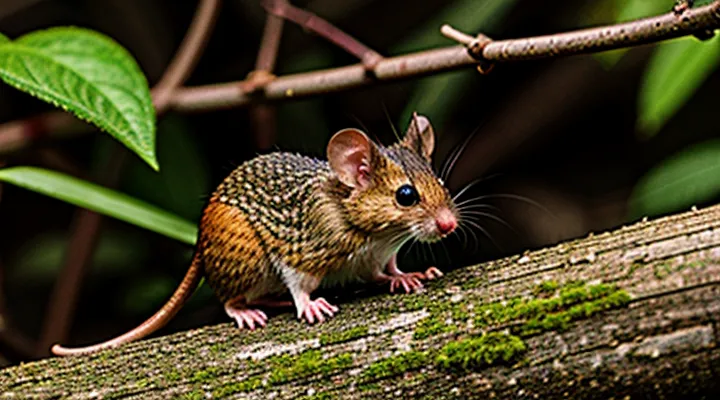
Physical Characteristics
Size and Weight
The small forest mouse exhibits modest dimensions consistent with other sylvan rodent species. Adult body length, measured from nose to base of the tail, typically spans 70–95 mm, while tail length adds an additional 55–80 mm. Overall mass ranges from 12 to 22 g, reflecting seasonal fluctuations in food availability.
Key morphometric data:
- Body length: 70–95 mm
- Tail length: 55–80 mm
- Weight: 12–22 g
These measurements provide a baseline for field identification and ecological studies across the species’ distribution.
Fur Coloration and Texture
The small forest mouse exhibits a dorsal pelage ranging from dark brown to reddish‑brown, often interspersed with black tips that create a speckled appearance. Ventral fur is markedly lighter, typically a pale gray‑white, providing a clear contrast with the back. Seasonal molts may introduce a subtle shift toward a grayer tone during winter months, while summer coats retain richer, more saturated hues.
Texture of the coat is uniformly soft and dense, with guard hairs interwoven among a finer underlayer. This arrangement yields a plush surface that resists moisture and enhances insulation. The guard hairs are slightly longer, measuring approximately 5–7 mm, and possess a fine, tapered tip that contributes to the mouse’s sleek silhouette.
Key characteristics of fur coloration and texture include:
- Dorsal coloration: dark brown, reddish‑brown, black‑tipped speckles.
- Ventral coloration: pale gray‑white, uniform.
- Seasonal variation: grayish winter coat, richer summer coat.
- Guard hair length: 5–7 mm, semi‑rigid.
- Underfur density: high, providing insulation and water repellency.
These attributes facilitate camouflage within leaf litter and undergrowth, while the dense, soft fur supports thermoregulation across the mouse’s temperate habitat.
Distinguishing Features
The small forest mouse exhibits a suite of morphological traits that separate it from sympatric rodent species. Body length ranges from 70 to 95 mm, with a proportionally long tail measuring 80–110 mm, a ratio that exceeds the head‑body length. Fur presents a dorsal hue of rich russet brown, interspersed with subtle grayish speckles, while the ventral side remains uniformly pale gray. Ears are notably large, rounded, and covered with fine, translucent hair, enhancing auditory acuity in dense understory. Whiskers extend beyond the snout by 1.5 times the head width, providing tactile precision for navigation among leaf litter. The skull displays a narrow, elongated rostrum and a well‑developed zygomatic arch, supporting strong masticatory muscles. Dental formula follows the typical murid pattern, but the molar occlusal surfaces possess a distinctive crescentic ridge that aids in processing fibrous seeds. These characteristics collectively define the species and facilitate reliable field identification.
Habitat and Geographical Distribution
Preferred Habitats
The small forest mouse occupies environments that provide dense ground cover, abundant food sources, and protection from predators. Preferred habitats include:
- Deciduous woodlands with thick leaf litter and fallen logs.
- Mixed forests where understory vegetation offers shelter.
- Coniferous stands featuring mossy trunks and damp soil.
- Riparian zones with moist substrates and proximity to streams.
- Shrub thickets and hedgerows that supply nesting material and foraging opportunities.
These settings share common characteristics: high humidity, low light penetration at the forest floor, and a complex structure of debris that supports the mouse’s nocturnal activity and diet of seeds, insects, and fungi. Access to continuous cover reduces exposure to aerial predators and facilitates safe movement across the terrain.
Global Range
The small forest mouse occupies a broad Eurasian distribution, extending from western Europe through the Mediterranean basin to Central and Eastern Asia. Populations thrive in temperate woodlands, shrublands and agricultural margins where dense ground cover provides shelter and foraging opportunities.
Key regions of occurrence include:
- Western and Southern Europe: United Kingdom, France, Spain, Italy, Portugal and the Balkans.
- Central Europe: Germany, Austria, Switzerland, Poland, Czech Republic, Hungary and Slovakia.
- Eastern Europe and the Caucasus: Russia (European part), Ukraine, Belarus, Georgia and Armenia.
- Western Asia: Turkey, Iran, Iraq, Syria and Lebanon.
- Central Asia: Kazakhstan, Uzbekistan, Turkmenistan and parts of northern Iran.
The species adapts to altitudes from sea level up to approximately 2 500 m, demonstrating ecological flexibility across diverse climatic zones. Its presence is documented in both natural forests and human‑altered landscapes, reflecting a capacity for coexistence with agricultural practices.
Regional Variations
The small forest mouse exhibits distinct regional forms that reflect adaptation to local environments. Morphological differences include variations in body mass, tail length, and ear size. Populations in northern latitudes tend to have larger bodies and longer fur, while those in southern regions display slimmer builds and shorter pelage.
Ecological preferences shift across the range. In temperate woodlands, the species favors dense understory with abundant leaf litter, whereas in mountainous zones it occupies rocky crevices and alpine meadows. Coastal populations are more frequently associated with scrub habitats near water sources.
Genetic studies reveal clinal patterns correlating with geographic distance. Northern groups show higher allelic diversity, suggesting historical refugia, while central populations exhibit intermediate genetic signatures.
Key regional characteristics can be summarized:
- Northern Europe: larger size, thick dorsal coat, preference for coniferous forests.
- Central Europe: moderate size, mixed‑forest habitats, intermediate fur density.
- Southern Europe and the Balkans: smaller stature, lighter coloration, affinity for shrubland and rocky slopes.
- Eastern Asia: elongated tail, reduced ear size, occupation of temperate broadleaf forests.
These variations underscore the species’ capacity to adjust morphology, behavior, and genetics in response to diverse climatic and ecological conditions across its distribution.
Behavior and Ecology
Diet
The forest‑dwelling mouse consumes a varied diet that reflects the availability of resources within temperate woodland ecosystems. Primary food items include seeds, nuts, and fruits such as acorns, beech mast, and berries. In addition to plant material, the species incorporates insects, spiders, and other small arthropods, especially during the breeding season when protein demand increases.
Seasonal adjustments are evident:
- Spring: fresh leaves, herbaceous shoots, and emerging insects.
- Summer: ripe berries, mature seeds, and a higher proportion of arthropods.
- Autumn: fallen nuts, hard‑seeded fruits, and stored seeds.
- Winter: cached seeds and occasional opportunistic consumption of bark or cambium.
Foraging occurs primarily on the forest floor and within the lower understory, with individuals exhibiting nocturnal activity patterns. The mouse employs keen olfactory cues to locate concealed seeds and utilizes tactile exploration to capture mobile prey. Cache building behavior ensures food supply during periods of scarcity.
Nutritional intake balances carbohydrates from plant sources with protein and lipids derived from animal prey. This combination supports rapid growth in juveniles and sustains reproductive output in adults.
Reproduction and Life Cycle
The forest-dwelling mouse reproduces primarily during the spring and early summer months, when ambient temperatures and food availability are optimal. Breeding peaks between April and July, with females capable of producing multiple litters within a single season.
Gestation lasts approximately 21 days, after which a litter of three to six altricial pups is born. Neonates are hairless, blind, and weigh less than one gram. Maternal care includes nest construction, frequent feeding, and thermoregulation until the young achieve independence.
Development proceeds through distinct stages:
- Neonatal period (0–10 days): Pups remain immobile, rely entirely on maternal milk.
- Early growth (10–21 days): Fur appears, eyes open, and pups begin to explore the nest.
- Weaning (21–28 days): Solid food is introduced; dependence on the mother declines.
- Juvenile stage (28–45 days): Individuals attain full body size, develop territorial behavior.
- Sexual maturity (45–60 days): Mice become capable of reproduction, joining the breeding population.
Adult lifespan in the wild averages 12–18 months, with most individuals reproducing for only one to two breeding seasons before succumbing to predation or environmental pressures. Seasonal breeding, rapid maturation, and short gestation collectively ensure the species maintains stable populations across its forested habitats.
Social Structure
The small forest mouse exhibits a social organization that varies with habitat density and seasonal resource availability. Individuals form loose associations rather than permanent colonies, allowing flexible adjustment to fluctuating environmental conditions.
Territorial boundaries are established by scent marking and vocalizations, with each adult defending a core area that overlaps minimally with neighboring ranges. Overlap typically occurs at the periphery, where foraging paths intersect.
Reproductive dynamics involve a dominant breeding pair within each local cluster, while subordinate adults contribute to communal nest maintenance and offspring care. This hierarchy reduces competition for limited nesting sites and enhances juvenile survival rates.
Communication relies on a repertoire of ultrasonic calls, tail‑slapping displays, and chemical cues. These signals coordinate activities such as foraging, predator avoidance, and mate attraction.
Key aspects of the social structure include:
- Flexible grouping based on resource distribution
- Defined territorial zones maintained through scent and sound
- Dominant breeding pair supported by subordinate helpers
- Multimodal communication for coordination and defense
Predators and Threats
The small forest mouse faces predation from a range of vertebrate and invertebrate hunters. Primary predators include:
- Red foxes (Vulpes vulpes) and other small carnivores such as weasels (Mustela spp.).
- Avian raptors, notably Eurasian sparrowhawks (Accipiter nisus) and tawny owls (Strix aluco).
- Ground-dwelling snakes, especially grass snakes (Natrix natrix) and smooth snakes (Coronella austriaca).
- Larger arthropods, for example wolf spiders (Lycosidae) and centipedes (Lithobiomorpha).
In addition to natural predation, the species encounters several anthropogenic and ecological threats. Habitat loss resulting from deforestation, agricultural expansion, and urban development reduces available cover and foraging grounds. Pesticide application diminishes insect prey populations and introduces toxic exposure. Climate fluctuations, particularly prolonged droughts, exacerbate food scarcity and increase vulnerability to heat stress. Invasive mammals such as the American mink (Neovison vison) may intensify predation pressure in altered ecosystems.
Conservation Status
Current Population Trends
The forest‑dwelling mouse, a diminutive rodent inhabiting temperate woodlands, exhibits distinct demographic patterns across its range. Recent surveys, conducted by national wildlife agencies and academic institutions, provide a quantitative basis for assessing population dynamics.
Key observations include:
- A gradual decline of approximately 12 % in total numbers over the past decade, driven primarily by habitat fragmentation.
- Stable or modestly increasing populations in protected reserves where canopy continuity is maintained.
- Noticeable reductions in peripheral zones, especially in regions experiencing intensive logging and agricultural expansion.
- Elevated juvenile mortality rates correlated with increased predation pressure from introduced mustelids.
Long‑term monitoring indicates that the species’ overall conservation status remains vulnerable, with projected declines of 15–20 % by 2035 if current land‑use trends persist. Mitigation measures emphasizing habitat connectivity and predator management are identified as critical for reversing negative trajectories.
Conservation Efforts
The small forest mouse inhabits temperate woodlands across Eastern Europe and Western Asia, preferring dense underbrush and moist leaf litter. Habitat loss, fragmentation, and predation by invasive species constitute primary threats to population stability.
Conservation actions focus on habitat protection, population monitoring, and community engagement:
- Designation of protected areas encompassing critical breeding sites; examples include the «Northern Forest Reserve» and the «River Valley Conservation Zone».
- Restoration of degraded forest patches through native vegetation planting and removal of invasive flora.
- Implementation of standardized live‑trapping surveys to assess abundance and distribution trends.
- Development of predator‑control programs targeting introduced mustelids and feral cats.
- Promotion of sustainable forestry practices that maintain understorey complexity and minimize clear‑cutting.
Long‑term monitoring indicates modest population increases within managed reserves, while continued habitat connectivity projects aim to reduce genetic isolation. Ongoing research emphasizes adaptive management, integrating new data to refine protection measures and ensure species resilience.