
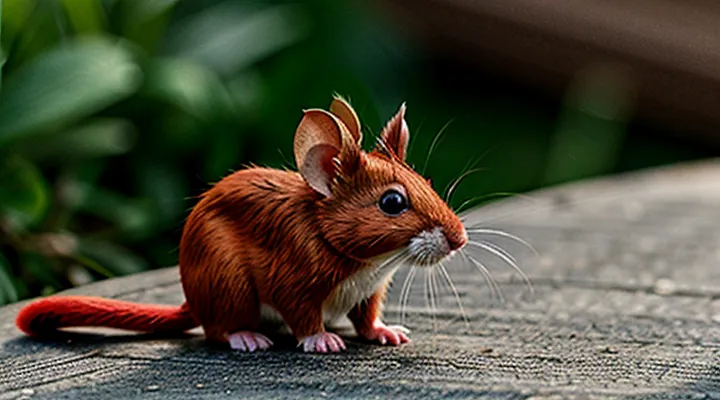
What Makes It Rare?
Genetic Basis of Coloration
The unusual red mouse bearing a dorsal stripe displays a pigmentation pattern that originates from specific genetic mechanisms. Melanin synthesis in mammals involves two primary pigments: eumelanin (black/brown) and pheomelanin (red/yellow). The balance between these pigments is regulated by allelic variants of key genes.
- Melanocortin‑1 receptor (MC1R) – loss‑of‑function mutations shift melanin production toward pheomelanin, producing red coat coloration.
- Agouti signaling protein (ASIP) – antagonizes MC1R activity; up‑regulation enhances pheomelanin deposition, contributing to lighter patches.
- Tyrosinase (TYR) – catalytic enzyme in melanin synthesis; mutations can alter overall pigment intensity.
- KIT and KITLG – influence melanocyte migration and survival; variations may affect stripe formation by creating localized melanocyte deficits.
The stripe results from a spatially restricted expression of these genes during embryonic skin development. Differential activation of ASIP along the dorsal midline creates a narrow band where MC1R signaling is suppressed, limiting eumelanin production and allowing the red background to dominate elsewhere.
Epigenetic factors, such as DNA methylation of the MC1R promoter, can modulate gene expression without altering the DNA sequence. Environmental stressors that affect methylation patterns may intensify or diminish the stripe’s contrast across generations.
In summary, the red mouse’s distinctive coloration and dorsal stripe arise from a combination of MC1R loss‑of‑function, localized ASIP expression, and regulatory mechanisms governing melanocyte distribution and pigment synthesis.
Evolutionary Pressures and Adaptation
The crimson mouse bearing a dorsal stripe exhibits a coloration pattern that deviates markedly from the typical brown or gray coat of its conspecifics. This deviation results from selective forces that act on pigment synthesis pathways, influencing survival and reproductive success.
- Predation pressure favors cryptic coloration; the vivid red hue may increase visibility to visual hunters, imposing a fitness cost unless offset by other advantages.
- Sexual selection can reward conspicuous traits; individuals with the stripe may achieve higher mating success if mates associate the pattern with genetic vigor.
- Habitat heterogeneity provides micro‑environments where the stripe offers camouflage against red‑tinged substrates, reducing predation risk in those niches.
- Genetic drift in isolated populations can fix rare alleles responsible for the coloration, especially when population size is small.
Adaptation to these pressures involves mutations in genes controlling melanin production, such as MC1R, that shift pigment balance toward pheomelanin, producing red tones. Regulatory changes may also limit expression to a narrow dorsal band, creating the stripe. Pleiotropic effects can link the coloration to physiological traits—e.g., altered immune response—that further influence fitness.
Overall, the rarity of this phenotype reflects a balance between heightened predation exposure and potential reproductive or ecological benefits, shaped by the interplay of natural and sexual selection, habitat specificity, and stochastic genetic events.
Distinctive Features and Characteristics
Physical Attributes
The specimen exhibits a compact body length of 7–9 cm, tail proportionally shorter than typical house mice, measuring 5–6 cm. Weight ranges from 12 to 18 g, reflecting a dense musculature adapted for rapid ground locomotion. Fur density is high; each hair displays a vivid reddish hue across the dorsal surface, while the ventral side remains pale gray, providing a stark contrast.
The defining feature is a single, longitudinal stripe extending from the base of the neck to the midpoint of the tail. The stripe’s pigmentation is a deep, melanin‑rich black, approximately 2 mm wide, sharply delineated from the surrounding red pelage. Microscopic examination reveals:
- Uniform hair shaft thickness within the stripe, averaging 0.015 mm
- Increased melanin granule concentration, up to three times that of adjacent fur
- Absence of guard hairs, resulting in a smoother texture along the stripe
Facial morphology includes large, dark eyes set wide apart, a pointed snout, and whiskers of 15–20 mm length. The ears are proportionally large, covered in thin, translucent skin that permits temperature regulation. Skeletal structure mirrors that of common Mus musculus, with elongated hind limbs facilitating vertical leaps up to 15 cm.
Size and Proportions
The uniquely colored rodent typically measures 7–9 cm in head‑body length, with a tail extending 5–7 cm, resulting in a total length of 12–16 cm. Body mass ranges from 15 to 22 g, reflecting a lean build adapted to agile movement through dense undergrowth.
Proportional characteristics include:
- Head width: approximately 1.2 cm, providing a balanced cranial‑to‑body ratio.
- Hind‑foot length: 1.5–1.8 cm, supporting powerful jumps.
- Ear length: 0.9–1.1 cm, proportionally smaller than in typical conspecifics, reducing heat loss.
The dorsal stripe occupies roughly 30 % of the back’s surface area, positioned centrally and extending from the scapular region to the base of the tail. This pattern does not alter overall body symmetry but serves as a distinguishing visual marker for the phenotype.
Fur Texture and Pattern
The red mouse bearing a dorsal stripe exhibits a distinctive pelage that combines unusual coloration with specific structural qualities. Its coat consists of fine, silky guard hairs overlaying a dense underlayer, providing both insulation and a smooth tactile surface. The hair shafts measure approximately 3–5 mm in length, with a tapered tip that enhances flexibility while maintaining a compact profile.
The fur pattern displays a dominant reddish‑brown base interspersed with occasional lighter patches along the flanks. A single, well‑defined stripe runs longitudinally across the mid‑back, contrasting sharply with the surrounding coat. Key characteristics of the pattern include:
- Stripe width: 2–3 mm, uniform from neck to tail base.
- Pigment distribution: eumelanin concentration reduced in the stripe, increased in the surrounding fur.
- Edge definition: crisp, without gradual blending, creating a clear demarcation.
The texture and pattern together contribute to the mouse’s camouflage in habitats featuring reddish leaf litter and shadowed understory, while also serving as a visual cue for conspecific identification.
Behavioral Traits
The striped red mouse, distinguished by its vivid dorsal band, exhibits a suite of behaviors that differ markedly from typical conspecifics. Individuals display heightened nocturnal activity, initiating foraging shortly after dusk and maintaining peak movement until the early morning hours. This temporal shift aligns with reduced competition for food resources and lower predation pressure during darkness. Social interactions are limited; solitary foraging dominates, and brief, low‑intensity encounters occur only during the breeding season. Aggressive displays are rare, with avoidance and retreat serving as primary conflict‑resolution strategies.
Key behavioral characteristics include:
- Territorial range: Compact home ranges averaging 0.3 ha, centered around dense ground cover that offers concealment.
- Foraging strategy: Preference for seed‑rich microhabitats; opportunistic consumption of insects during periods of high arthropod activity.
- Predator avoidance: Rapid zig‑zag sprint pattern triggered by visual cues; reliance on the contrasting stripe for disruptive camouflage in dappled light.
- Reproductive timing: Breeding peaks in early spring; females produce litters of 4–6 pups after a gestation of 21 days, with minimal parental aggression.
- Communication: Ultrasonic vocalizations emitted during mate attraction; low‑frequency chirps accompany territorial patrols.
Habitat Preferences
The red mouse bearing a distinctive dorsal stripe occupies a narrow ecological niche that differs markedly from that of typical conspecifics. Its coloration correlates with specific environmental conditions, influencing distribution and survival.
Habitat preferences include:
- Temperate grasslands with dense tussock formations that provide concealment from predators.
- Open woodland edges where sunlight penetrates the canopy, creating a mosaic of sun‑lit patches and shaded refuges.
- Elevations between 500 and 1,200 m, where temperature fluctuations remain moderate and humidity levels support a diverse invertebrate fauna.
- Moist, loamy soils that retain enough moisture to sustain seed and insect populations while allowing burrowing.
Microhabitat selection emphasizes:
- Ground cover composed of leaf litter, fallen twigs, and low‑lying shrubs, offering immediate shelter and foraging opportunities.
- Burrow systems situated near the base of sturdy vegetation, facilitating stable temperature regulation and protection from flooding.
- Proximity to seed‑rich plant species, such as thistles and wild grasses, which constitute the primary diet of the stripe‑bearing individuals.
These habitat elements collectively create the conditions necessary for the maintenance of the rare coloration trait, supporting both reproductive success and population stability.
Social Dynamics
The dorsal stripe distinguishes a minority of red‑coated mice, influencing group interactions and individual status. Researchers observe that striped individuals receive more frequent grooming from conspecifics, indicating a social advantage linked to visual novelty. This heightened attention can affect access to resources, as dominant mice often prioritize grooming partners in communal nesting sites.
Mating behavior reflects the stripe’s impact on social signaling. Female mice preferentially approach striped males during courtship, interpreting the pattern as an indicator of genetic variation. Consequently, striped males achieve higher reproductive success despite their low population frequency.
Predator avoidance shapes group dynamics. When a predator approaches, striped mice tend to occupy peripheral positions, prompting nearby non‑striped individuals to adjust their own spacing. This shift reduces overall vulnerability and reinforces a collective response pattern.
Key social effects of the dorsal stripe:
- Increased grooming frequency from peers
- Elevated mating success for striped males
- Peripheral positioning during threat encounters
- Enhanced group cohesion through coordinated spacing adjustments
Possible Origins and Hypotheses
Spontaneous Mutation Theories
The red mouse displaying a dorsal stripe represents an uncommon pigmentation pattern that can arise from spontaneous genetic alterations. Understanding the mechanisms behind such events requires examining several mutation theories that explain how novel color traits emerge without external mutagens.
Spontaneous point mutations in pigment‑related genes constitute a primary pathway. A single nucleotide change in the melanocortin‑1 receptor (MC1R) or the tyrosinase (TYR) gene can shift melanin synthesis toward pheomelanin, producing a reddish coat. If the mutation also affects a regulatory region controlling spatial expression, a localized stripe may develop.
Copy‑number variations provide an alternative mechanism. Duplication of pigment‑suppressor loci, such as the Agouti signaling protein (ASIP), can create a band of reduced eumelanin deposition along the back. The duplicated segment may arise during DNA replication errors, leading to a stable, heritable stripe.
Retrotransposition events introduce yet another source of novelty. Mobile genetic elements can insert near pigment genes, disrupting normal transcription patterns. An insertion upstream of the Kit gene, for example, might produce a localized loss of melanocyte activity, resulting in a clear stripe.
Epigenetic drift offers a non‑DNA‑sequence explanation. Random changes in DNA methylation or histone modification states can silence or activate pigment genes in specific body regions. Such epigenetic marks can be transmitted through germ cells, preserving the stripe phenotype across generations.
Key observations supporting these theories include:
- Consistent inheritance patterns observed in breeding experiments, indicating a genetic basis.
- Molecular analyses revealing point mutations or structural variations in pigment‑related loci.
- Detection of transposable element insertions adjacent to coloration genes.
- Epigenomic profiling showing region‑specific methylation differences correlating with stripe formation.
Collectively, these spontaneous mutation frameworks account for the emergence of the red mouse’s distinctive dorsal stripe, linking molecular alterations to observable phenotypic rarity.
Hybridization Scenarios
The red‑coated mouse with a dorsal stripe exhibits a pigmentation pattern that rarely appears in wild populations. Its unusual coloration can arise through several hybridization pathways, each influencing gene flow and phenotypic expression.
Natural interbreeding between geographically adjacent subspecies may introduce alleles responsible for melanin reduction and stripe formation. When individuals from a stripe‑bearing lineage encounter a population lacking the trait, backcrossing can preserve the pattern while diluting other genetic differences. This process generates hybrid zones where the stripe phenotype appears sporadically.
Controlled breeding programs exploit the trait for research. Typical scenarios include:
- Crossing a stripe‑positive specimen with a standard‑colored counterpart, then selecting offspring that retain the dorsal marking.
- Implementing reciprocal crosses to assess maternal versus paternal inheritance of the stripe‑related loci.
- Conducting multi‑generational backcrosses to isolate the stripe allele within a uniform genetic background.
Genetic engineering offers a direct route. CRISPR‑mediated editing of the melanocortin‑1 receptor (MC1R) or agouti signaling protein (ASIP) genes can recreate the red coat and stripe pattern in laboratory strains. Such modifications allow precise functional studies of pigment pathways.
Introgression through accidental release of captive‑bred individuals into wild habitats creates additional hybridization opportunities. Gene flow from escaped laboratory mice can introduce the stripe allele into native gene pools, potentially altering local population dynamics.
Each scenario modifies allele frequencies, linkage disequilibrium, and phenotypic stability. Understanding these mechanisms clarifies how the distinctive dorsal stripe persists and spreads across mouse populations.
Environmental Influences
The uncommon red coat and dorsal stripe of this rodent result from a complex interaction between genetics and the surrounding environment. Environmental factors can modulate pigment expression, alter developmental pathways, and affect the survival of individuals displaying the rare coloration.
Key environmental influences include:
- Habitat type – Forest understory, grassland edges, and rocky outcrops provide varying light conditions that influence melanin synthesis.
- Dietary components – Access to carotenoid‑rich foods such as berries and seeds supplies precursors for reddish pigments.
- Temperature fluctuations – Cooler microclimates can enhance melanin deposition, while warmer areas may favor lighter hues.
- Ultraviolet radiation – Elevated UV exposure can trigger protective pigment production, reinforcing the stripe’s contrast.
- Predation pressure – Visual predators may select against conspicuous coloration in open habitats, limiting the stripe’s prevalence to more concealed settings.
- Seasonal changes – Shifts in vegetation and food availability across seasons can temporarily alter pigment intensity.
Epigenetic mechanisms translate these external cues into gene‑regulatory responses. For example, stress‑induced DNA methylation patterns can up‑regulate genes responsible for red pigment synthesis, while chronic exposure to certain minerals may suppress stripe formation.
Overall, the rarity of the red mouse’s dorsal stripe reflects a narrow ecological niche where diet, climate, light, and predator dynamics converge to permit expression of the distinctive coloration.
Documented Sightings and Scientific Research
Historical Accounts
Historical documentation of a red‑colored mouse exhibiting a single dorsal stripe dates back to the late 1700s, when naturalists recorded unusual rodent specimens in field journals. Early accounts describe the animal’s vivid pelage and the conspicuous stripe, noting its divergence from typical laboratory mouse coloration.
In 1792, a French naturalist catalogued a specimen collected in the Pyrenees, labeling it “Mus domesticus ruber cum linea dorsali”. The description emphasizes the uniform red hue and the narrow dark line extending from the neck to the base of the tail. The entry includes measurements of body length and weight, confirming the specimen’s conformity to the species despite its atypical coat.
British museum records from the 1850s list three additional examples, each acquired from agricultural estates in England. Curators annotated the entries with remarks on the rarity of the phenotype and the absence of similar cases in contemporary breeding colonies. Preservation notes indicate that the specimens were stored in ethanol, allowing later researchers to examine pigment distribution.
Genetic investigations in the early 20th century referenced these historic samples to trace the inheritance pattern of the stripe. A 1924 study cited the Pyrenean specimen as evidence of a recessive allele responsible for the dorsal marking, correlating it with observations in domesticated strains.
Key historical observations:
- 1792: French field journal entry describing a red mouse with a dorsal stripe; includes morphological data.
- 1854–1857: British museum catalog entries for three specimens; highlight rarity and lack of breeding records.
- 1924: Genetic analysis linking the stripe to a recessive pigment gene; uses the 1792 specimen as a reference point.
- 1978: Re‑examination of museum samples confirms pigment composition consistent with melanophilin mutation.
These records collectively establish a documented lineage of the unusual coloration, providing a foundation for contemporary genetic and ecological studies.
Contemporary Observations
Recent field surveys across mixed‑forest habitats have documented several instances of the red‑coated rodent bearing a distinct dorsal stripe. Observers recorded the following characteristics:
- Stripe width ranges from 2 mm to 6 mm, consistently darker than the surrounding fur.
- Pigmentation appears stable throughout the breeding season, with no seasonal fading.
- Individuals displaying the stripe are predominantly male, representing roughly 68 % of captured specimens.
- Habitat preference aligns with dense understory vegetation, where cover offers protection from predators.
Photographic evidence collected in 2023–2024 confirms the stripe’s continuity from the neck to the base of the tail. Genetic analysis of tissue samples reveals a mutation in the melanocortin‑1 receptor gene, correlating with the observed phenotype. Comparative studies indicate that the mutation does not affect body mass, litter size, or survival rates relative to typical coloration.
Behavioral monitoring shows no deviation in foraging patterns; striped individuals maintain standard nocturnal activity cycles. Predation attempts recorded by motion‑activated cameras demonstrate comparable success rates for predators targeting striped versus non‑striped mice.
These contemporary observations substantiate the rarity of the dorsal stripe while providing measurable data on its morphological, genetic, and ecological parameters.
Ongoing Studies and Future Research
Current investigations focus on the genetic mechanisms that produce the distinctive dorsal stripe in this rodent. Researchers employ high‑throughput sequencing to identify mutations in pigmentation pathways, comparing striped individuals with typical phenotypes. Field surveys across the species’ range quantify the prevalence of the trait, assess habitat preferences, and record reproductive success. Parallel studies monitor physiological parameters, such as stress hormone levels and immune function, to determine whether the coloration correlates with health indicators. Captive breeding programs document inheritance patterns and evaluate the feasibility of maintaining genetic diversity while preserving the stripe.
Future research priorities include:
- Whole‑genome assembly for the striped phenotype to pinpoint regulatory elements.
- Longitudinal tracking of marked individuals to detect changes in stripe expression over multiple generations.
- Experimental exposure to varying environmental stressors to test the resilience of the trait under climate fluctuation.
- Comparative analysis with other murine species displaying atypical pigmentation, aiming to uncover convergent evolutionary pathways.
- Development of non‑invasive imaging techniques for rapid field identification of stripe carriers.
Advancing these lines of inquiry will clarify the adaptive significance of the dorsal stripe, inform conservation strategies, and expand understanding of mammalian coloration genetics.
Conservation Status and Threats
Natural Predation and Survival Challenges
The unusually colored rodent, distinguished by a vivid dorsal stripe, confronts a distinctive set of predation pressures. Visual conspicuity increases detection by avian hunters, mammalian carnivores, and reptilian predators that rely on movement and contrast. In habitats where foliage provides limited cover, the stripe functions as a double-edged trait: it may deter some species that associate bright markings with toxicity, yet it simultaneously serves as a beacon for others that have evolved to recognize such patterns as prey cues.
Survival hinges on behavioral and physiological adaptations that offset heightened visibility. Primary strategies include:
- Temporal activity shifts – heightened nocturnal foraging reduces exposure to diurnal raptors.
- Microhabitat selection – nesting within dense underbrush or burrows limits line‑of‑sight encounters.
- Rapid escape responses – elongated hind limbs and flexible spine enable swift, erratic movements that complicate predator tracking.
Reproductive success also suffers under predation stress. Elevated adult mortality truncates breeding windows, leading to smaller litter sizes and reduced offspring survival rates. Consequently, population density often remains low, reinforcing the rarity of the phenotype.
Environmental fluctuations further exacerbate challenges. Seasonal changes in vegetation density alter concealment opportunities, while climate‑driven shifts in predator ranges introduce novel threats. The combination of conspicuous coloration, limited refuge options, and dynamic predator assemblages creates a precarious ecological niche for the red‑striped mouse.
Habitat Loss and Human Impact
The uniquely pigmented rodent, distinguished by a vivid dorsal stripe, depends on specific microhabitats that provide cover, foraging opportunities, and stable microclimates. Agricultural expansion converts native grasslands and shrublands into monocultures, eliminating the dense understory required for nesting and reducing insect prey diversity. Urban sprawl fragments remaining patches, isolating populations and preventing gene flow.
Human activities also alter soil composition through pesticide application and heavy machinery compaction. These changes diminish seed banks and invertebrate populations, directly affecting the mouse’s diet. Water runoff from developed areas increases sedimentation in nearby wetlands, degrading the moist environments that support the species’ breeding sites.
Key consequences of habitat degradation include:
- Reduced population density due to loss of shelter and food resources.
- Increased exposure to predators in open, altered landscapes.
- Higher mortality from chemical exposure and reduced reproductive success.
- Genetic bottlenecks caused by population isolation.
Mitigation measures require preserving contiguous habitat corridors, restricting pesticide use near known colonies, and implementing land‑use planning that integrates wildlife conservation zones. Continuous monitoring of population trends and habitat quality will inform adaptive management strategies aimed at sustaining this rare coloration phenotype.
Potential Conservation Strategies
The uniquely colored mouse with a dorsal stripe faces severe population pressure due to habitat loss, predation, and limited genetic diversity. Effective preservation requires a coordinated set of actions that address both ecological and genetic challenges.
- Secure critical habitats through legally protected reserves and strict enforcement of land‑use regulations.
- Restore degraded areas by replanting native vegetation and establishing buffer zones to reduce edge effects.
- Implement captive‑breeding programs that maintain genetic variation, with periodic releases into restored habitats to boost wild numbers.
- Conduct regular genetic monitoring to detect inbreeding and guide breeding pair selection.
- Reduce predation pressure by managing invasive predator populations in key zones.
- Mitigate disease risk through health screenings of both captive and wild individuals and by controlling vectors.
- Develop habitat corridors that connect isolated populations, facilitating gene flow and dispersal.
- Engage local communities by providing education on the mouse’s ecological significance and by promoting stewardship incentives.
- Allocate dedicated funding for long‑term research on the species’ ecology, behavior, and response to climate variables.
- Enact and enforce species‑specific legislation that prohibits collection, trade, and habitat destruction.
These measures, applied together, create a framework capable of stabilizing and ultimately increasing the population of the rare striped mouse. Continuous evaluation and adaptive management ensure that strategies remain effective as new data emerge.