
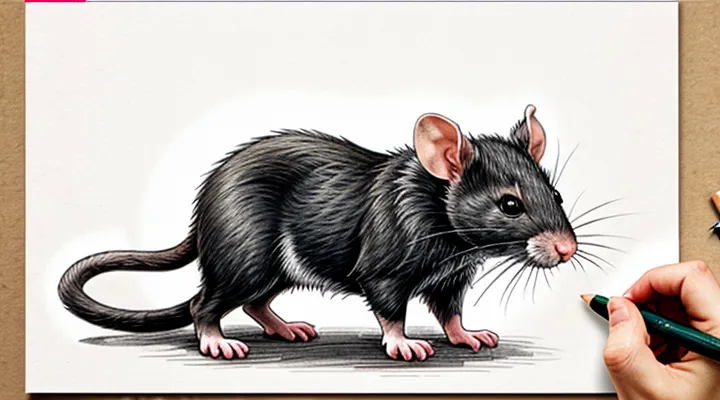
Getting Started: Materials You'll Need
Essential Drawing Supplies
Pencils and Erasers
Pencils provide the line work needed for a clear rat sketch. A hard‑lead (HB‑2H) pencil creates precise outlines without smudging, while a softer lead (2B‑4B) adds depth to fur, ears, and tail. Switching between grades allows control over line weight and texture.
Erasers correct mistakes and refine details. A kneaded eraser lifts graphite without tearing the paper, ideal for lightening fur highlights. A vinyl eraser removes darker strokes cleanly, useful for erasing stray lines and sharpening edges.
- Begin with an HB pencil to draw the basic shape: head, body, limbs, and tail.
- Use light strokes; the eraser can lift unwanted marks before they harden.
- Switch to a 2B pencil for shading the mouse’s fur, applying short, directional strokes.
- Employ the kneaded eraser to pull out subtle highlights on the ears and whiskers.
- Refine the outline with a vinyl eraser, sharpening the tail curve and foot contours.
- Finish by smoothing transitions with a blended 2B stroke, then clean residual graphite with the vinyl eraser.
Choosing the appropriate pencil hardness and eraser type streamlines the process, producing a tidy rat illustration with minimal rework.
Paper Choices
Choosing the right paper determines line clarity, shading depth, and overall durability when sketching a rat with minimal effort. Smooth surfaces preserve fine pencil marks, while slightly textured sheets enhance grip for charcoal or ink. Paper weight influences handling; heavier stock resists tearing and prevents warping during erasing.
- Hot-pressed (HP) Bristol – 180–250 gsm, ultra‑smooth finish, ideal for precise line work and graphite shading.
- Cold-pressed watercolor – 300 gsm, fine grain, supports wet media and allows subtle washes to suggest fur tones.
- Medium‑weight sketch pad – 120–150 gsm, lightly textured, suitable for quick drafts and erasing without damaging the surface.
- Recycled mixed‑media paper – 200 gsm, balanced texture, accommodates pencil, ink, and light watercolor without excessive bleed.
Select a paper that matches the intended medium: use HP Bristol for crisp outlines, watercolor paper for tonal depth, and sketch pads for rapid studies. Consistency in paper choice eliminates unexpected smudging and ensures the rat illustration retains clean edges throughout the process.
Reference Images
Reference images serve as the visual foundation for a quick and accurate rat illustration. Choose pictures that display the animal from multiple angles—side, front, and three‑quarter views—to capture the overall silhouette and distinctive features such as the elongated snout, rounded ears, and tapered tail. Prioritize high‑resolution photos with clear lighting; shadows reveal muscle contours and fur direction, which helps translate three‑dimensional form onto paper.
When gathering sources, consider the following steps:
- Search reputable wildlife photography sites, museum archives, or scientific illustration databases for unedited, full‑body shots.
- Select images that include a scale reference (e.g., a ruler or a known object) to verify proportions.
- Compile a small set (3–5 images) covering different poses; this reduces reliance on a single perspective and improves anatomical accuracy.
- Crop each picture to isolate the rat’s outline, then overlay the cuts on a light‑box or digital layer to trace basic shapes.
- Note recurring details—fur texture, whisker placement, foot placement—and incorporate them into the sketch gradually.
Using these curated references streamlines the drawing process, minimizes guesswork, and ensures that the final rat sketch retains realistic proportions while remaining simple to execute.
Step-by-Step Rat Drawing Guide
Basic Shapes: Foundation of Your Rat
Drawing the Head and Body Ovals
Begin by sketching a light oval for the head. Position the shape horizontally, about the size of a small coin, to accommodate the rat’s facial features. Keep the line faint; it will serve only as a framework for later details.
Next, add the body oval directly beneath the head. Use a larger, slightly elongated ellipse that aligns with the head’s centerline. Ensure the body’s width is roughly twice the head’s width, providing enough space for the limbs and tail.
- Place the head oval first, then connect the two shapes with a short, gentle curve to suggest the neck.
- Adjust the body oval’s length until the overall silhouette resembles a typical rat posture.
- Maintain consistent spacing between the head and body to preserve proportion.
After confirming the proportions, darken the outlines of both ovals. These definitive lines will guide the addition of ears, eyes, whiskers, and the rest of the anatomy.
Connecting the Shapes with a Neck Line
When assembling the rat sketch, the neck line serves as the bridge between the head oval and the body shape. Begin by placing the head near the top of the page, then sketch a simple elongated oval for the torso. Draw a short, slightly curved line from the lower edge of the head to the upper edge of the torso; this line defines the neck and establishes the animal’s posture.
- Position the head oval so its lower edge aligns with the intended neck start point.
- Extend a gentle curve toward the torso, keeping the line thin to allow easy adjustment.
- Connect the curve to the torso’s upper contour, matching the angle of the body’s forward lean.
- Refine the junction by smoothing any sharp angles, ensuring a natural flow into the body.
After the neck line is in place, add the ears, whiskers, and tail, then darken the outline for a finished rat illustration.
Adding Features: Bringing Your Rat to Life
Eyes, Nose, and Mouth Placement
Begin with a proportional guide. Sketch a light oval for the head; divide it vertically and horizontally to locate facial features.
- Eyes – Position them on the horizontal line, about one‑third of the head width apart. Place each eye slightly toward the front of the face, leaving a small gap for the bridge of the nose. Draw simple almond shapes; fill only the upper half to suggest a reflective gleam.
- Nose – Locate the nose at the intersection of the vertical line and the lower third of the head. Use a tiny triangle or rounded point, pointing outward. Keep the size modest; an oversized nose distorts the rat’s natural proportion.
- Mouth – Extend a short, shallow curve from the base of the nose downward, curving gently toward the chin. Add a second, lighter curve beneath to indicate the lower lip. Position the mouth so the line ends just above the chin’s lowest point, preserving a balanced profile.
After establishing these landmarks, refine the shapes, erase construction lines, and add subtle shading to emphasize depth. The placement of eyes, nose, and mouth determines the rat’s expression and overall realism; following the measured guide ensures consistency across sketches.
Ears: Shape and Position
When sketching a rat, the ears define the animal’s silhouette and convey its alertness. Their shape is roughly triangular with a rounded tip; the base of each ear attaches to the head at a shallow angle, slightly behind the eye line.
Begin with a light oval to mark the ear’s outer contour. Refine the outline by curving the lower edge inward, creating a subtle point at the top. Add a smaller inner oval to represent the inner ear membrane, leaving a narrow margin between the two shapes for realistic depth.
- Position: place the ears symmetrically on either side of the head, about one‑third of the way back from the snout.
- Size: keep each ear proportionate to the head, roughly one‑quarter of the head’s height.
- Angle: tilt the ears forward by 10‑15 degrees to suggest a listening stance.
Finalize by shading the outer ear lightly, leaving the inner oval brighter to suggest the thin skin covering. The resulting ears will appear natural and consistent with the overall rat sketch.
Legs and Paws: Simple Limbs
When drawing a rat, the legs and paws define the animal’s posture and movement. Begin with the skeletal framework: two thin lines for each hind leg and a shorter line for each foreleg, positioned at the appropriate angles relative to the body’s axis. Mark the joints—hip, knee, ankle for the hind limbs; shoulder, elbow, wrist for the forelimbs—to ensure correct proportion.
- Sketch the upper leg as a simple elongated oval; attach a narrower oval for the lower leg.
- Place a small circle at each joint to keep angles consistent.
- Draw the paw as a rounded rectangle, flattening the bottom edge to suggest the sole.
- Add three to four short, tapered strokes for the toes, spacing them evenly.
- Refine the outline by trimming excess lines, creating a smooth silhouette.
After establishing the basic shape, apply light shading to convey volume. Darken the area under the joints to suggest depth, and use short, curved strokes to indicate fur texture on the paw pads. Keep the line weight uniform for the limbs, reserving thicker strokes for the outer contour to emphasize the rat’s overall form.
The Tail: Length and Curve
The rat’s tail determines the overall balance of the figure; a correctly proportioned tail prevents the sketch from appearing awkward.
Measure the tail as roughly 1.5 – 2 times the length of the body. Start with a light, straight guideline that extends from the base of the spine. Adjust the endpoint until the total length matches the chosen proportion, then erase the guideline after the final shape is established.
Create the curve by dividing the tail into three segments:
- Base segment: Slightly thicker, follows the body’s angle for a smooth transition.
- Middle segment: Narrows gradually and bends in a gentle S‑shape; use a soft, continuous stroke to avoid sharp angles.
- Tip segment: Thinnest part, tapers to a point or a subtle hook, depending on the desired pose.
Maintain consistent thickness reduction from base to tip, and keep the curvature fluid by drawing with long, confident strokes rather than short, choppy lines. A well‑executed tail adds realism and completes the rat’s silhouette with minimal effort.
Refining and Detailing
Outlining Your Sketch
Outlining defines the shape of the rat before adding details, ensuring proportion and structure remain consistent throughout the drawing process. Begin with light strokes to allow easy modification; the outline serves as a framework that guides later shading and texture work.
- Sketch a basic oval for the head, keeping lines faint.
- Attach a slightly larger circle for the body, aligning the bottom of the head with the top of the body.
- Draw a short, curved line from the head to indicate the neck, connecting the two shapes smoothly.
- Add two small triangles at the front of the head for ears, positioned symmetrically.
- Place a pair of almond‑shaped eyes within the head oval, leaving space for the nose.
- Extend a tapered line from the body to form the tail, curving it gently to suggest natural movement.
- Sketch four simple leg outlines using short, straight lines ending in tiny ovals for paws.
After completing the outline, assess the silhouette for balance and adjust any discrepancies before proceeding to render fur, shading, and final details. This disciplined approach minimizes errors and accelerates the overall creation of a recognizable rat illustration.
Adding Fur Texture
When you add fur to a rat sketch, focus on the direction of the hair and the contrast between light and shadow. Begin with a light pencil line that follows the spine, then extend short strokes outward to indicate the flow of the coat. Keep each stroke short and slightly curved; this mimics the natural waviness of a rodent’s fur.
- Sketch the back fur in long, overlapping strokes that angle toward the tail.
- Render the side fur with slightly shorter, denser lines that curve toward the belly.
- Apply lighter, finer marks on the underbelly to suggest softer, thinner hair.
- Darken the areas near the head, ears, and tail base with layered strokes to create depth.
- Use a blending tool or a clean tissue to soften harsh edges, preserving the texture’s individuality.
Finish by erasing any stray guideline marks and reinforcing the darkest shadows with a darker pencil or ink. The result should convey a realistic, tactile coat while maintaining the simplicity of the overall rat illustration.
Shading for Depth and Dimension
Shading transforms a flat rat outline into a three‑dimensional figure by indicating how light interacts with the animal’s form. Correct placement of shadows and highlights creates the illusion of volume, making the sketch appear realistic rather than schematic.
Identify the primary light source before applying any tone. Light that strikes the head, back, and upper limbs will remain relatively bright, while the underside, side opposite the light, and recessed areas such as the belly and ear cavities require progressively darker values. Gradual transitions between these zones avoid harsh edges and preserve a smooth surface appearance.
- Choose a single light direction; mark its angle on the paper if needed.
- Lay down a light base tone over the entire silhouette to establish a uniform foundation.
- Add midtones on surfaces that receive indirect illumination, blending them into the base with soft strokes.
- Apply deep shadows to areas blocked from light, using a darker pencil or charcoal to enhance contrast.
- Introduce small highlights on the most exposed points, such as the tip of the nose and the top of the head, to reinforce the light source.
- Blend all layers with a blending stump or tissue, ensuring each transition remains seamless.
Consistent application of these steps produces a rat drawing with convincing depth, allowing viewers to perceive the creature’s rounded body, textured fur, and subtle anatomical contours.
Tips for Success
Practice Makes Perfect
Consistent repetition of the drawing routine transforms a vague idea of a rat into a reliable visual reference. Each session should focus on a single element—silhouette, ear shape, tail curvature—so the brain records the motion pattern without overload.
- Sketch the basic outline three times, varying the size each attempt.
- Add details such as whisker placement and foot positioning after the outline stabilizes.
- Repeat the full figure from memory, comparing it with a reference image only at the end.
- Allocate a short, timed interval (5–10 minutes) for each repetition to build speed.
Tracking progress through side‑by‑side comparisons highlights improvements and reveals persistent inaccuracies. Recording the number of successful strokes per session provides quantifiable data that guides adjustments.
Integrating these cycles into a regular schedule—daily or every other day—maintains muscle memory and refines line confidence. Over time, the effort required to produce a clear rat drawing diminishes, confirming that disciplined practice directly yields proficiency.
Experimenting with Poses
Experimenting with poses expands the range of rat illustrations and prevents repetitive silhouettes. Begin by collecting reference images that show the animal from various angles—side, front, three‑quarter view, and dynamic actions such as climbing or nibbling. Study each reference to identify the primary line of action, which determines the overall flow of the figure.
- Sketch a loose stick‑figure using the line of action as a backbone.
- Add basic shapes (circles for the head, ovals for the torso and hindquarters) to define volume.
- Adjust limb placement by rotating the stick‑figure around the central axis; small rotations produce noticeably different gestures.
- Refine the contour by tracing over the shapes, incorporating characteristic features: pointed snout, rounded ears, and long tail.
- Test the composition by erasing the sketch and redrawing the pose from memory; this reinforces muscle memory and reveals which angles feel most natural.
Switch between static and kinetic poses to discover how the rat’s weight shifts. In static poses, distribute weight evenly across the hind limbs; in kinetic poses, emphasize the forward thrust of the front paws and the curvature of the spine. Vary the tail’s curvature to convey balance or tension.
Repeat the cycle—reference, sketch, refine—until the pose feels dynamic and anatomically credible. Recording successful configurations in a quick‑reference sheet accelerates future drawings and ensures consistent quality across multiple rat illustrations.
Don't Be Afraid of Mistakes
When learning to sketch a rat quickly, mistakes are inevitable. Accepting errors as part of the process prevents hesitation and accelerates improvement.
Each error reveals a specific area for adjustment. Identify the line that feels off, erase or modify it, and observe how the shape changes. This immediate feedback builds muscle memory and refines proportion control.
Practical steps to manage mistakes:
- Draw the basic outline with light strokes; heavy lines become difficult to correct.
- Keep an eraser within reach; use it to remove only the problematic segment, leaving the rest intact.
- After each correction, pause briefly to assess the overall silhouette before proceeding.
- Record recurring issues in a short notebook; review them before the next drawing session.
By treating errors as data rather than failures, you develop confidence and produce cleaner rat sketches with fewer revisions. The habit of swift correction transforms tentative sketches into decisive artwork.