
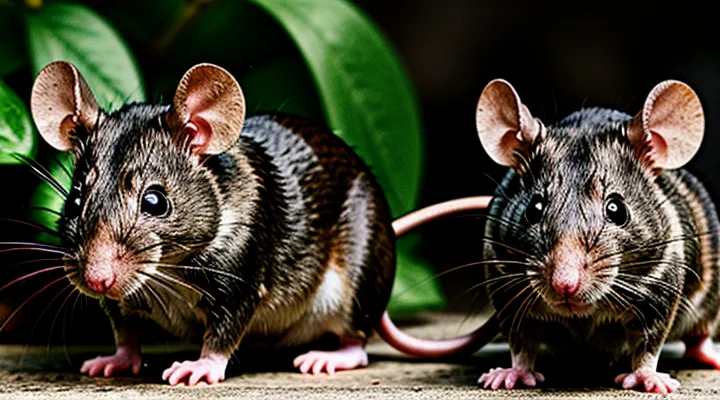
Introduction to Rodent Identification
Why Distinguish Between Mice and Rats?
Health Implications
Distinguishing mice from rats by external characteristics influences public‑health strategies because each species carries a distinct set of pathogens and allergenic risks. Accurate identification guides pest‑control measures, reduces unnecessary chemical exposure, and informs medical assessment after human contact.
Key external differences include overall body length, tail proportion, ear size, and snout shape. Mice typically measure 6–10 cm in body length, possess tails equal to or slightly longer than the body, and have proportionally large ears. Rats range from 15–25 cm, display shorter tails relative to body length, and have smaller ears in proportion to the head. Snout dimensions and fur coloration also vary, providing reliable visual cues for field personnel.
Health implications arising from misidentification:
- Disease transmission: mice are primary vectors for hantavirus and certain salmonella strains; rats more commonly transmit leptospirosis, plague, and rat‑borne hantavirus variants. Confusing the two may delay appropriate diagnostic testing.
- Allergic reactions: mouse urine proteins trigger occupational asthma in laboratory settings; rat allergens, especially from saliva and dander, affect urban residents. Incorrect species identification can lead to ineffective allergen mitigation.
- Bite injuries: rat bites tend to be deeper and carry higher bacterial load, increasing infection risk. Treating a mouse bite as a rat bite may result in over‑prescribing antibiotics, while the opposite can leave a serious infection untreated.
- Pest‑control toxicity: rodenticides calibrated for rats often exceed safe exposure limits for mice, raising concerns for non‑target wildlife and human residents. Accurate species assessment prevents unnecessary chemical use.
Implementing routine visual checks of size, tail ratio, ear proportion, and snout shape ensures that health‑related responses align with the specific risks each rodent presents.
Property Damage Concerns
Distinguishing between small rodents and larger ones based on outward characteristics is essential for assessing potential property damage. Mice typically measure up to four inches in body length, possess a slender build, and have a proportionally long, hairless tail. Their incisors are relatively small, limiting the size of materials they can gnaw. Consequently, damage caused by mice often includes fine wiring, delicate insulation, and thin fabric, resulting in subtle but costly repairs.
Rats generally exceed seven inches in body length, display a robust body, and feature a thick, scaly tail. Their powerful incisors enable them to chew through thicker materials such as wooden beams, PVC piping, and heavy insulation. Damage associated with rats frequently involves structural compromise, water leakage from breached pipes, and extensive contamination of stored goods.
Key considerations for property owners:
- Size and tail morphology indicate the likely scale of material damage.
- Chewing strength correlates with the thickness of penetrable surfaces.
- Habitat preference (elevated nesting for mice, ground burrows for rats) influences the location of damage within a building.
Accurate identification of the rodent species guides appropriate mitigation strategies, reduces repair costs, and prevents escalation of damage.
Effective Pest Control Strategies
Correct identification of rodent species determines the choice of control measures, reduces non‑target impacts, and improves eradication efficiency.
Mice and rats differ in several external characteristics. Typical mouse size ranges from 5 to 10 cm in body length, with a proportionally long, hairless tail that is roughly equal to the body length. Ears are relatively large, and the head presents a pointed snout. In contrast, rats exhibit body lengths of 15 to 20 cm, a thicker, shorter tail, smaller ears relative to head size, and a blunt snout. Fur texture, coloration, and foot pad patterns also vary, providing reliable visual cues for field personnel.
Accurate species determination guides the selection of appropriate control tactics. For instance, bait stations calibrated for larger rodents may fail to attract mice, while snap traps sized for rats can be ineffective against smaller specimens.
Effective pest control strategies include:
- Maintain rigorous sanitation: eliminate food residues, store waste in sealed containers, and remove standing water.
- Implement structural exclusion: seal entry points with steel wool, cement, or metal flashing; install door sweeps and window screens.
- Deploy species‑specific trapping: use lightweight snap traps or electronic devices for mice; apply heavier, multi‑capture traps for rats.
- Apply baiting judiciously: select anticoagulant or non‑anticoagulant formulations matched to target size; monitor bait consumption regularly.
- Conduct systematic monitoring: place tracking stations, review droppings, and record activity patterns to assess population trends.
- Integrate pest management: combine sanitation, exclusion, trapping, and baiting within a coordinated plan, adjusting tactics based on ongoing observations.
Adhering to these measures ensures targeted intervention, minimizes collateral damage, and promotes sustainable rodent management.
Key External Features for Identification
Size and Body Shape
Overall Length
Overall length measures the distance from the tip of the snout to the end of the tail. This metric includes the tail because tail proportion differs markedly between the two species.
Typical overall length ranges:
- House mouse (Mus musculus): 6 – 10 cm, tail 5 – 7 cm, total 11 – 17 cm.
- Common rat (Rattus norvegicus): 20 – 25 cm, tail 15 – 20 cm, total 35 – 45 cm.
Mice rarely exceed 12 cm in total length; rats seldom fall below 30 cm. When an individual measures within the overlap of 12 – 30 cm, additional features such as body mass, head shape, and ear size become decisive.
Weight Comparison
Weight serves as a primary indicator when separating mice from rats. Adult house mice typically weigh between 10 and 30 grams, while adult Norway rats range from 150 to 300 grams. The disparity is evident even when individuals are of comparable age; a mouse remains markedly lighter than a rat of the same developmental stage.
Key points for practical assessment:
- Mice: 0.01–0.03 kg; body length 6–10 cm, excluding tail.
- Rats: 0.15–0.30 kg; body length 20–25 cm, excluding tail.
- Juvenile rats may overlap the upper mouse weight range; however, their body proportions and tail length differ significantly.
When weighing specimens, use a digital scale calibrated to 0.1 gram precision. Record the mass before handling to avoid stress‑induced weight fluctuations. Comparing the measured weight against the ranges above quickly confirms whether the animal is a mouse or a rat.
Torso Proportions
Torso proportions provide a reliable metric for separating the two common rodents. The overall length of the body, relative to head size, differs markedly between the smaller species and its larger counterpart.
Mice exhibit a compact torso. The body length, measured from the occipital crest to the base of the tail, typically ranges from 5 cm to 10 cm. The head occupies a larger fraction of the total length, creating a short, rounded appearance. The dorsal profile is shallow, and the ventral surface shows minimal curvature.
Rats possess an elongated torso. Body length usually falls between 15 cm and 25 cm, with the head representing a smaller proportion of the total measurement. The dorsal line is more pronounced, giving the animal a streamlined silhouette. The ventral surface demonstrates deeper curvature, accommodating larger internal organs.
Key comparative figures:
- Body length: mouse ≈ 5–10 cm; rat ≈ 15–25 cm.
- Head‑to‑body ratio: mouse ≈ 1:1.5; rat ≈ 1:2.5.
- Torso depth (dorsal‑ventral distance): mouse ≈ 1 cm; rat ≈ 2–3 cm.
These dimensional differences, when observed alongside other external traits, enable accurate identification without reliance on behavioral cues.
Head and Facial Characteristics
Snout Shape
The snout provides a reliable external cue when separating mice from rats.
Mice possess a sharply pointed snout that tapers to a fine tip. The rostral profile appears triangular, and the whiskers emerge close to the tip, giving a delicate appearance.
Rats exhibit a noticeably blunter snout. The rostrum widens near the tip, forming a more rounded silhouette. Whisker origins are set farther back from the tip, contributing to a sturdier look.
Key distinctions:
- Shape: mouse – acute, triangular; rat – broad, rounded.
- Tip: mouse – fine; rat – blunt.
- Whisker placement: mouse – near tip; rat – set back from tip.
Eye Size
Eye size provides a reliable external indicator when separating mice from rats.
Mice possess eyes that occupy a greater proportion of the skull’s width; the ocular diameter often approaches one‑third of the head’s total width. Rats display relatively smaller eyes, typically measuring about one‑fifth of the head’s width. This proportionate difference remains consistent across adult specimens and is evident even in juvenile individuals.
Observation guidelines:
- Compare eye diameter to the distance between the ears; a larger ratio suggests a mouse.
- Note the visibility of the pupil; mice exhibit a more prominent pupil relative to the surrounding fur.
- Assess the overall head shape; a rounder cranium with enlarged eyes aligns with mouse morphology, whereas a elongated skull with reduced ocular prominence indicates a rat.
These measurements enable quick field identification without the need for invasive procedures.
Ear Proportions
Ear size relative to head length provides a reliable criterion for separating the two species. In mice, the ear length typically reaches 40‑50 % of the skull width, whereas in rats the ear length rarely exceeds 30 % of the same measurement. This disparity results from the mouse’s need for heightened auditory sensitivity and the rat’s larger body mass, which reduces the proportional importance of the ears.
Key proportional differences:
- Mice: ear length ≈ 0.45 × skull width; ear height ≈ 0.4 × skull height.
- Rats: ear length ≈ 0.25‑0.30 × skull width; ear height ≈ 0.2‑0.25 × skull height.
- Ear cartilage thickness: thinner in mice, thicker in rats, influencing overall ear bulk.
- Visibility of the ear rim: clearly defined in mice; often obscured by fur in rats.
The shape of the auricle also varies. Mice possess a triangular, sharply pointed auricle with a pronounced notch at the tip. Rats display a more rounded auricle with a smoother edge and a less distinct notch. When observed from a lateral view, the mouse ear projects outward at a steeper angle, while the rat ear lies closer to the head surface.
These measurements, when taken with calipers or visual estimation, enable accurate identification without reliance on internal anatomy. Consistent application of the proportional criteria eliminates ambiguity in field assessments and laboratory settings.
Tail Anatomy
Tail Length Relative to Body
Tail length provides a reliable metric for separating mice from rats. The mouse tail typically measures about 75‑100 % of its body length, resulting in a slender, proportionally long appendage. In contrast, a rat’s tail seldom exceeds 60‑70 % of its body length, appearing shorter and often thicker relative to the torso.
Key comparative points:
- Mouse: tail length ≈ body length; diameter narrow; often hair‑covered along entire surface.
- Rat: tail length < body length; diameter relatively robust; may display sparse hair or a bare ventral surface.
The proportion can be assessed by aligning the animal on a flat surface and measuring the tail from the base to the tip, then comparing to the distance from the snout to the base of the tail. Rat specimens consistently display a reduced tail‑to‑body ratio, whereas mouse specimens exhibit a near‑equal measurement. This difference assists in rapid visual identification without requiring detailed anatomical examination.
Fur or Scales on Tail
The presence or absence of covering on the tail provides a reliable external indicator when separating house mice from common rats.
Mice display a uniformly furred tail. The hair extends to the tip, creating a smooth, soft surface. The fur may appear slightly darker than the body coat but remains continuous throughout the length.
Rats possess a tail that is largely naked. Sparse hairs appear only near the base; the majority of the tail is covered by thin, overlapping scales. The scaly surface feels dry and firm to the touch.
Key distinctions:
- Tail surface: fully furred (mouse) vs. predominantly scaly (rat)
- Hair distribution: continuous along entire length (mouse) vs. limited to basal region (rat)
- Texture: soft and pliable (mouse) vs. dry and rigid (rat)
Observing the tail’s covering quickly narrows identification to the appropriate rodent species.
Tail Thickness
Mice possess tails that are noticeably slender and lack visible fur, giving a smooth appearance along the entire length. The diameter of a mouse tail is typically one‑third or less of the body width, and the structure tapers gradually toward the tip. The surface is essentially naked, revealing only a thin layer of skin with few scales.
Rats exhibit tails that are considerably thicker and covered with coarse, overlapping scales. The tail diameter approaches half of the body width, and the cross‑section remains relatively uniform rather than tapering sharply. The presence of prominent scales creates a rough texture distinguishable by touch.
Key comparative points for tail thickness:
- Diameter relative to body: mouse ≤ 33 % of body width; rat ≈ 50 % of body width.
- Surface texture: mouse smooth and hairless; rat scaly and coarse.
- Tapering: mouse tail gradually narrows; rat tail maintains consistent thickness.
These external characteristics provide reliable criteria for separating the two species in field observations.
Fur and Coat Description
Coloration Patterns
Coloration offers reliable clues when separating small rodents from larger ones. Mice typically display a uniform, light‑brown to gray dorsal coat, often with a subtle pinkish hue on the ventral side. Their fur lacks distinct markings, and the transition between back and belly is smooth.
Rats exhibit a broader palette. Common species show a darker, almost black dorsal coloration, sometimes interspersed with brown or reddish tones. Ventral fur is usually lighter, ranging from white to pale gray, creating a pronounced contrast with the back. Many rats possess a distinct stripe or mottling along the spine, especially in wild varieties.
Key visual markers for identification:
- Dorsal uniformity: consistent for mice, variable for rats.
- Ventral contrast: minimal in mice, marked in rats.
- Presence of dorsal stripes or patches: rare in mice, frequent in rats.
These coloration traits remain consistent across habitats, providing a practical basis for field identification without reliance on size or behavior.
Texture of Fur
Fur texture provides a reliable indicator when separating mice from rats.
Mice possess a soft, fine coat that feels almost silky to the touch. The individual hairs are thin, lie flat against the body, and create a smooth surface. Rats, by contrast, display a coarser pelage. Their hairs are thicker, stand out more prominently, and give the skin a rougher feel.
Key observations:
- Mouse fur: silky, delicate, uniform in length, minimal variation across body regions.
- Rat fur: dense, bristly, noticeable texture differences between dorsal and ventral areas.
When examining a specimen, run a fingertip gently over the back and sides. A smooth glide indicates a mouse; a slight resistance signals a rat. This tactile assessment, combined with other external characteristics, enhances accurate identification.
Droppings and Other Indirect Visual Cues
Size and Shape of Feces
The size and shape of droppings provide reliable clues when separating small rodents from larger ones. Mouse feces are typically 3–6 mm in length, cylindrical, and possess a smooth, glossy surface. Rat droppings range from 12–20 mm, often reaching 30 mm in large individuals, and display a more tapered, blunt-ended profile with a matte texture.
Key distinguishing points:
- Length: mouse 3–6 mm; rat 12–20 mm (up to 30 mm).
- Shape: mouse uniformly cylindrical; rat tapered, blunt at one end.
- Surface: mouse glossy; rat matte, sometimes with slight ridges.
Observation of these characteristics, combined with other external markers, enables accurate identification of the species responsible for the droppings.
Gnaw Marks Distinctions
Gnaw marks provide reliable external clues for separating small rodents from larger ones. The size, shape, and pattern of the bite edges differ consistently between the two species.
- «Mouse» gnaw marks are shallow, with a narrow width of 1–2 mm; the incisor edges appear fine and produce parallel, smooth lines on soft materials.
- «Rat» gnaw marks are deeper, ranging from 3–5 mm in width; the incisor edges are broader, leaving jagged, irregular grooves that may chip surrounding material.
- The spacing between successive bites on a «mouse» trail is tight, typically less than 5 mm, creating a continuous line. In contrast, «rat» bite spacing exceeds 7 mm, resulting in a dotted or staggered appearance.
- On hard surfaces, «mouse» teeth leave delicate, crescent-shaped indentations, whereas «rat» teeth generate larger, semicircular pits with pronounced flaking around the perimeter.
These characteristics enable accurate identification of gnaw evidence without reliance on additional anatomical inspection.
Common Misconceptions and Similarities
Behavioral Overlaps
Mice and rats share several observable habits that can obscure visual differentiation. Both species display nocturnal activity, frequent gnawing on similar materials, and a propensity for nesting in confined spaces. These commonalities often lead to misidentification when external size or morphology is not immediately apparent.
- Exploration of new objects occurs with comparable curiosity levels.
- Social interaction includes grooming of conspecifics and occasional aggression over resources.
- Food storage behavior involves hoarding dry seeds or grains within hidden caches.
The overlap in such behaviors reduces reliance on activity patterns for species-level identification. Accurate distinction therefore depends on measurable physical traits—body length, tail proportion, ear size, and fur texture—rather than on behavioral observation alone.
Habitat Preferences (Brief Mention)
Mice and rats occupy distinct environments, and these preferences reinforce visual distinctions. Small rodents favour areas with limited exposure, while larger ones adapt to more open, resource‑rich spaces.
-
Mice commonly inhabit: • Interior walls, ceilings, and stored‑food compartments; • Dense vegetation near ground level; • Structures offering narrow passages and concealment.
-
Rats regularly occupy: • Sewers, basements, and outdoor burrows; • Areas with abundant water sources; • Open ground near trash piles or agricultural fields.
Recognising these habitat trends assists in confirming species identification based on size, tail length, and ear shape.
Practical Identification Tips
Observation Techniques
Observation techniques provide the foundation for reliable differentiation between small rodents commonly encountered in domestic and laboratory environments. Precise visual assessment eliminates reliance on anecdotal descriptions and supports consistent identification.
Key external characteristics to examine:
- Body length: mice typically measure 6–10 cm, rats exceed 15 cm.
- Tail proportion: mouse tail approximates body length; rat tail often longer than the body.
- Ear size: mouse ears are large relative to skull; rat ears are proportionally smaller.
- Fur texture and coloration: mouse fur is fine and uniform; rat fur appears coarser, often with distinct dorsal‑ventral shading.
- Foot dimensions: mouse hind feet are narrow; rat hind feet are broader and display more pronounced pads.
- Whisker length: mouse whiskers extend roughly the length of the head; rat whiskers are markedly longer.
Accurate measurement requires calibrated instruments and controlled lighting. Recommended equipment includes a metric ruler or digital caliper, a hand‑held magnifier (10× magnification), and a diffuse light source to reduce shadows. Photographic documentation with a scale bar enhances reproducibility and permits later review.
A systematic observation workflow:
- Secure the specimen in a neutral position on a flat surface.
- Apply magnification to inspect ear shape, whisker arrangement, and fur texture.
- Record body and tail lengths using the ruler or caliper.
- Capture high‑resolution images with scale reference.
- Compare recorded data against the characteristic ranges listed above.
Consistent application of these techniques yields clear distinction between «mouse» and «rat» based solely on external morphology.
When to Seek Expert Help
Distinguishing a mouse from a rat based on outward characteristics can become problematic under specific circumstances, warranting professional consultation.
Typical situations that justify expert involvement include:
- Overlap in body length and tail proportion that prevents reliable visual separation.
- Presence of juvenile specimens whose features have not fully developed, leading to ambiguous identification.
- Observation of health‑related symptoms, such as unusual fur loss or lesions, that may indicate disease and require veterinary assessment.
- Need for accurate species determination before implementing pest‑management strategies, especially when local regulations differentiate between mouse and rat control measures.
- Encounter with trapped or deceased specimens lacking clear external markers, where forensic analysis is necessary to confirm species.
In each case, a qualified entomologist, veterinarian, or licensed pest‑control professional can provide definitive identification, advise on appropriate remediation, and ensure compliance with relevant health and safety standards.