
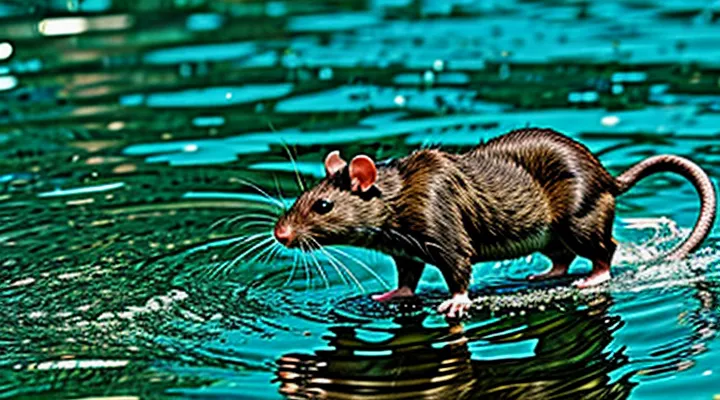
«The Aquatic Prowess of Rats»
«Natural Habitats and Water Access»
«Urban Environments»
Rats exhibit proficient swimming abilities that enable them to navigate the complex water networks of cities. Their bodies are streamlined, limbs positioned for efficient propulsion, and fur treated by a natural oil that reduces water absorption. These physiological traits allow rapid movement through storm drains, sewer pipes, and flooded streets, facilitating access to food sources and shelter.
Urban water infrastructure creates multiple pathways for rat locomotion:
- Storm‑water channels connect rooftops, sidewalks, and basements, providing continuous routes.
- Sewer systems offer low‑light environments where rats travel undetected.
- Temporary floodplains form during heavy rain, allowing surface swimming between districts.
Adaptations to urban environments extend beyond physical traits. Rats possess acute sensory perception that detects subtle water currents, enabling them to orient toward exits or safe zones. Their ability to hold breath for several seconds supports brief submersion, while rapid lung ventilation restores oxygen after surfacing.
Research indicates that the presence of interconnected waterways correlates with higher rat population density. Effective pest control therefore requires targeting both terrestrial habitats and aquatic conduits. Monitoring water flow patterns, sealing pipe openings, and managing surface runoff reduce the opportunities for rats to exploit swimming routes. «Effective urban planning must consider the dual terrestrial‑aquatic mobility of rats to mitigate infestation risks».
«Rural Settings»
Rural environments provide distinct hydraulic features that shape the swimming patterns of rats. Open ditches, irrigation canals, and seasonal floodplains create shallow, vegetation‑rich water bodies where rats frequently enter to forage, escape predators, or relocate between fields. The irregular banks and soft substrates typical of countryside waterways influence the ease of entry and exit, thereby affecting overall aquatic activity.
Key environmental variables influencing rat swimming in agrarian landscapes include:
- Water depth variability, ranging from a few centimeters in drainage channels to several meters in farm reservoirs.
- Presence of submerged vegetation, offering concealment and influencing buoyancy control.
- Seasonal flow fluctuations, which alter current speed and water temperature.
- Soil composition of banks, affecting slip resistance and the likelihood of accidental immersion.
These factors collectively determine the frequency, duration, and efficiency of rat locomotion in water. Understanding the interaction between rural hydraulic structures and rat behavior informs pest‑management strategies, habitat restoration projects, and ecological risk assessments related to disease transmission in agricultural settings.
«The Mechanics of Rat Swimming»
«Body Adaptations for Water»
«Fur and Insulation»
Rats frequently encounter aquatic environments, requiring physiological adaptations that preserve core temperature during immersion. Their pelage consists of a dense undercoat overlain by coarser guard hairs. The undercoat forms a fine, interlocking network that captures microscopic air pockets; these pockets constitute the primary mechanism of thermal protection. Guard hairs repel water, directing surface moisture away from the skin and limiting heat transfer.
Key attributes of the pelage that contribute to thermal regulation in water:
- High hair density creates a thick insulating layer.
- Air‑filled microcavities reduce conductive heat loss.
- Sebaceous secretions increase hydrophobicity, preventing saturation.
- Guard hairs streamline the body, enhancing buoyancy and reducing drag.
The combination of retained air and water‑repellent surface maintains a relatively stable temperature gradient between the skin and surrounding water. Consequently, rats can sustain prolonged swimming bouts without rapid hypothermia, supporting efficient locomotion and foraging in wet habitats.
«Tail as a Rudder»
Rats exhibit efficient aquatic locomotion despite their terrestrial origins. Propulsion results from coordinated fore‑ and hind‑limb strokes, while the posterior appendage contributes to steering. The elongated, flexible structure at the animal’s rear functions as a rudder, generating lateral forces that adjust heading during forward movement.
When a rat initiates a turn, muscular contraction bends the tail toward the desired direction. This deformation creates asymmetrical drag, producing a torque that rotates the body around its longitudinal axis. The effect is immediate, allowing rapid correction of trajectory in turbulent water. Tail movement also stabilizes pitch, preventing unwanted vertical oscillations that could disrupt forward thrust.
Key characteristics of the rudder function:
- High surface area relative to body mass enhances drag modulation.
- Musculature permits fine‑grained curvature adjustments.
- Neural control synchronizes tail bending with limb cycles.
- Hydrodynamic shape reduces vortex shedding, maintaining smooth flow.
Experimental observations confirm that rats lacking a functional tail display reduced maneuverability and increased energy expenditure to maintain a straight path. Restoring tail motion restores directional precision, confirming its critical contribution to aquatic navigation.
«Swimming Techniques»
«Doggy Paddle Style»
Rats adopt a swimming technique comparable to the “doggy‑paddle” observed in many mammals. The motion involves simultaneous, alternating strokes of the forelimbs while the hind limbs remain relatively still, generating thrust and maintaining body orientation near the surface. This pattern enables rapid adjustments to water currents and supports buoyancy without requiring complex limb coordination.
Key characteristics of the rat’s doggy‑paddle style include:
- Forelimb propulsion: each forepaw pushes backward in a semi‑circular arc, producing forward thrust.
- Head position: the snout stays elevated, allowing breathing while the body remains submerged.
- Limb rhythm: strokes occur at a frequency of 3–5 cycles per second, matching the animal’s metabolic rate during moderate exertion.
- Energy efficiency: the method minimizes muscular fatigue by distributing effort across both forelimbs rather than relying on hind‑limb paddling.
Observational studies confirm that this stroke pattern is the default response for rats placed in shallow or turbulent water, providing reliable locomotion and facilitating escape behaviors. The simplicity of the doggy‑paddle allows rats to transition quickly between swimming and terrestrial movement without extensive training or anatomical specialization.
«Hind Leg Propulsion»
Rats achieve forward movement in water primarily through the coordinated action of their hind limbs. The posterior limbs generate thrust by executing rapid, alternating strokes that push against the surrounding fluid. Each stroke begins with a dorsal extension, followed by a ventral flexion that displaces water posteriorly, creating a reaction force that propels the animal forward.
Key characteristics of «Hind Leg Propulsion» include:
- Stroke frequency ranging from 8 to 12 cycles per second in adult specimens.
- Peak force output measured at 0.15 N per hind limb during maximal flexion.
- Phase lag of approximately 30 ms between left and right limb cycles, ensuring continuous thrust without interruption.
- Integration with tail undulations that augment stability and directional control.
Neurophysiological control relies on spinal central pattern generators that synchronize motor neuron pools for the hind limbs. Sensory feedback from muscle spindles and cutaneous receptors adjusts stroke amplitude in response to changes in water resistance, maintaining efficient propulsion across varying depths and velocities.
«Duration and Endurance»
«Factors Affecting Swim Time»
«Water Temperature»
Water temperature directly influences the metabolic rate, buoyancy control, and endurance of rats during aquatic activity. Lower temperatures increase heat loss, prompting vasoconstriction and reduced muscle efficiency; higher temperatures elevate metabolic demand, potentially leading to fatigue and impaired coordination.
Typical laboratory observations identify three functional zones:
- Cold zone (10 °C – 15 °C): rapid decrease in core temperature, elevated shivering response, shortened swim duration.
- Thermoneutral zone (20 °C – 25 °C): stable core temperature, optimal oxygen consumption, maximal swim time.
- Warm zone (30 °C – 35 °C): heightened heart rate, accelerated glycolysis, early onset of exhaustion.
Experimental protocols must maintain the water bath within the thermoneutral range to avoid confounding variables. Continuous monitoring with calibrated thermometers ensures temperature stability. Adjustments for ambient conditions and animal acclimation periods further enhance data reliability.
In summary, precise control of «Water Temperature» is essential for reproducible assessments of rat swimming performance, influencing physiological stress markers and behavioral outcomes.
«Rat Species»
Various rodent taxa display distinct swimming capacities that reflect differences in morphology, habitat, and behavior. The term «Rat Species» encompasses these taxa, each exhibiting adaptations that influence aquatic locomotion.
- Rattus norvegicus – Large body mass, dense fur, and webbed hind feet facilitate efficient propulsion; observed to maintain steady speeds of 0.3–0.5 m s⁻¹ in laboratory water channels.
- Rattus rattus – Slimmer build and longer tail provide increased maneuverability; capable of rapid bursts for short distances, typically less than 10 s of continuous swimming.
- Rattus exulans – Small stature and reduced body fat result in higher buoyancy; relies on frequent surface breathing and exhibits intermittent swimming patterns.
- Rattus tanezumi – Semi-aquatic tendencies in coastal environments lead to partially webbed digits; demonstrates sustained swimming endurance comparable to R. norvegicus.
Physiological traits such as lung volume, muscle fiber composition, and fur water‑repellency correlate with observed performance across these species. Recognizing species‑specific swimming profiles informs experimental design, habitat management, and risk assessment for flood‑prone urban areas.
«Physical Condition»
Rats possess a muscular framework optimized for aquatic movement. The forelimb and hindlimb muscles generate propulsion through rapid, coordinated strokes, while the elongated tail provides stabilization and directional control.
Key physiological traits supporting swimming:
- Muscle fiber composition – predominance of fast‑twitch fibers enables quick, powerful strokes.
- Pulmonary capacity – enlarged alveolar surface area allows extended breath‑holding during submersion.
- Fur properties – dense, water‑repellent coat reduces drag and maintains thermal insulation.
- Tail morphology – laterally flattened tail acts as a rudder, enhancing maneuverability.
- Body density – slightly higher than water, facilitating buoyancy control without excessive flotation.
These characteristics collectively ensure efficient locomotion in water, allowing rats to navigate aquatic environments with speed and endurance.
«Survival Strategies in Water»
«Navigating Obstacles»
Rats demonstrate efficient aquatic locomotion, yet water environments often contain physical barriers that impede forward progress. Successful movement through such barriers requires coordinated sensory processing, muscular adjustment, and spatial planning.
Key mechanisms involved in «Navigating Obstacles» include:
- Tactile whisker input that detects surface irregularities and water flow changes.
- Rapid alteration of stroke amplitude to generate increased thrust when confronting confined passages.
- Real‑time body rotation to align the dorsal side with narrow openings, minimizing drag.
- Utilization of buoyancy control to rise or sink, allowing passage beneath floating debris.
Empirical observations indicate that obstacle negotiation enhances overall swimming proficiency, reducing energy expenditure during prolonged submersion. Mastery of these strategies enables rats to exploit diverse aquatic habitats while maintaining high survival prospects.
«Holding Breath and Diving»
Rats demonstrate a remarkable ability to suspend respiration while submerging, enabling effective underwater locomotion. The capacity to hold breath for up to 30 seconds reflects a specialized response of the cardiovascular and respiratory systems.
During immersion, heart rate declines by 30–40 % through vagal activation, diverting blood flow from peripheral tissues toward vital organs. Hemoglobin affinity for oxygen increases, and muscular oxygen consumption drops as anaerobic pathways become predominant. These adjustments extend the duration of apnea and support sustained thrust generation.
Observed diving episodes reveal rapid descent, steady propulsion, and swift resurfacing. Rats employ their hind limbs in a coordinated paddling motion, generating thrust comparable to that of small aquatic mammals. Surface‐to‐submerged transitions occur within a fraction of a second, minimizing exposure to hypoxic stress.
Key physiological adaptations include:
- Bradycardia induced by autonomic regulation
- Elevated blood oxygen affinity
- Shift to anaerobic metabolism in skeletal muscle
- Efficient limb kinematics for thrust production
The phenomenon described as «Holding Breath and Diving» underpins rat aquatic performance, illustrating a convergence of cardiovascular modulation and musculoskeletal coordination that permits brief but effective submersion.
«When Rats Swim: Common Scenarios»
«Escaping Predators»
Rats employ rapid, streamlined movements in water to evade terrestrial and aquatic predators. Their bodies flatten during submersion, reducing drag and allowing bursts of speed that outpace many threats. Muscular coordination between hind limbs and tail generates thrust, while the whiskers detect vibrations, alerting the animal to approaching danger.
Key adaptations support this escape strategy:
- Dense, water‑repellent fur maintains buoyancy and prevents rapid heat loss.
- Elevated lung capacity provides oxygen reserves for prolonged swims.
- Flexible spine enables swift directional changes, essential when navigating obstacles.
Predator encounters often trigger a predictable sequence: detection, immediate plunge into water, sustained high‑velocity swimming, and eventual emergence on a distant shore. Field observations confirm that rats can cover distances up to 30 meters in under a minute, sufficient to outrun most predators that lack comparable aquatic proficiency.
«Foraging for Food»
Rats exhibit efficient swimming techniques when searching for edible resources beyond the confines of terrestrial habitats. Their buoyancy is enhanced by a low‑density body composition and a streamlined torso that reduces drag. Limb coordination follows a synchronous paddling pattern, generating thrust while maintaining stability. This aquatic locomotion enables rapid transit between waterborne food patches and shore‑based caches.
During exploratory foraging, rats assess water depth, current velocity, and surface tension. Sensory input from whiskers detects vibrations that indicate prey presence or floating debris. Decision‑making relies on a cost‑benefit analysis: energy expended in swimming is weighed against caloric gain from captured items. Successful individuals integrate spatial memory of previous foraging routes with real‑time environmental cues.
Key adaptations supporting this behavior include:
- Muscular development of forelimbs for powerful strokes.
- Tail musculature functioning as a rudder for directional control.
- Elevated lung capacity allowing extended submersion periods.
The combination of morphological traits and behavioral strategies permits rats to exploit aquatic niches for nourishment, expanding their ecological impact beyond ground‑level food sources.
«Seeking New Territory»
Rats demonstrate efficient aquatic locomotion when confronted with unfamiliar water bodies. Their muscular coordination and buoyancy control enable rapid traversal across varied depths, supporting exploration beyond familiar confines.
Sensory detection drives the pursuit of novel environments. Vibrissae capture water flow variations, while olfactory receptors identify chemical gradients emerging from distant sources. These inputs guide directional adjustments without reliance on visual cues.
The sequence of actions associated with «Seeking New Territory» includes:
- Initial assessment of water currents and temperature differentials;
- Incremental advancement toward zones of higher nutrient or shelter potential;
- Repeated surface breaches to evaluate air exposure and predator presence;
- Consolidation of a new foothold once environmental parameters satisfy safety thresholds.
Observations of this behavior inform experimental designs that examine spatial memory, risk assessment, and habitat colonization. Understanding the mechanisms underlying aquatic exploration expands knowledge of rodent adaptability and contributes to ecological risk modeling.