
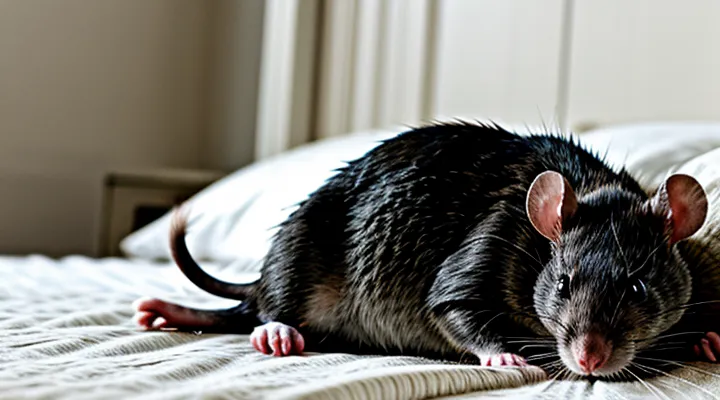
The Fundamentals of Rat Sleep
Sleep Stages in Rats
REM Sleep in Rats
Rats exhibit a distinct rapid eye movement (REM) phase that occupies roughly 20–25 % of total sleep time in adult individuals. This proportion increases during the light phase, when rodents are most inactive, and declines in the dark phase, correlating with heightened locomotor activity.
During REM episodes, electroencephalographic recordings reveal low‑amplitude, high‑frequency activity comparable to wakefulness, while electromyographic signals show pronounced muscle atonia. Bilateral ocular movements are observable through infrared video monitoring, confirming the classic REM phenotype.
Developmental studies indicate that the onset of REM sleep occurs within the first post‑natal week, with episode duration and frequency peaking around post‑natal day 10 before stabilizing in adulthood. Juvenile rats display longer REM bouts and a higher overall percentage of REM sleep compared with mature adults.
Experimental protocols commonly employ polysomnographic setups to quantify REM characteristics. Typical findings include:
- Average REM episode length: 30–45 seconds in adults, up to 90 seconds in juveniles.
- Inter‑REM interval: 2–4 minutes during the light phase, extending to 5–7 minutes in the dark phase.
- Total REM time per 24‑hour period: 2–3 hours for adult rats, reaching 4 hours in developing animals.
Pharmacological manipulations that alter cholinergic transmission produce predictable changes in REM duration and frequency, supporting the involvement of specific neurotransmitter systems in the regulation of this sleep stage.
Non-REM Sleep in Rats
Rats spend the majority of their daily rest in non‑rapid eye movement (NREM) sleep, a state characterized by synchronized cortical activity and reduced physiological arousal.
During each sleep episode, NREM periods alternate with brief bouts of REM sleep, forming cycles that last approximately 10–15 minutes in typical laboratory conditions. Over a 24‑hour span, NREM occupies roughly 70 % of total sleep time, reflecting its dominance in the rat’s sleep architecture.
Electroencephalographic recordings reveal high‑amplitude, low‑frequency delta waves (0.5–4 Hz) as the hallmark of NREM. Power spectra show a pronounced increase in slow‑wave activity during the dark phase, aligning with the animal’s nocturnal activity pattern.
Physiological markers include a marked decline in heart rate, respiratory frequency, and core body temperature, accompanied by muscle tone reduction without the atonia observed in REM sleep. These changes support energy conservation and synaptic homeostasis.
Key features of rat NREM sleep:
- Cycle length: 10–15 minutes, repeating throughout the rest phase.
- Proportion of total sleep: ~70 % NREM, ~30 % REM.
- EEG signature: dominant delta (0.5–4 Hz) and spindle‑like activity.
- Autonomic profile: lowered heart rate, respiration, and temperature.
- Behavioral correlates: immobility, closed eyes, reduced responsiveness to external stimuli.
Experimental protocols typically employ implanted telemetry devices or surface electrodes to monitor EEG, EMG, and thermistor signals. Data analysis focuses on spectral power, bout duration, and latency to the first NREM episode after lights‑off, providing quantitative benchmarks for comparative studies.
Understanding the structure and regulation of NREM sleep in rats informs broader investigations of mammalian sleep physiology and facilitates translational research into sleep disorders.
Duration and Patterns of Rat Sleep
Daily Sleep Cycles
Rats exhibit a polyphasic sleep pattern, dividing rest into numerous short bouts throughout the 24‑hour period. Activity peaks during the dark phase, while the light phase contains the majority of sleep episodes. Each sleep episode typically lasts from one to fifteen minutes, resulting in frequent transitions between wakefulness and sleep.
Sleep cycles in rats are ultradian, with a full cycle—comprising non‑rapid eye movement (NREM) sleep, rapid eye movement (REM) sleep, and brief wakefulness—lasting approximately 15–20 minutes. NREM sleep dominates the early portion of the cycle, followed by a shorter REM phase that occupies roughly 10–15 % of total sleep time. The cycle repeats continuously, producing 10–12 cycles per hour during peak sleep periods.
Quantitative observations for laboratory‑bred adult rats:
- Total daily sleep time: 12–14 hours.
- Average number of sleep bouts per day: 300–400.
- Mean NREM bout duration: 4–6 minutes.
- Mean REM bout duration: 1–2 minutes.
- Proportion of REM sleep: 12–15 % of total sleep.
The distribution of sleep bouts aligns closely with the ambient light‑dark schedule. Light onset triggers a rapid increase in NREM sleep, whereas the transition to darkness initiates heightened locomotor activity and reduced sleep propensity. This daily organization supports metabolic regulation, memory consolidation, and predator avoidance, reflecting the adaptive significance of the rat’s fragmented yet efficient sleep architecture.
Factors Influencing Sleep Duration
Rats exhibit variability in nightly sleep length, reflecting a complex interaction of physiological and environmental parameters. Understanding the determinants of sleep duration provides insight into rodent circadian regulation and informs experimental design.
«Factors Influencing Sleep Duration» include:
- Ambient temperature: moderate warmth promotes longer sleep bouts, while extreme cold or heat reduces total sleep time.
- Light‑dark cycle: exposure to consistent darkness extends sleep periods; irregular lighting disrupts sleep architecture.
- Age: juveniles display fragmented sleep, whereas mature adults achieve prolonged uninterrupted sleep; senescence often shortens sleep duration.
- Health status: infection, inflammation, or metabolic disorders trigger sleep reduction as part of acute phase responses.
- Nutritional intake: high‑fat diets can increase sleep propensity, whereas caloric restriction shortens sleep episodes.
- Stress exposure: acute stressors elevate arousal, decreasing total sleep; chronic stress may produce compensatory sleep rebound.
- Social environment: solitary housing typically leads to longer sleep, while group housing introduces competition and intermittent awakenings.
- Genetic background: inbred strains differ in baseline sleep length, reflecting hereditary influences on circadian mechanisms.
Each factor exerts measurable effects on the quantity of sleep recorded in laboratory rats, and their combined impact determines the observed sleep profile. Accurate control or reporting of these variables is essential for reproducibility in studies of rodent sleep physiology.
Neurological Aspects of Rat Sleep
Brain Activity During Rat Sleep
Electroencephalogram (EEG) Patterns
Electroencephalographic recordings provide the primary objective metric for distinguishing sleep states in laboratory rats. Implantable electrodes positioned over the frontal and parietal cortices capture voltage fluctuations that reflect underlying neuronal synchrony.
During wakefulness, the EEG exhibits low‑amplitude, high‑frequency activity. Power spectral analysis shows dominant beta (15–30 Hz) and gamma (>30 Hz) components, with occasional transient theta bursts linked to exploratory behavior.
Non‑rapid eye movement (NREM) sleep is characterized by high‑amplitude, low‑frequency waves. The dominant delta band (0.5–4 Hz) increases markedly, producing slow‑wave activity that occupies the majority of the NREM episode. Spectral density peaks shift toward the delta range, and the overall signal power rises relative to wakefulness.
Rapid eye movement (REM) sleep displays a distinct pattern of low‑amplitude, mixed‑frequency activity. Theta oscillations (6–10 Hz) become prominent, while delta power diminishes. The EEG during REM resembles the waking state in frequency composition but retains a unique theta dominance that correlates with muscle atonia observed in concurrent electromyographic recordings.
Additional EEG features enrich the characterization of rat sleep:
- Sleep spindles: brief bursts of 12–15 Hz activity occurring primarily in NREM stage 2, indicative of thalamocortical interaction.
- K‑complex‑like transients: high‑amplitude, biphasic waveforms that precede spindle occurrence, serving as markers of cortical arousal thresholds.
- Gamma bursts during REM: intermittent increases in 30–80 Hz power associated with phasic events such as whisker movement.
Temporal analysis reveals a circadian modulation of these patterns; delta power reaches its maximum during the light phase, whereas theta activity predominates in the dark phase, reflecting the nocturnal nature of rodent sleep‑wake cycles.
Neural Oscillations
Neural oscillations provide a measurable index of brain activity during rat sleep, revealing distinct patterns across vigilance states. During rapid‑eye‑movement (REM) sleep, high‑frequency gamma bursts dominate the hippocampal formation, coinciding with vivid cortical activation. Non‑REM sleep is characterized by synchronized slow‑wave activity, with delta oscillations (0.5‑4 Hz) reflecting widespread neuronal synchrony. Sleep spindles (12‑15 Hz) emerge in thalamocortical circuits, marking transitional periods between sleep stages.
Key oscillatory features include:
- Delta waves: maximal amplitude in frontal cortex, supporting synaptic down‑scaling.
- Theta rhythm: 6‑10 Hz activity prevalent in the hippocampus during REM, associated with memory consolidation.
- Spindles: brief bursts in the sigma band, linked to cortical plasticity.
- Gamma oscillations: 30‑80 Hz bursts during REM, indicating heightened cortical processing.
Temporal coordination of these rhythms facilitates inter‑regional communication. Phase‑amplitude coupling, for instance, aligns gamma bursts with the peak of theta cycles, enabling precise timing of neuronal firing. Cross‑frequency interactions adjust dynamically as sleep progresses, reflecting the brain’s shifting computational demands.
Experimental recordings using intracranial electrodes demonstrate that oscillatory power and coherence correlate with behavioral outcomes after sleep. Disruption of specific rhythms, such as spindle suppression, impairs subsequent learning performance, underscoring the functional relevance of these patterns.
Overall, neural oscillations constitute a quantitative framework for interpreting rat sleep architecture, offering insights into the mechanisms that govern restorative processes and memory consolidation.
The Purpose of Sleep in Rats
Memory Consolidation
Rats exhibit polyphasic sleep, alternating brief bouts of rapid eye movement (REM) and non‑REM (NREM) sleep throughout the 24‑hour cycle. Each cycle lasts approximately 10–15 minutes, providing multiple opportunities for neurophysiological processes that support memory formation.
During NREM sleep, slow‑wave activity dominates the cortex and hippocampus. This state facilitates synaptic down‑scaling, a process that reduces overall synaptic strength while preserving salient connections. Concurrently, hippocampal place cells replay firing sequences experienced during wakefulness, reinforcing spatial representations.
REM sleep is characterized by heightened cholinergic activity and theta oscillations. These dynamics promote protein synthesis and the consolidation of procedural and emotional memories. The alternation of NREM and REM phases enables complementary mechanisms: NREM stabilizes recent traces, while REM integrates them into existing networks.
Key mechanisms linking sleep to memory consolidation in rats include:
- Synaptic down‑scaling during slow‑wave NREM.
- Reactivation of hippocampal ensembles (replay) during NREM.
- Theta‑driven protein synthesis in REM.
- Cross‑regional coordination between hippocampus and neocortex.
Experimental manipulations that disrupt specific sleep stages impair performance on tasks such as the Morris water maze and fear‑conditioning paradigms. Sleep deprivation confined to NREM reduces replay frequency, whereas REM deprivation diminishes long‑term retention of conditioned responses.
These findings underscore the necessity of intact sleep architecture for efficient memory consolidation in rodents, offering a model for understanding similar processes in other mammals.
Brain Restoration and Repair
Rats exhibit distinct sleep phases that facilitate extensive neural recovery. During non‑rapid eye movement (NREM) sleep, extracellular space expands, allowing cerebrospinal fluid to circulate more efficiently. This circulation clears metabolic by‑products such as β‑amyloid, reducing oxidative stress and supporting neuronal integrity.
Rapid eye movement (REM) sleep contributes to synaptic remodeling. Elevated acetyl‑CoA activity promotes protein synthesis, which restores damaged synaptic proteins and reinforces dendritic architecture. Concurrently, gene expression shifts toward neurotrophic factors, enhancing cell survival pathways.
Key mechanisms of «brain restoration» and «repair» in sleeping rodents include:
- Glymphatic clearance of waste metabolites during NREM.
- Up‑regulation of brain‑derived neurotrophic factor (BDNF) during REM.
- Activation of autophagy pathways that remove dysfunctional organelles.
- Increased expression of heat‑shock proteins that stabilize protein conformations.
These processes operate synergistically, ensuring that each sleep cycle contributes to the maintenance of cognitive function and overall neural health in rats.