
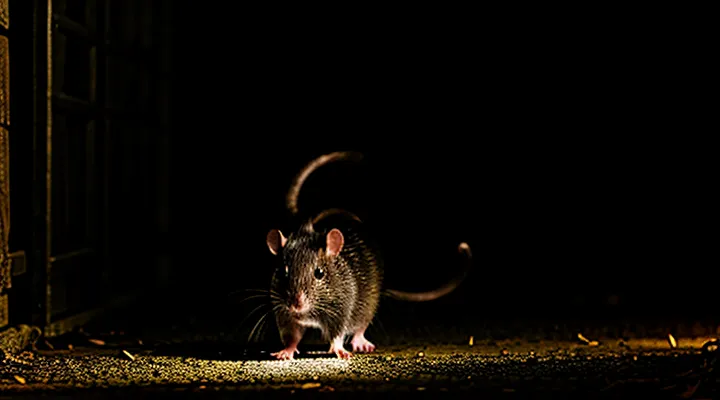
Rodent Eye Anatomy: A Night Vision Primer
Photoreceptors: Rods and Cones
Rats rely on two types of photoreceptor cells to detect light under low‑illumination conditions: rods and cones. Rods dominate the retinal surface, accounting for roughly 95 % of photoreceptors. Their high sensitivity to photons allows detection of single‑photon events, enabling visual function at scotopic light levels. Rods exhibit a slow response time, which sacrifices temporal resolution for heightened sensitivity. Their peak spectral sensitivity lies near 500 nm, matching the wavelength range most prevalent in dim environments.
Cones constitute the remaining photoreceptors and provide color discrimination and high‑acuity vision under photopic illumination. In rats, cone density is low, concentrated in the central retina, and their contribution to vision in darkness is minimal. Cones possess faster response kinetics, enabling rapid adaptation to changes in light intensity but requiring higher photon flux to become active.
Key distinctions:
- Sensitivity – rods: high; cones: low.
- Temporal resolution – rods: slow; cones: fast.
- Spectral range – rods: peak at ~500 nm; cones: multiple peaks corresponding to short‑ and medium‑wavelength opsins.
- Distribution – rods: widespread; cones: central retina.
The predominance of rods, combined with their ability to integrate photon signals over time, explains the rat’s capacity to navigate and locate objects in environments with minimal ambient light.
Tapetum Lucidum: Nature's Reflective Screen
The tapetum lucidum is a thin, multilayered membrane situated behind the retina in many nocturnal mammals. Its cellular architecture consists of densely packed, reflective crystals of guanine or lipids arranged in a regular lattice, which maximizes back‑scattering of incident light toward photoreceptor cells.
Functionally, the tapetum serves as a physiological mirror:
- redirects photons that pass through the photoreceptor layer;
- increases the probability of photon capture on a second pass;
- enhances visual sensitivity under scotopic conditions.
In rats, the presence of this reflective screen augments rod‑mediated vision, allowing detection of objects at luminance levels far below those perceivable by diurnal species. The amplified photon flux compensates for the relatively low density of rods, extending the functional visual field during nighttime activity.
Evolutionary pressure for predation avoidance and foraging in dim environments has driven the refinement of tapetal composition, resulting in a balance between reflectivity and retinal resolution. Excessive scattering is limited by the precise orientation of crystalline layers, preserving image acuity while providing a substantial gain in light availability.
Beyond the Eyes: Sensory Compensation
Whiskers: The Ultimate Tactile Sensors
Rats rely on a dense array of facial vibrissae to acquire spatial information when ambient light is insufficient for visual cues. Each whisker functions as a highly sensitive mechanical probe, converting minute deflections into neural signals that encode object distance, texture, and motion. The follicle‑sac structure contains thousands of mechanoreceptive nerve endings, enabling detection of forces as low as a few micronewtons. Signal transduction occurs within milliseconds, allowing rapid updates of a three‑dimensional representation of the surrounding environment.
Integration of whisker input with limited visual data occurs in the somatosensory cortex, where overlapping maps of tactile and residual photic information generate a coherent perception of obstacles and prey. This multimodal processing enhances navigation efficiency, supports prey capture, and reduces collision risk during nocturnal foraging.
Key features of the vibrissal system include:
- Highly ordered arrangement: rows and columns provide predictable spatial coding.
- Active movement: rhythmic whisking sweeps the sensory field, sampling multiple points per second.
- Adaptive sensitivity: muscle‑controlled tension adjusts receptor responsiveness to varying airflow and texture conditions.
Olfaction: A World of Scents in Darkness
Rats rely on an exceptionally sensitive olfactory apparatus to compensate for limited visual input in low‑light environments. The nasal epithelium contains up to 1 200 functional odorant receptors, a density that exceeds that of most mammals. Each inhalation delivers a complex mixture of volatile compounds to these receptors, generating neural patterns that encode spatial and temporal information about the surroundings.
The olfactory bulb processes these patterns through distinct glomerular clusters, preserving the identity of individual odorants while integrating intensity cues. This organization enables rapid discrimination of food sources, conspecific scent marks, and predator odors, often within a few hundred milliseconds of exposure.
Key functional outcomes of olfactory processing in darkness include:
- Precise localization of food items through gradient tracking of volatile chemicals.
- Detection of alarm pheromones released by stressed conspecifics, prompting immediate avoidance behavior.
- Identification of territorial boundaries via urine and glandular secretions, supporting social hierarchy maintenance.
- Navigation along familiar scent trails, allowing efficient movement through cluttered burrow systems.
Behavioral experiments demonstrate that rats can solve maze tasks using odor cues alone, achieving success rates comparable to visual navigation under illuminated conditions. Lesion studies confirm that removal of the olfactory bulb severely impairs spatial performance, underscoring the system’s centrality to nocturnal orientation.
In summary, the rat’s olfactory network constructs a multidimensional map of the environment, translating chemical signals into actionable spatial representations that sustain survival when visual information is scarce. «The world of scents becomes a reliable guide where darkness prevails».
Auditory Acuity: Echolocation and Beyond
Rats rely on a refined auditory system to navigate environments where visual cues are limited. High‑frequency sound production combined with precise echo analysis compensates for reduced illumination, enabling spatial orientation and object discrimination.
Key characteristics of the acoustic strategy include:
- Emission of ultrasonic pulses ranging from 40 kHz to 80 kHz.
- Reception of returning echoes with temporal resolution below 1 ms.
- Calculation of distance based on echo latency, achieving accuracy within a few centimeters.
- Directional hearing facilitated by pinna orientation and ear canal morphology.
Beyond the basic echo‑tracking mechanism, rats exhibit several advanced auditory functions. They detect broadband rustling sounds generated by moving prey, allowing rapid localization without reliance on a full echo cycle. Frequency‑modulated calls support conspecific communication, conveying information about social status and territorial boundaries. The auditory system also integrates with the somatosensory whisker network, providing multimodal feedback that refines obstacle avoidance.
Neural processing of acoustic information occurs in a specialized auditory cortex region characterized by:
- Dense representation of high‑frequency tones.
- Enhanced synaptic plasticity for rapid adaptation to novel echo patterns.
- Cross‑modal connections linking auditory and tactile pathways, facilitating coherent perception of the surrounding space.
Comparative analysis shows that rat acoustic acuity surpasses that of many other nocturnal rodents, reflecting evolutionary pressure to exploit auditory channels when visual input is unreliable. Understanding these mechanisms informs the design of bio‑inspired sonar technologies and improves pest‑control strategies that target auditory perception.
Evolutionary Adaptations for Low Light
Pupil Dilation and Light Sensitivity
Rats possess a highly adaptable iris that expands the pupil dramatically when ambient illumination drops. Muscular fibers surrounding the pupil relax, allowing the aperture to increase up to five times its daylight size. This enlargement maximizes photon capture, compensating for the low‑light conditions typical of their habitats.
The retina of a rat is dominated by rod photoreceptors, which confer extreme sensitivity to faint light. Rod density reaches approximately 120 million cells per square centimeter, far exceeding that of most diurnal mammals. Spectral responsiveness peaks near 500 nm, aligning with the blue‑green wavelengths prevalent in twilight environments. Consequently, even minimal photon flux triggers neural signaling sufficient for navigation.
Key physiological features supporting nocturnal vision include:
- Rapid pupil dilation controlled by sympathetic innervation
- High rod-to‑cone ratio, enhancing luminance detection
- Elevated expression of rhodopsin, the visual pigment optimized for low‑intensity light
- Retinal circuitry tuned to amplify weak signals while suppressing noise
Collectively, these adaptations enable rats to maintain visual performance in darkness, facilitating foraging, predator avoidance, and social interaction without reliance on external illumination.
Neural Processing of Visual Information
Rats possess a visual system optimized for low‑light environments, allowing detection of objects at illumination levels far below human thresholds. The retina contains a high density of rod photoreceptors, each tuned to maximize photon capture. Rods converge onto bipolar cells that transmit signals to retinal ganglion cells, forming the primary output channel for scotopic vision.
Key neural elements involved in nocturnal visual processing include:
- Rod photoreceptors with elevated sensitivity to photons.
- Bipolar cells that integrate rod inputs and modulate signal strength.
- Retinal ganglion cells, especially those projecting to the suprachiasmatic nucleus and the superior colliculus.
- The lateral geniculate nucleus, relaying information to cortical areas.
- Primary visual cortex (V1) and adjacent extrastriate regions that refine spatial resolution and motion detection.
The axons of ganglion cells travel via the optic nerve to the brainstem, where the superior colliculus coordinates reflexive orienting responses. Parallel pathways reach the lateral geniculate nucleus, preserving temporal contrast essential for detecting moving prey. Within the cortex, neurons exhibit increased receptive‑field size and reduced spatial acuity, reflecting adaptation to sparse photon input while preserving motion sensitivity.
Neurophysiological recordings demonstrate that rat visual cortex maintains firing rates at scotopic luminance comparable to those observed under photopic conditions, indicating compensatory amplification mechanisms. Synaptic plasticity in thalamocortical circuits adjusts gain control, ensuring reliable signal transmission despite fluctuating ambient light.
«Rats retain visual discrimination at scotopic levels» summarizes experimental findings, highlighting the integration of retinal specialization and central processing that sustains functional vision in darkness.
Genetic Predispositions for Nocturnal Life
Rats possess a suite of genetic adaptations that underlie their ability to navigate environments with minimal illumination. These adaptations affect retinal architecture, phototransduction efficiency, and circadian regulation, collectively supporting nocturnal visual performance.
Key genetic elements include:
- «Rho» (rhodopsin) – a rod photopigment with elevated expression levels, extending photon capture capacity.
- «Gnat1» – encodes transducin α‑subunit, accelerating signal amplification in rod cells.
- «Pde6b» – modulates cyclic GMP turnover, fine‑tuning photoreceptor recovery after activation.
- «Mel1a» – melatonin receptor variant that synchronizes retinal sensitivity with night‑time hormonal cues.
- «Clock» and «Bmal1» – core circadian clock genes influencing the timing of rod renewal and outer segment disc shedding.
The combined effect of these loci manifests as an increased rod‑to‑cone ratio, a shift in peak spectral sensitivity toward shorter wavelengths, and heightened retinal pigment epithelium activity that sustains photoreceptor health during prolonged darkness. Comparative analyses reveal that nocturnal rodents exhibit accelerated evolution of these genes relative to diurnal counterparts, indicating strong selective pressure for low‑light vision.
Functional studies demonstrate that targeted disruption of «Rho» or «Gnat1» reduces scotopic acuity, confirming their essential contribution to night vision. Conversely, up‑regulation of «Mel1a» aligns retinal responsiveness with the nocturnal surge of melatonin, optimizing visual processing during the active phase.
Understanding the genetic foundation of rat nocturnality informs broader research on sensory adaptation, provides a model for human night‑vision disorders, and supports the development of bio‑engineered visual systems capable of operating under low‑light conditions.
Comparing Rat Vision to Other Species
Rodents vs. Humans: A Vision Spectrum
Rats possess a visual system optimized for low‑light environments. Their retinas contain a high proportion of rods—up to 90 % of photoreceptors—providing superior scotopic sensitivity. Human retinas balance rods and cones, with cones representing roughly 35 % of photoreceptors, enabling detailed color perception under photopic conditions but limiting performance in dim illumination.
The spectral range of rodent vision extends into the ultraviolet (UV) region, where wavelengths around 350 nm are detectable. Humans lack UV sensitivity due to the presence of a UV‑blocking lens and the absence of UV‑responsive photopigments. Consequently, rats can discriminate stimuli invisible to human observers, an advantage for navigating nocturnal habitats.
Key comparative features:
- Photoreceptor composition: rodents – predominantly rods; humans – mixed rods and cones.
- Peak sensitivity: rodents – ~500 nm (scotopic peak); humans – ~560 nm (photopic peak).
- UV detection: present in rodents; absent in humans.
- Visual acuity: humans – high spatial resolution (≈20/20); rodents – lower acuity (≈20/200).
- Field of view: rodents – wide peripheral vision due to laterally placed eyes; humans – narrower, forward‑focused field.
These differences reflect divergent evolutionary pressures: rodents prioritize motion detection and contrast in darkness, while humans emphasize detailed, color‑rich perception under ample lighting. The resulting vision spectrum positions rodents as specialists in nocturnal visual tasks, whereas humans remain generalists across a broader illumination range.
Predators and Prey: Visual Arms Race
Rats possess a retinal architecture optimized for low‑light environments. High density of rod photoreceptors maximizes photon capture, while a reflective layer behind the retina (the tapetum) redirects unabsorbed light toward photoreceptors, extending visual sensitivity. These features enable detection of movement and contrast at luminance levels far below human thresholds.
Nocturnal predators have evolved complementary visual enhancements that pressure rodent sensory systems. Owls exhibit enlarged eyes with large pupils and a dense rod mosaic, allowing precise localization of prey against starlit backdrops. Cats combine a tapetum lucidum with a high proportion of rods, granting rapid motion detection in near‑darkness. Both groups display superior temporal resolution, reducing motion blur during swift strikes.
The interaction between rodent and predator vision creates a continuous arms race:
- Rodents enhance whisker‑mediated tactile perception to compensate for residual visual gaps.
- Predators refine binocular overlap and focal acuity to improve depth perception during ambushes.
- Evolutionary adjustments in pupil dynamics and retinal pigment density occur reciprocally, balancing sensitivity against susceptibility to glare.
Resulting dynamics shape nocturnal ecosystems: prey species rely on minimal visual cues and heightened non‑visual senses, while predators exploit refined low‑light optics to maintain hunting efficiency. The mutual pressure drives persistent refinement of ocular structures across both groups.
Implications for Pest Control and Research
Understanding Behavior for Effective Management
Rats possess a visual system adapted to low‑light environments, enabling accurate detection of movement and contrast when illumination is minimal. This capability drives foraging activity during nighttime hours and supports navigation across cluttered burrow networks.
In darkness, rats exhibit heightened exploratory behavior, rapid assessment of novel objects, and increased reliance on whisker‑mediated tactile cues. Social interactions intensify near food sources, with scent marking and vocalizations coordinating group movements under limited visibility.
Effective management depends on anticipating these patterns. Strategies that align with nocturnal activity reduce exposure to non‑target species and improve capture rates. Key actions include:
- Deploying traps equipped with low‑intensity infrared emitters to mimic natural lighting conditions.
- Scheduling bait placement during peak foraging periods identified through motion‑sensor monitoring.
- Modifying shelter structures to limit dark refuges, thereby encouraging movement into illuminated zones.
- Applying scent‑disrupting agents that interfere with nocturnal communication pathways.
Understanding rat behavior under minimal illumination informs the design of control programs, enhances resource allocation, and increases the likelihood of sustainable population reduction.
Researching Retinal Diseases and Treatments
Research on rodent visual systems provides a direct pathway to understanding retinal degeneration that impairs low‑light perception. Laboratory rats possess a high proportion of rod photoreceptors, mirroring the physiological basis of scotopic vision in many mammals. Genetic manipulation of these animals generates models of retinitis pigmentosa, age‑related macular degeneration, and other inherited disorders. By monitoring changes in rod density, outer‑segment morphology, and electrophysiological responses under dim illumination, investigators obtain quantitative metrics of disease progression.
Therapeutic strategies evaluated in rat models include gene‑replacement vectors, CRISPR‑mediated genome editing, and pharmacological agents targeting oxidative stress pathways. Delivery of viral constructs to the subretinal space restores phototransduction cascade components, as evidenced by increased a‑wave amplitudes in electroretinograms recorded under scotopic conditions. Small‑molecule antioxidants administered systemically reduce photoreceptor apoptosis, prolonging functional vision in night‑adapted assays.
Behavioral assessments complement physiological measurements. Maze navigation tests performed under low‑light levels quantify visual acuity and contrast sensitivity after treatment. Improvement in escape‑latency times correlates with restored retinal structure observed in histological sections stained for rhodopsin and synaptic markers.
Cross‑species comparison of retinal circuitry highlights conserved mechanisms governing dim‑light detection. Insights derived from rat studies inform the design of clinical interventions aimed at preserving or restoring night vision in patients with retinal disease. Continuous refinement of animal models, combined with advanced imaging and molecular techniques, accelerates translation from bench to bedside.