
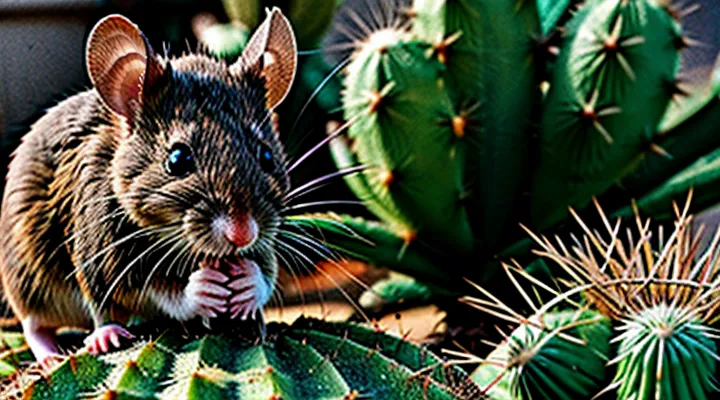
The Desert's Unlikely Feast
Cactus as a Lifeline
Water Source
Mice that rely on cactus as a primary food source obtain water directly from the plant’s succulent tissues. The fleshy stems and pads of cacti contain up to 90 % moisture, which becomes available when the rodent gnaws through the outer layer and ingests the inner pulp. This fluid provides immediate hydration without the need for external water bodies.
Physiological adaptations support efficient use of cactus water. Kidneys concentrate urine to minimize loss, while the digestive system extracts maximal moisture from the plant material. The metabolic breakdown of carbohydrates stored in cactus tissue also generates water as a by‑product, augmenting the intake obtained from direct consumption.
Key mechanisms that supply water to these rodents include:
- Direct ingestion of cactus juice during feeding.
- Production of metabolic water from the oxidation of sugars and lipids derived from the cactus.
- Absorption of atmospheric moisture that condenses on the plant surface during cooler night periods.
- Limited reliance on free‑standing water sources, which are rare in arid habitats.
Nutrient Content
Cactus tissue supplies mice with a unique nutrient profile that compensates for the scarcity of conventional food sources in arid habitats. The edible pads (cladodes) of Opuntia spp. contain up to 90 % water, providing immediate hydration without the need for separate drinking. Carbohydrate concentrations range from 8 % to 12 % of fresh weight, primarily as simple sugars (glucose, fructose) that support rapid energy metabolism.
Key micronutrients include:
- Calcium: 150–250 mg kg⁻¹ fresh tissue, contributing to skeletal maintenance and signaling pathways.
- Potassium: 1 500–2 200 mg kg⁻¹, essential for osmotic regulation and nerve function.
- Magnesium: 30–50 mg kg⁻¹, a cofactor for enzymatic reactions.
- Vitamin C: 25–40 mg kg⁻¹, acting as an antioxidant and enhancing iron absorption.
Fiber content, measured as insoluble cellulose, reaches 20 % of dry mass. The high fiber load slows gastrointestinal transit, allowing prolonged extraction of nutrients and reducing the frequency of foraging trips. Protein levels remain low (1–2 % of fresh weight), but the amino acid profile includes sufficient lysine and methionine to meet minimal growth requirements when combined with occasional insect prey.
Metabolic adaptation enables mice to convert stored mucilage—a polysaccharide matrix rich in arabinose and galactose—into glucose via endogenous enzymes. This conversion supplies a steady glucose supply during periods when external food is unavailable. The combination of water, readily digestible sugars, essential minerals, and protective fiber forms a self‑sufficient dietary package that underpins survival in desert ecosystems.
Evolutionary Adaptations of Mice
Physiological Mechanisms
Efficient Water Extraction
Desert-dwelling mice obtain the majority of their hydration from succulent cactus tissue, bypassing the scarcity of free water sources. Their survival depends on rapid extraction of liquid from the plant’s interior while minimizing loss.
Efficient water extraction relies on coordinated anatomical and physiological traits:
- Sharp incisors create precise perforations, exposing inner mucilage without excessive damage.
- Saliva contains proteolytic enzymes that liquefy mucilage, reducing viscosity and facilitating flow.
- Rapid tongue movements draw liquid into the oral cavity, directing it toward the esophagus within seconds.
- Highly concentrated urine production conserves absorbed water; antidiuretic hormone levels rise immediately after ingestion.
- Feeding bouts concentrate during cooler periods, lowering evaporative loss during intake.
These mechanisms enable mice to transform cactus flesh into a reliable water supply, sustaining metabolic functions and reproductive cycles in arid environments.
Toxin Neutralization
Desert-dwelling mice regularly ingest cactus tissue that contains high concentrations of secondary metabolites such as alkaloids, phenolics, and oxalic acid. These compounds are inherently toxic to most mammals, yet the animals persist by rendering them harmless before systemic exposure.
The neutralization process begins in the oral cavity, where salivary enzymes initiate hydrolysis of labile glycosidic bonds, reducing the potency of phenolic toxins. Once the material reaches the stomach, gastric acidity denatures unstable molecules, while specific peptidases cleave alkaloid precursors into non‑reactive fragments.
In the small intestine, hepatic detoxification pathways dominate. Phase I enzymes (e.g., cytochrome P450 isoforms) oxidize residual toxins, creating functional groups that serve as attachment points for Phase II conjugation. Glutathione‑S‑transferases, UDP‑glucuronosyltransferases, and sulfotransferases attach glutathione, glucuronic acid, or sulfate, respectively, producing water‑soluble conjugates readily eliminated via urine or feces.
A symbiotic gut microbiota further assists the process. Certain bacterial strains express β‑glucosidases and decarboxylases that break down complex phenolics and oxalates, preventing crystal formation and reducing oxidative stress. The microbial community also recycles liberated nutrients, supporting the host’s metabolic demands.
Key components of toxin neutralization in cactus‑eating mice:
- Salivary hydrolytic enzymes that pre‑process phenolic compounds.
- Gastric peptidases that degrade alkaloid precursors.
- Hepatic cytochrome P450 enzymes for oxidative modification.
- Phase II conjugating enzymes (glutathione‑S‑transferase, UDP‑glucuronosyltransferase, sulfotransferase).
- Gut bacteria producing β‑glucosidase and oxalate‑degrading activities.
Genomic analyses reveal up‑regulation of genes encoding the above enzymes in populations that habitually consume cactus. Parallel increases in transporter proteins (e.g., multidrug resistance–associated proteins) facilitate rapid export of conjugated toxins from enterocytes into the bloodstream for renal clearance. This coordinated biochemical network enables the rodents to exploit a resource that is otherwise inaccessible to competitors.
Behavioral Strategies
Foraging Habits
Mice that rely on cactus as a primary food source exhibit specialized foraging patterns that maximize nutrient intake while minimizing exposure to predators and extreme heat. Activity peaks during the cooler twilight hours, when surface temperatures drop below the threshold that would cause rapid dehydration. Individuals locate cactus patches by scent cues and visual landmarks, then assess the plant’s water content before committing to consumption.
Key foraging behaviors include:
- Selecting young pads or newly sprouted phyllodes, which contain higher concentrations of soluble sugars and lower levels of defensive spines.
- Using incisors to carefully remove epidermal layers, exposing the moist inner tissue while avoiding damage to the spines.
- Harvesting pulp and sap by creating shallow incisions, allowing capillary action to draw liquid into the mouth.
- Storing small quantities of cactus moisture in cheek pouches for transport to burrows, reducing the need for repeated exposure.
- Rotating feeding sites within a defined home range to prevent overexploitation of a single cactus, thereby sustaining the plant’s regenerative capacity.
Physiological adaptations support these habits. Renal concentration mechanisms enable the reabsorption of water from cactus sap, while specialized gut flora facilitate the breakdown of mucilage and the detoxification of alkaloids present in the plant tissue. Together, these behavioral and physiological traits constitute an efficient foraging system that sustains mouse populations in arid environments.
Nocturnal Activity
Mice that rely on cactus as a primary food source conduct most of their foraging after sunset. Nighttime activity reduces exposure to diurnal predators and aligns with the opening of cactus stomata, which lowers internal water pressure and makes pulp easier to extract.
During darkness, these rodents exhibit several physiological adjustments. Elevated melatonin levels suppress metabolic heat production, conserving water while the cooler ambient temperature limits evaporative loss. Retina cells contain a high density of rod photoreceptors, enhancing visual sensitivity to low‑light environments and allowing precise navigation among spiny stems.
Behavioral tactics reinforce nocturnal efficiency:
- Mice emerge shortly after dusk, timing excursions to coincide with the brief period when cactus sap is most fluid.
- Individuals travel in small groups, sharing scent trails that mark safe routes and reduce time spent searching for edible tissue.
- Burrow entrances are oriented away from prevailing winds, minimizing moisture loss during the night’s cooler phase.
The nocturnal habit also influences ecosystem dynamics. By feeding at night, mice limit competition with diurnal herbivores and create a temporal niche that supports cactus regeneration. Their seed‑dispersal activities, performed under cover of darkness, contribute to cactus propagation across arid landscapes.
Cactus Defenses and Mouse Counter-Strategies
Physical Barriers
Spines and Glochids
Cactus spines are hardened, lignified structures emerging from areoles. Their sharp geometry deters large herbivores and protects internal tissues from desiccation. Glochids are minute, barbed bristles, also originating from areoles, that easily detach and embed in skin, delivering irritating chemicals such as mucilage and alkaloids.
Mice mitigate these defenses through a series of behavioral and mechanical actions. They preferentially target young pads where spines are shorter and glochids less dense. Teeth are positioned to slice along the spine axis, allowing the animal to break or push spines aside rather than puncture them. After initial bites, mice frequently scrape the cut surface with their forepaws, dislodging loose glochids before swallowing.
Physiological adaptations complement the mechanical tactics. Saliva contains proteolytic enzymes that degrade mucilage, reducing the irritant effect of glochid secretions. The oral mucosa exhibits a thicker keratinized layer, providing resistance to micro‑abrasions. Digestive tract epithelium shows increased turnover, limiting tissue damage from any residual bristles.
The net result of these adaptations is a reliable source of moisture, carbohydrates, and minerals. By overcoming spine and glochid barriers, mice secure a diet that compensates for the arid environments they inhabit.
- Select young, less defended tissue
- Slice spines parallel to their length
- Scrape off glochids before ingestion
- Utilize enzymatic saliva and reinforced mucosa
These coordinated strategies enable rodents to exploit cactus resources that many other species cannot access.
Chemical Defenses
Alkaloids and Oxalates
Cactus tissues contain high concentrations of alkaloids and oxalates, compounds that deter most herbivores. Small rodents that feed on these plants have evolved biochemical strategies to neutralize the toxins while extracting water and nutrients.
Alkaloids interfere with neural transmission. Mice metabolize them primarily through hepatic cytochrome P450 isoforms that oxidize the molecules into less active metabolites. Enhanced expression of these enzymes is documented in populations regularly consuming cactus. Gut microbiota contribute additional detoxification by hydrolyzing alkaloid glycosides before absorption.
Oxalates bind calcium, forming insoluble crystals that can obstruct renal function. Rodents counteract this risk by:
- Increasing urinary acidity, which reduces crystal precipitation.
- Up‑regulating calcium‑binding proteins that sequester free calcium in the bloodstream.
- Hosting oxalate‑degrading bacteria (e.g., Oxalobacter spp.) that convert oxalate to carbon dioxide and formate within the gastrointestinal tract.
These physiological adjustments enable mice to derive caloric value and hydration from cactus spines and pads without succumbing to toxin‑induced pathology. The net energy gain supports reproduction and population stability in arid ecosystems where cactus is a dominant resource.
Mouse Resilience
Oral Adaptations
Mice that feed on cactus have evolved specialized oral structures that enable them to process the plant’s tough, spiny tissues. Their incisors exhibit reinforced enamel and a self‑sharpening edge, allowing repeated gnawing without rapid wear. The jaw musculature is proportionally larger than in granivorous relatives, generating greater bite force to break fibrous pulp.
Key oral adaptations include:
- Hypertrophied masseter muscles that increase occlusal pressure.
- Flattened molar crowns with additional ridges for grinding silica‑rich fibers.
- Highly keratinized palate that protects soft tissue from cactus spines.
- Enhanced salivary glands that secrete mucus rich in mucopolysaccharides, lubricating the mouth and neutralizing mild alkaloids present in cactus sap.
These features collectively permit efficient ingestion of cactus while minimizing damage from spines and chemical defenses, supporting the mouse’s ability to extract moisture and nutrients from an otherwise hostile food source.
Digestive Enzymes
Mice that consume desert cactus rely on a specialized set of digestive enzymes to break down the plant’s fibrous tissue and defensive chemicals. Their pancreatic secretions contain elevated levels of cellulase, an enzyme that hydrolyzes β‑1,4‑glycosidic bonds in cellulose, allowing extraction of glucose from the thickened cell walls. Pectinase activity degrades the pectin matrix that cements plant cells, facilitating access to intracellular nutrients. Proteases such as trypsin and chymotrypsin remain active despite the presence of cactus-derived protease inhibitors, ensuring protein digestion from the cactus’s tender inner layers.
The small intestine of these rodents exhibits increased expression of brush‑border enzymes. Lactase and sucrase process the limited sugars present in cactus mucilage, while alkaline phosphatase assists in mineral absorption from the alkaline-rich tissue. A microbiota enriched with Bacillus and Clostridium species contributes additional cellulolytic and xylanolytic enzymes, extending the host’s capacity to ferment otherwise indigestible polysaccharides into short‑chain fatty acids.
Key enzymes involved in cactus digestion:
- Cellulase – hydrolyzes cellulose to glucose units.
- Pectinase – cleaves pectin, releasing galacturonic acid.
- Xylanase – degrades hemicellulose components.
- Proteases (trypsin, chymotrypsin) – digest cactus proteins.
- Amylase – converts limited starches to maltose.
- Lipase – emulsifies cactus lipids for absorption.
Adaptation includes up‑regulation of these enzymes at the transcriptional level and a symbiotic gut community that supplies complementary catalytic activities. The combined enzymatic arsenal enables mice to extract sufficient energy, water, and minerals from a diet dominated by spiny, water‑rich cactus tissue.
Ecological Impact
Predator-Prey Dynamics
Food Chain Role
Mice that consume cactus occupy a distinct position in arid‑zone food webs. By ingesting succulent pads, they acquire water and nutrients otherwise scarce in desert environments, allowing them to maintain metabolic activity and reproduce. Their herbivorous behavior transfers plant biomass to higher trophic levels, providing a reliable energy source for insectivorous and small‑carnivore predators such as owls, foxes, and rattlesnakes.
- Primary consumption: cactus tissue supplies carbohydrates, fibers, and moisture, supporting mouse survival during prolonged droughts.
- Secondary transfer: mouse carcasses and feces introduce organic matter into the soil, enhancing microbial activity and nutrient recycling.
- Predator support: stable mouse populations sustain predator reproduction and reduce reliance on less predictable prey.
The interaction also influences cactus populations. Selective feeding on younger pads can stimulate growth of older stems, while occasional damage limits over‑expansion, contributing to plant community balance. Overall, mouse cactus consumption links primary producers to secondary consumers, reinforces energy flow, and facilitates ecosystem resilience in desert habitats.
Seed Dispersal
Mutualistic Relationship
Mice that feed on desert cactus have developed a mutualistic partnership with the plant. The rodents obtain water and carbohydrates from the fleshy tissue, while their chewing activity removes dead or diseased sections, promoting new growth. Saliva introduced during feeding contains enzymes that break down tough cellulose, facilitating the cactus’s internal repair mechanisms.
The relationship yields measurable advantages for both parties:
- Mice receive a reliable source of hydration during prolonged droughts, reducing mortality rates.
- Cactus experiences reduced fungal colonization because damaged tissue is promptly cleared, enhancing overall vigor.
- Nutrient cycling improves as mouse excrement deposits nitrogen-rich waste near the plant’s root zone, supporting soil fertility.
Long‑term observations indicate that populations of these desert rodents remain stable in regions where cactus species with edible pads are abundant, confirming the ecological interdependence of the two organisms.