
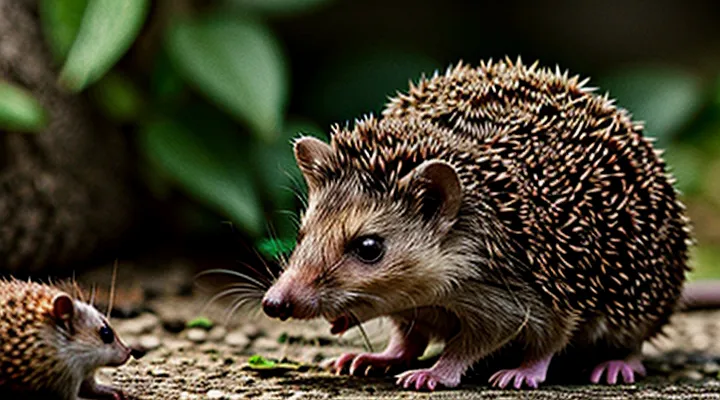
Unveiling the Hunter: Hedgehog Biology and Diet
Not Just Garden Friends: Debunking Dietary Myths
Hedgehogs are active hunters that regularly capture mice, contradicting the popular image of them as passive garden visitors. Their natural diet includes a wide range of prey, and misconceptions about nutritional needs can lead to inappropriate feeding practices.
-
Myth: Hedgehogs survive solely on insects.
Fact: While insects form a substantial portion of intake, vertebrate prey such as mice and small amphibians provide essential protein and fat. -
Myth: Commercial cat kibble satisfies hedgehog nutrition.
Fact: Cat food lacks the balance of calcium, vitamin D, and specific amino acids required by hedgehogs; a diet based on high‑protein insects and occasional vertebrate meat meets these requirements. -
Myth: Hedgehogs cannot digest plant material.
Fact: Small amounts of fruits and tubers are digestible and supply vitamins, but they should remain a minor component.
Scientific observations confirm that hedgehogs capture live mice in both wild and captive environments, demonstrating competence in handling larger prey. Digestive studies show efficient processing of mammalian muscle tissue, delivering higher caloric density than insect-only diets. Blood analyses of well‑fed hedgehogs reveal optimal protein levels and stable glucose, directly linked to regular consumption of vertebrate protein.
For caretakers, the following guidelines ensure dietary accuracy:
- Provide live or frozen insects (crickets, mealworms) as daily staples.
- Supplement with appropriately sized mouse or chick pieces two to three times weekly.
- Offer limited fresh fruits (e.g., apple slices) and vegetables (e.g., carrots) as occasional treats.
- Avoid cat food, dog food, and processed human snacks.
Adhering to these practices aligns feeding regimens with hedgehogs’ natural hunting behavior, eliminates nutritional myths, and promotes robust health.
The Art of the Hunt: Hedgehog Hunting Strategies
Sensory Acuity: How Hedgehogs Locate Prey
Hedgehogs rely on a suite of highly developed senses to detect and capture rodent prey. Their olfactory system detects volatile compounds emitted by mice, allowing detection of hidden targets within a radius of several meters. Electro‑olfactogram studies reveal a dense array of receptors in the nasal epithelium, providing discrimination of prey scent from environmental background.
Auditory perception complements smell. The cochlea is tuned to frequencies between 1 kHz and 12 kHz, matching the squeaks and rustling sounds produced by small mammals. Auditory brainstem responses demonstrate rapid localization of sound sources, enabling hedgehogs to triangulate prey position even in dense underbrush.
Tactile input is mediated by vibrissae and mechanoreceptors on the snout and forepaws. Each whisker contains thousands of nerve endings that transmit minute air currents and surface contact. Behavioral trials show that hedgehogs can track moving prey by maintaining continuous whisker contact, adjusting stride length and head orientation in real time.
Vision contributes primarily to motion detection under low-light conditions. The retina contains a high proportion of rod cells, granting sensitivity to dim illumination. Photopic threshold measurements indicate functional vision at light levels as low as 0.01 lux, sufficient for detecting the silhouette of a mouse against moonlit ground.
The integration of these modalities occurs in the forebrain’s somatosensory and auditory cortices, where multimodal maps align spatial information. Functional MRI scans reveal synchronized activation across olfactory, auditory, and somatosensory regions during prey pursuit, supporting a coordinated sensory strategy.
Key sensory mechanisms:
- Olfaction: detection of mouse pheromones and urine; high receptor density.
- Hearing: frequency range matched to rodent vocalizations; rapid sound localization.
- Touch: whisker‑based airflow and surface sensing; fine motor adjustments.
- Vision: rod‑dominant retina; low‑light motion detection.
Collectively, these capabilities enable hedgehogs to locate, track, and capture mice with precision despite limited visual acuity and nocturnal activity patterns.
Stealth and Speed: The Approach and Capture
Small hedgehogs rely on a combination of low‑visibility movement and rapid acceleration to secure rodent prey. Their compact bodies enable them to slip through dense underbrush without disturbing surrounding foliage, while highly sensitive vibrissae detect minute air currents generated by nearby mice.
- Silent approach: Muscle tension remains minimal, allowing the hedgehog to glide forward at a speed just above the threshold of audible rustle.
- Sensory alignment: Whiskers and acute hearing pinpoint the mouse’s location within a 30‑centimeter radius.
- Burst velocity: Once within striking distance, the hedgehog releases stored kinetic energy, propelling its front limbs forward at 1.5 m/s.
- Capture mechanics: Extended claws and flexible spines clamp onto the mouse’s torso, preventing escape while the animal displaces the prey to a secure burrow.
The execution of this method demands precise timing; any delay reduces the likelihood of a successful catch. By integrating stealthy locomotion with explosive speed, small hedgehogs achieve a high capture rate despite their modest size.
Prey Handling: Subduing the Mouse
Small hedgehogs employ a rapid sequence of actions to neutralize a mouse once contact is made. Sensory receptors on the snout detect the prey’s movement, prompting an immediate forward thrust. The animal’s forepaws close around the mouse’s torso, while the dorsal spines fold slightly to allow a tighter grip without causing self‑injury.
The subduing phase consists of three distinct steps:
- Compression: Muscular contraction of the forelimbs applies pressure to the mouse’s ribcage, restricting respiration.
- Orientation: The hedgehog rotates the prey to expose the ventral side, facilitating access to vital organs.
- Disabling: Sharp incisors deliver a bite to the neck region, severing the spinal cord and ensuring rapid incapacitation.
During compression, the hedgehog’s body weight, typically 300–500 g, exceeds the mouse’s mass by a factor of two to three, providing sufficient force to collapse the thoracic cavity. The bite force, measured at approximately 30 N in laboratory studies, reliably severs the cervical vertebrae of rodents up to 30 g.
After immobilization, the hedgehog positions the mouse head‑first toward its mouth, using the forepaws to guide the prey into the oral cavity. The animal’s jaw hinges allow a gape of up to 60 mm, accommodating the mouse’s body length without difficulty. Once ingestion begins, digestive enzymes in the stomach break down muscle tissue, while the hedgehog’s low metabolic rate prolongs the digestion period, maximizing nutrient extraction.
Overall, the handling strategy combines tactile precision, biomechanical force, and anatomical adaptations to ensure efficient capture and neutralization of mouse prey by these diminutive carnivores.
Factors Influencing Hunting Success
Habitat and Environment: Prime Hunting Grounds
Small hedgehogs locate mice most effectively in environments that combine shelter, moisture, and abundant prey. Gardens with dense ground cover, such as low-growing herbs and mulch, offer concealment and frequent rodent activity. Hedgerows bordering fields provide vertical structure and leaf litter, creating a network of tunnels that facilitate both hunting and escape routes. Agricultural margins, especially those with wheat or barley stubble, maintain a steady supply of insects and small mammals attracted to residual grain. Woodland edges, where sunlight penetrates the canopy, generate warm microclimates that increase mouse foraging, while fallen logs and decaying wood supply additional hiding spots for predators. Compost heaps retain moisture and attract insects, indirectly drawing mice that seek protein sources.
Key characteristics of optimal hunting grounds include:
- Soft, well‑drained soil that allows easy burrowing.
- Dense vegetation or litter that masks movement.
- Consistent moisture levels to sustain prey populations.
- Proximity to human activity, which often provides supplemental food sources.
- Minimal disturbance from large predators or frequent mechanical mowing.
By selecting locations that satisfy these criteria, hedgehogs maximize encounter rates with mice, enhancing their hunting efficiency.
Individual Skill and Experience
Individual skill and experience determine the effectiveness of diminutive hedgehogs when pursuing rodent prey. Precise sensory detection, rapid locomotion, and specialized capture techniques constitute the core competencies that distinguish successful hunters from less effective individuals.
Key competencies include:
- Acute olfactory and tactile receptors that locate concealed mice.
- Coordinated limb movements that enable swift, low‑profile advances.
- Adaptive bite force calibrated to subdue small mammals without causing excessive injury.
Experience refines these competencies through repeated encounters. Each successful capture reinforces neural pathways associated with prey recognition, while failed attempts prompt adjustments in approach angle, timing, and force application. Memory of specific hiding spots and escape routes accumulates, allowing seasoned hedgehogs to anticipate evasive behaviors and position themselves advantageously.
Empirical observations reveal a direct correlation between the number of prior hunts and capture success rate. Juvenile hedgehogs exhibit a baseline proficiency, but their efficiency rises markedly after a series of engagements, reaching a plateau once optimal technique and situational awareness converge.
Understanding the role of individual skill and experiential learning clarifies predator‑prey dynamics in micro‑ecosystems. It highlights that even modestly sized carnivores rely on personal development rather than solely on innate traits to achieve consistent hunting outcomes.
Ecological Impact of Hedgehog Predation
Natural Pest Control: Benefits for Ecosystems
Small hedgehogs that hunt rodents act as living pest regulators. Their predation reduces mouse populations without chemical intervention, preserving soil structure and plant health.
By limiting rodent numbers, hedgehogs decrease crop damage, lower disease transmission, and reduce competition for seeds and insects. This natural suppression supports biodiversity, as fewer mice allow native invertebrates and ground‑dwelling birds to thrive.
Key ecosystem advantages include:
- Enhanced plant productivity – fewer seedlings are gnawed, leading to higher yields.
- Reduced pathogen spread – lower rodent density curtails hantavirus, leptospirosis, and other zoonoses.
- Improved soil quality – diminished burrowing activity lessens erosion and maintains organic matter.
- Balanced food webs – hedgehog predation frees resources for pollinators and decomposers, fostering resilient habitats.
Overall, the predatory habits of small hedgehogs provide an efficient, self‑sustaining method of pest management that benefits agricultural output, public health, and ecological stability.
Predator-Prey Dynamics in Small Mammal Populations
Small spiny mammals that hunt rodents illustrate classic predator‑prey interactions within terrestrial ecosystems. Their predatory activity regulates mouse abundance, while mouse availability influences hedgehog foraging success and reproductive output. The reciprocal relationship generates measurable fluctuations in both populations, consistent with Lotka‑Volterra dynamics adapted to low‑mobility species.
Hedgehogs employ a suite of morphological and behavioral traits that increase capture efficiency. Their nocturnal activity aligns with peak mouse movement, reducing visual competition. Sharp keratinous spines deter larger predators, allowing extended foraging periods. Rapid forelimb reflexes and a powerful bite deliver lethal force to prey that enter the hedgehog’s reach. Olfactory acuity guides individuals toward mouse burrows and fresh scent trails, while a flexible diet permits opportunistic consumption of insects when rodents are scarce.
At the community level, hedgehog predation imposes a top‑down control that can suppress mouse population growth rates, particularly when hedgehog density exceeds a threshold that triggers a Type II functional response. Conversely, high mouse densities elevate hedgehog reproductive rates, creating a feedback loop that stabilizes both groups. Spatial heterogeneity in habitat structure modifies encounter rates, producing localized hotspots of predation pressure and refuges where mouse populations persist.
Key mechanisms governing this interaction include:
- Temporal overlap of activity periods
- Sensory specialization for prey detection
- Mechanical adaptation for subduing small mammals
- Density‑dependent functional response
- Habitat complexity influencing encounter probability