
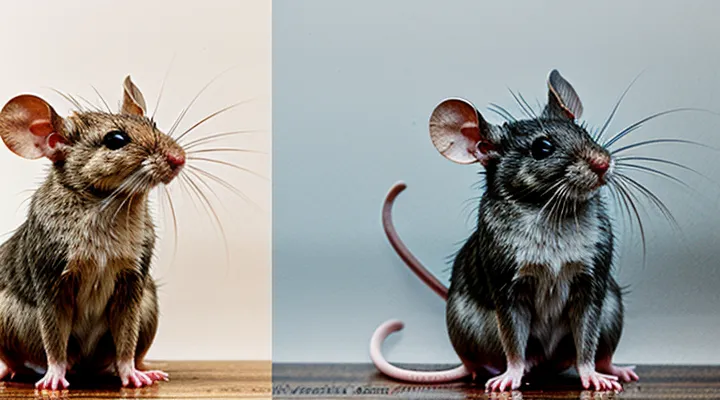
Understanding the Differences: Mouse vs. Rat
Size and Body Proportions
Head and Snout Shape
Mice possess a compact head with a relatively short, triangular snout that tapers sharply toward the tip. The nasal bones are narrow, and the palate appears flat, giving the face a sleek profile. In contrast, rats display a broader skull and a longer, more cylindrical snout that elongates noticeably from the eyes to the nose. The rat’s nasal region is wider, and the palate shows a slight curvature, creating a sturdier appearance.
- Snout length: mouse ≈ 0.8 cm; rat ≈ 1.5 cm.
- Snout width: mouse ≈ 0.4 cm; rat ≈ 0.7 cm.
- Head shape: mouse – rounded, low-profile; rat – broader, higher dome.
These dimensional differences are evident in side‑view photographs, where the mouse’s head appears streamlined, while the rat’s head presents a more robust, elongated silhouette.
Ear Size and Placement
Mice possess relatively large, triangular ears that extend laterally from the skull, occupying roughly 30 % of head width. The pinna is thin, lightly furred, and positioned high on the head, allowing a broad field of sound capture. In contrast, rats exhibit smaller, rounded ears that cover about 20 % of head width. Their pinnae sit lower on the skull and are covered by denser fur, providing a more compact auditory profile.
Key visual distinctions:
- Proportion: Mouse ears appear proportionally larger than rat ears relative to overall body size.
- Shape: Mouse ears are sharply angled; rat ears are rounded and blunt.
- Position: Mouse ears sit higher and more outward; rat ears are situated lower and closer to the midline.
These anatomical differences affect acoustic sensitivity and habitat adaptation, which become evident when comparing side‑by‑side photographs of the two species.
Tail Length and Thickness
Tail morphology provides a clear visual cue for distinguishing mice from rats in photographic comparisons. The mouse tail is proportionally longer relative to its body, while the rat tail is shorter but noticeably thicker.
Typical measurements (adult specimens, laboratory strains) are:
- Mouse: tail length 70–100 mm; tail length ≈ 1.5 × head‑body length; diameter 2–3 mm.
- Rat: tail length 150–250 mm; tail length ≈ 0.9 × head‑body length; diameter 5–7 mm.
Thickness differences are evident in cross‑sectional appearance. Mouse tails display a slender, almost cylindrical profile with minimal musculature, whereas rat tails show a robust, slightly flattened shape with a more pronounced vertebral column and surrounding musculature.
These dimensional contrasts appear consistently across high‑resolution images, allowing reliable species identification based solely on tail characteristics.
Fur and Coat Characteristics
Color Variations
The side‑by‑side images expose clear pigmentation differences that aid species identification. Mice typically display a limited palette, while rats present a broader spectrum.
-
Mouse coloration:
- Standard laboratory strain – uniform light gray to white fur, minimal melanin.
- Wild‑type – brownish‑gray dorsal coat, lighter ventral side, occasional speckling.
- Albino – pure white hair, pink nose and ears, red eyes.
-
Rat coloration:
- Common laboratory strain – solid white or light gray, often with a pink nose.
- Brown rat – dark brown to black dorsal fur, lighter belly; may show a distinct mask around eyes.
- Agouti – mixed brown and black banding on individual hairs, giving a salt‑and‑pepper appearance.
- Satin – glossy black or deep brown coat with a metallic sheen.
- Hooded – black dorsal region with a white or cream ventral strip extending from the throat to the tail.
Lighting conditions influence perceived hue. Direct illumination can accentuate contrast, whereas diffused light softens color boundaries and may obscure subtle markings. Background selection matters; neutral gray backdrops prevent color bleed and preserve true fur tones.
When evaluating photographs, focus on the dorsal‑ventral contrast, the presence of agouti banding, and the intensity of melanin. These attributes consistently differentiate mouse fur from rat fur across varied photographic settings.
Texture and Sheen
The visual comparison of mouse and rat photographs highlights distinct surface qualities that aid identification. Texture refers to the visible pattern of fur, while sheen describes the light‑reflective finish of the coat.
Mouse fur appears fine, densely packed, and uniformly short. Individual hairs create a soft, matte surface that diffuses light, resulting in minimal gloss. The coat often shows a subtle, even coloration without noticeable highlights.
Rat fur is coarser, with longer guard hairs interspersed among shorter underfur. This arrangement produces a slightly rough texture that catches light on the longer strands, generating a modest sheen. The coat may display faint specular reflections, especially on the dorsal region.
Key differences:
- Fiber length: mouse – short; rat – mixed short and longer guard hairs.
- Surface appearance: mouse – matte, low reflectivity; rat – semi‑glossy, higher reflectivity.
- Fur density: mouse – uniformly dense; rat – variable density with visible longer hairs.
Recognizing these textural and reflective characteristics in photographic material enables reliable differentiation between the two rodents.
Key Visual Distinctions in Photographs
Head-on View Comparison
Eye Size and Placement
The visual comparison of mouse and rat highlights distinct differences in ocular dimensions and positioning. In mice, the eyes occupy roughly 15 % of head length, situated laterally on the skull roof. The rat’s eyes are larger, representing about 20 % of head length, and are positioned slightly more ventrally, giving a broader field of view.
Key observations:
- Relative size: Rat eyes exceed mouse eyes by approximately 30 % in diameter.
- Inter‑orbital distance: Mice display a narrower spacing between eyes, enhancing binocular overlap; rats have a wider separation, reducing overlap but increasing peripheral coverage.
- Placement relative to snout: Both species place eyes near the anterior margin, yet the rat’s eyes sit marginally lower, aligning with its longer snout.
These measurements, derived from side‑by‑side photographs, provide a reliable reference for distinguishing the two rodents based on ocular characteristics alone.
Whisker Patterns
The visual comparison of mouse and rat whisker patterns reveals distinct morphological features that aid species identification. Mouse whiskers are generally shorter, with a uniform diameter along the shaft, and arrange in tight, symmetrical rows extending forward from the snout. Rat whiskers are longer, display a gradual taper toward the tip, and form broader, more spaced-out rows that curve slightly outward.
Key differences observable in photographs:
- Length: mouse whiskers average 10–15 mm; rat whiskers exceed 20 mm.
- Thickness: mouse shafts maintain consistent thickness; rat shafts thin progressively.
- Arrangement: mouse rows are tightly packed and parallel; rat rows are wider apart and exhibit a gentle outward angle.
- Sensory specialization: mouse whiskers concentrate on tactile precision for navigating confined spaces; rat whiskers prioritize broader detection of obstacles in open environments.
These characteristics provide reliable visual cues for distinguishing the two rodents in comparative imaging.
Side Profile Analysis
Back Arch and Body Shape
The visual comparison of mouse and rat specimens highlights distinct differences in dorsal curvature and overall silhouette. In mice, the spine exhibits a modest, gently rounded arch that supports a compact, streamlined torso. Rats display a more pronounced lumbar curve, creating a longer, slightly elevated back that contributes to a bulkier torso profile.
Key morphological contrasts:
-
Back arch:
- Mouse – subtle, low‑angle curvature; minimal elevation above the horizontal plane.
- Rat – pronounced, high‑angle curvature; noticeable lift in the lumbar region.
-
Body shape:
Photographic evidence confirms that the mouse’s reduced arch aligns with its agile, rapid movements, while the rat’s stronger curvature supports greater muscular development and increased load‑bearing capacity. These structural variations are consistent across multiple imaging angles, providing reliable criteria for species identification based solely on dorsal profile and body outline.
Foot and Paw Structure
The foot of a mouse consists of five toes on each fore‑ and hind‑limb. Each digit ends in a claw that curves sharply upward. The distal phalanges are slender, with a well‑developed terminal pad (the digital pad) that provides traction on smooth surfaces. The plantar surface includes a central metatarsal pad and lateral plantar pads that spread the animal’s weight evenly. Musculature is dominated by the flexor digitorum brevis and extensor digitorum longus, allowing rapid flexion and extension during climbing.
A rat’s foot shares the five‑digit arrangement but exhibits several distinct features. The claws are broader and less sharply curved, facilitating burrowing in loose substrate. The digital pads are larger, providing increased surface area for weight distribution. Additionally, rats possess a prominent heel pad (calcaneal pad) absent in mice, which aids in stability when navigating uneven terrain. The flexor and extensor muscle groups are proportionally larger, supporting stronger grip strength.
Key comparative points:
- Toe length: mouse digits are proportionally longer relative to body size; rat digits are shorter but more robust.
- Claw shape: mouse claws are acute; rat claws are blunted.
- Pad configuration: mouse has a central metatarsal pad with smaller lateral pads; rat adds a substantial calcaneal pad and expanded lateral pads.
- Musculature: rat foot muscles are bulkier, delivering greater force; mouse muscles are finer, favoring agility.
These anatomical differences reflect adaptations to distinct ecological niches: mice prioritize speed and climbing, while rats emphasize digging and load‑bearing stability.
Distinguishing Juveniles
Young Mouse vs. Young Rat
Young mouse and young rat exhibit distinct visual characteristics that facilitate reliable identification in photographic comparisons. Both species belong to the order Rodentia, yet their external morphology diverges in measurable ways.
Size differences are immediately apparent. A young mouse typically measures 5–8 cm in head‑body length, whereas a young rat ranges from 10–15 cm. Corresponding weight ranges are 10–25 g for mice and 30–100 g for rats. These dimensions affect the proportion of the head to the body, with mice displaying a relatively larger head.
Fur coloration provides additional cues. Young mice often possess soft, gray‑brown dorsal fur and a lighter ventral surface. Young rats commonly exhibit coarse, reddish‑brown or black dorsal fur with a paler underside. The texture of the fur is finer in mice, creating a smoother appearance in close‑up images.
Tail morphology distinguishes the two species further. Mouse tails are slender, approximately equal in length to the body, and lack prominent scales. Rat tails are thicker, frequently exceeding body length, and display visible scaly rings. In photographs, the rat tail appears more robust and may show slight curvature.
Facial features differ as follows:
- Ear size: mice have proportionally larger ears relative to head width; rats have smaller, more tucked ears.
- Snout length: mouse snouts are short and rounded; rat snouts are longer and more pointed.
- Whisker arrangement: mouse whiskers are densely packed and shorter; rat whiskers are longer and spaced farther apart.
When evaluating comparative images, attention to these parameters—size, fur texture, tail structure, and facial traits—enables accurate differentiation between juvenile mouse and rat specimens.
Growth Stages and Appearance
The visual comparison highlights distinct developmental phases of laboratory mouse and rat, emphasizing size, fur texture, and cranial features at each stage.
-
Neonate (0–5 days)
Mouse: body length 1–1.5 cm, hairless, pink skin, eyes closed, ears rudimentary.
Rat: body length 2–2.5 cm, sparse silky fur, pink skin, eyes closed, ears barely visible. -
Pre‑weaning (5–21 days)
Mouse: fur appears on back, eyes open around day 12, ears enlarge, weight reaches 5–10 g.
Rat: fur becomes denser, eyes open by day 14, ears more prominent, weight reaches 20–30 g. -
Weaning (21–28 days)
Mouse: full coat of fine hair, tail length exceeds body length, adult ear shape, weight 15–20 g.
Rat: coat thickens, tail length comparable to body, adult ear morphology, weight 80–120 g. -
Juvenile (1–2 months)
Mouse: body growth continues, coat color stabilizes, tail slender, weight up to 30 g.
Rat: body elongates, coat pattern solidifies, tail robust, weight up to 250 g. -
Adult (≥2 months)
Mouse: mature size 7–10 cm, coat uniform, tail proportionate, weight 25–45 g.
Rat: mature size 20–25 cm, coat dense, tail thick, weight 250–350 g.
The side‑by‑side photographs illustrate these metrics, enabling rapid identification of species and age based on visual cues alone.
Behavioral Cues in Images
Posture and Movement
How They Sit and Stand
Mice and rats display distinct postures when photographed in seated or standing positions, allowing clear visual differentiation. In a seated posture, mice often curl their bodies tightly, with hind limbs tucked beneath the torso and forepaws positioned close to the head. Their tails usually rest flat against the surface, providing stability. Rats, by contrast, sit with a more extended torso; hind limbs remain visible beneath the body, and forepaws may extend forward. Their tails often arch upward, creating a recognizable silhouette.
When standing, mice adopt a compact stance. Front paws bear most of the weight, while the hind limbs remain relatively straight and positioned close to the body. The tail typically extends straight behind, aligned with the spine. Rats exhibit a broader stance; both fore and hind limbs spread outward to support a larger body mass. The tail frequently lifts slightly, contributing to balance.
Key visual cues for identification:
- Body curvature: tight curl (mouse) vs. extended torso (rat)
- Limb visibility: hind limbs hidden (mouse) vs. visible (rat)
- Tail orientation: flat against surface (mouse) vs. arched or lifted (rat)
- Overall silhouette: compact (mouse) vs. broader (rat)
These characteristics enable reliable comparison of mouse and rat photographs without reliance on textual description.
Typical Locomotion
Mice and rats move on four limbs with a rapid, alternating gait that is captured in side‑view photographs. The images reveal a low‑to‑ground posture, short stride length, and frequent foot‑placement adjustments that enable swift navigation through narrow openings.
Typical mouse locomotion features a rapid trot with a frequency of 8–12 steps per second. The fore‑ and hind‑limbs move nearly synchronously, producing a “scissor‑like” motion that minimizes vertical oscillation. Tail movements counterbalance torso rotation, allowing precise maneuvering on uneven surfaces.
Typical rat locomotion displays a slightly longer stride and a lower step frequency, around 6–9 steps per second. Hind‑limb propulsion is stronger, generating higher ground reaction forces that support faster bursts of speed. The tail is held more rigidly, providing additional stability during rapid turns.
Key comparative points:
- Stride length: mouse < rat
- Step frequency: mouse > rat
- Propulsive force: rat > mouse
- Tail function: mouse = dynamic counterbalance; rat = stabilizing brace
The visual guide emphasizes these distinctions, allowing direct observation of gait mechanics and facilitating accurate species identification based on locomotor patterns.
Nesting and Habitat Evidence
Materials Used
The visual comparison of mouse and rat relies on a defined set of materials that guarantee consistent image quality and accurate anatomical representation.
- Digital SLR or mirrorless camera with high-resolution sensor (minimum 24 MP)
- Macro lens (e.g., 100 mm f/2.8) or close‑up adapter for detailed capture
- Adjustable LED ring light or softbox diffuser to provide even illumination and reduce shadows
- Neutral gray or matte black backdrop to eliminate background interference
- Customized specimen holders or stereoscopic platforms that maintain standardized orientation and posture
- Calibrated scale bar or ruler placed within each frame for precise measurement reference
- Image‑processing software (e.g., Adobe Photoshop, Lightroom) for RAW conversion, color correction, and cropping
- Secure external SSD or RAID storage system for archiving high‑resolution files without compression.
Location Indicators
Location indicators are essential for interpreting side‑by‑side photographs of mice and rats. They provide precise references that allow viewers to identify anatomical regions, compare proportions, and assess experimental conditions.
Typical indicators include:
- Scale bars placed in the lower corner of each image, calibrated in millimeters, to convey absolute size differences.
- Colored arrows or lines that point to specific structures such as the whisker pad, tail base, or ear pinna.
- Letter or number tags positioned near landmarks (e.g., “A” for the dorsal cranial region, “B” for the ventral abdomen) to facilitate cross‑reference between the two species.
- Grid overlays with defined spacing, useful for evaluating spatial distribution of markings or lesions.
When a photograph contains multiple indicators, consistency is crucial. Use the same color scheme, line thickness, and labeling convention across all images to avoid confusion. Place legends adjacent to the visual content, ensuring that each symbol is described succinctly.
In comparative analysis, the relative placement of indicators enables direct measurement of morphological variations. For instance, aligning the tip of the mouse’s snout with the corresponding rat marker permits accurate calculation of head length ratios. Similarly, aligning scale bars before measuring organ dimensions eliminates scaling errors.
By adhering to standardized location markers, researchers ensure that visual documentation remains reproducible, comparable, and readily interpretable across studies.