
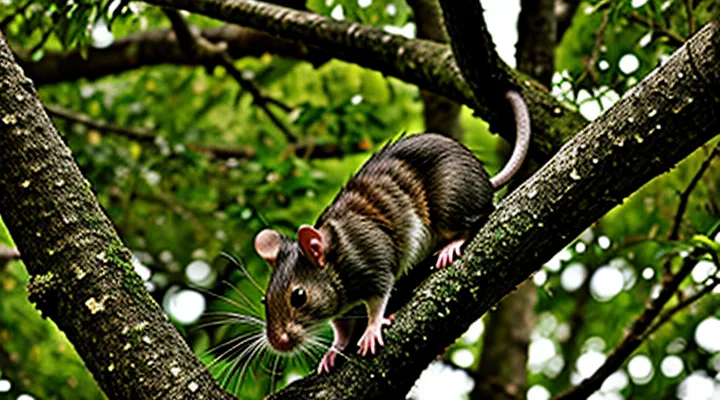
The Amazing Agility of Rats
Physical Adaptations for Climbing
Paws and Claws: Nature's Grippers
Rats possess specialized forepaws equipped with flexible digits, sharp ungual tips, and dense plantar pads. These structures provide a combination of traction and tactile feedback that supports rapid movements on varied substrates.
Key anatomical features contributing to arboreal ability include:
- Curved claws that penetrate bark and bark crevices;
- Muscular forelimbs capable of generating grip forces comparable to those of small mammals known for climbing;
- Highly sensitive vibrissae that detect surface irregularities and guide limb placement.
Observational data confirm that several rat species regularly ascend vertical surfaces such as tree trunks, fence posts, and utility poles. Field studies report successful climbs of heights exceeding three meters, with individuals employing alternating hand‑over‑hand motions and occasional tail assistance for balance. Laboratory experiments measuring grip strength demonstrate sufficient force to overcome the shear resistance of bark textures common in temperate forests.
The combination of morphological adaptations and demonstrated climbing performance indicates that rats are capable of navigating arboreal environments. This competency expands their ecological niche, allowing access to food resources, shelter, and escape routes unavailable to strictly terrestrial rodents.
Tails: Balancing Act and Prehensile Capabilities
Rats possess a relatively long, muscular tail that serves two primary functions during arboreal excursions: equilibrium maintenance and limited grasping. The vertebral column of the tail contains numerous caudal vertebrae, each equipped with interlocking processes that provide rigidity while allowing subtle curvature. This structure enables rapid adjustments of the tail’s position, counterbalancing shifts in the body’s centre of gravity as the animal navigates branches of varying diameter.
Key aspects of tail performance include:
- Dynamic balance – proprioceptive feedback from spinal nerves informs precise tail movements, stabilising the rat while it climbs or leaps.
- Prehensile aid – the distal portion of the tail exhibits enhanced flexibility and a modest degree of tactile sensitivity, allowing it to wrap loosely around slender supports and increase friction.
- Force distribution – muscular contraction along the ventral and dorsal musculature transfers load away from the forelimbs, reducing the risk of slip on inclined surfaces.
Although the tail contributes significantly to climbing efficiency, it does not function as a fully prehensile organ comparable to that of primates or opossums. The limited grasping capability assists primarily in maintaining contact with narrow substrates, while the dominant role remains the provision of balance. Consequently, rats can ascend modest-sized trees and shrubbery, leveraging tail‑mediated stability and supplemental grip, but their ascent is confined to structures that accommodate their body size and tail length.
Body Structure: Flexibility and Strength
Rats possess a musculoskeletal system that enables vertical locomotion on woody substrates. The vertebral column consists of numerous small, overlapping vertebrae, granting a high degree of spinal flexion. Intervertebral joints allow the torso to elongate and contract rapidly, facilitating the reach required to grasp bark and branches.
Forelimb anatomy contributes directly to climbing performance. Muscles such as the brachioradialis and flexor digitorum profundus generate substantial grip force, while elongated digits terminate in sharp, curved claws that embed securely in bark fibers. Hindlimbs provide propulsive power; the gastrocnemius and soleus groups deliver explosive jumps that position the animal onto higher perches.
Key structural attributes include:
- Flexible spine with numerous lumbar vertebrae
- Strong, dexterous forelimb musculature
- Curved, retractable claws on each digit
- Powerful hindlimb muscles for thrust and lift
Combined, these features explain why rats can ascend trees despite their modest size, relying on a balance of flexibility and muscular strength rather than specialized arboreal adaptations seen in squirrels or primates.
Types of Rats and Their Climbing Prowess
Norway Rats: Urban Climbers
Norway rats (Rattus norvegicus) exhibit strong climbing abilities that enable them to navigate vertical structures in cities. Their muscular hind limbs, flexible spine, and sharp claws provide traction on bark, wires, and masonry. These adaptations allow individuals to reach elevated food sources, nesting sites, and escape routes.
Key factors that facilitate urban climbing:
- Adhesive pads on the feet increase grip on rough surfaces.
- Tail balance supports rapid shifts in direction while ascending.
- Social learning spreads effective climbing techniques within colonies.
Observations in metropolitan settings show rats scaling tree trunks, utility poles, and building façades to access fruit, garbage bins, and interior openings. This behavior expands their foraging radius beyond ground-level resources and contributes to the spread of pathogens and contaminants throughout the urban ecosystem.
Roof Rats: Masters of Vertical Ascent
Roof rats (Rattus norvegicus) exhibit a suite of anatomical and behavioral traits that enable efficient vertical movement. Their slender bodies, long tails, and powerful hind limbs provide balance and grip on narrow trunks and branches. Sharp claws and flexible paws generate traction on bark and foliage, allowing ascent of heights that exceed typical ground‑level habitats.
Key adaptations include:
- Muscular hind‑leg extension that propels the animal upward with each leap.
- Tail prehensility that stabilizes the body during climbs.
- Acute spatial awareness that guides navigation around obstacles.
- Preference for dense canopy cover, which offers shelter and food sources.
Ecological implications arise from the species’ propensity to inhabit elevated structures such as attics, eaves, and ornamental trees. Access to high‑placed food supplies—fruits, bird nests, and stored grains—supports population growth and expands the potential for disease transmission. Control measures focus on limiting entry points, removing vegetation that provides direct pathways to roofs, and employing bait stations positioned at ground level to intercept individuals before ascent.
Understanding the vertical capabilities of roof rats informs effective management strategies and reduces the risk of infestation in residential and commercial settings.
Other Rat Species: A Spectrum of Abilities
Rats exhibit a broad range of locomotive adaptations, and climbing proficiency varies markedly among species.
- Roof rat (Rattus rattus): slender body, prehensile tail, and sharp claws enable rapid ascent of vertical surfaces, including tree trunks and branches.
- Black rat (Rattus rattus): similar morphology to the roof rat, displays comparable arboreal capacity, frequently foraging in canopy layers.
- Norway rat (Rattus norvegicus): robust build and shorter tail limit vertical climbing; primarily ground‑dwelling, occasional low‑branch navigation observed.
- Polynesian rat (Rattus exulans): small size and agile limbs allow moderate climbing, often utilized to access fruiting trees in island habitats.
- Himalayan field rat (Rattus nitidus): elongated hind limbs support climbing on rocky vegetation, though tree ascent remains infrequent.
Species‑specific anatomy dictates the extent of tree climbing, with tail prehensility, claw curvature, and body mass serving as primary determinants. Arboreal competence influences foraging strategies, predator avoidance, and habitat exploitation across diverse ecological niches.
Factors Influencing Rat Climbing
Environmental Conditions
Tree Bark Texture: Rough vs. Smooth
Rats attempting to ascend trees encounter the bark surface as a primary mechanical obstacle. The nature of the bark determines the available footholds and grip strength, directly influencing climbing success.
Rough bark presents irregular ridges, fissures, and protruding fibers. These features create multiple contact points that rats can exploit with their claws and whiskers. The uneven texture enhances friction, allowing the animal to generate upward thrust while maintaining stability on inclined trunks.
Smooth bark offers a uniform, low‑friction plane. The lack of natural crevices reduces the number of secure anchorage sites. Consequently, rats must rely more heavily on their claw curvature and tail balance, which often proves insufficient on steep, slick surfaces.
Key differences:
- Rough texture: abundant micro‑hooks, high friction coefficient, supports sustained traction.
- Smooth texture: minimal micro‑hooks, low friction coefficient, demands greater muscular effort.
Overall, bark roughness substantially increases the likelihood that rodents can navigate arboreal environments, whereas smooth bark presents a significant barrier to vertical movement.
Branch Proximity: Accessibility and Gaps
Rats possess a flexible body plan that enables them to negotiate vertical surfaces when branch arrangements provide sufficient footholds. Close spacing between lower and upper branches reduces the distance a rodent must bridge, allowing rapid ascent without prolonged suspension. Wider gaps force the animal to rely on its tail for balance and to generate greater muscular effort, which may limit climbing speed and increase exposure to predators.
Key factors influencing arboreal access:
- Distance from trunk to first branch; gaps under 10 cm typically permit easy reach.
- Overlap of successive branches; overlapping limbs create continuous pathways.
- Surface texture; rough bark or moss enhances grip, while smooth bark enlarges required force.
- Branch angle; upward‑inclined limbs reduce the need for backward leaping.
Observations indicate that when gaps exceed a rat’s maximal leap length—approximately 15 cm for adult individuals—climbing frequency declines sharply. In habitats where foliage forms dense ladders, rats exploit the continuity to move between canopy levels, locate food, and evade ground‑based threats. Conversely, isolated branches separated by large voids represent barriers that limit arboreal exploitation.
Presence of Vines and Other Support Structures
Rats exhibit considerable agility when vertical surfaces provide additional anchorage. Vines, lianas, and other natural supports create a network of footholds that reduce the need for solely muscular grip on bark. The presence of flexible, tensile elements allows rodents to distribute their weight across multiple points, increasing stability and decreasing the risk of slip.
Key support structures influencing arboreal ascent include:
- Thin, pliable vines that can be grasped with forepaws and tail.
- Broad, sturdy branches that serve as intermediate platforms.
- Moss‑covered trunks offering increased friction.
- Man‑made ladders or rope installations that mimic natural aids.
When such elements are abundant, rats can reach heights comparable to those achieved by species traditionally classified as arboreal. In environments lacking these aids, climbing performance declines markedly, confirming the critical function of external supports in facilitating vertical locomotion.
Motivation and Necessity
Foraging for Food: Fruits, Nuts, and Seeds
Rats exhibit strong, curved claws, flexible hind limbs, and a prehensile tail, all of which facilitate rapid ascent of bark and branches. These physical traits enable the species to reach elevated food sources that ground‑dwelling mammals cannot exploit.
Foraging in the canopy focuses on three primary categories of plant material:
- ripe fruits such as berries and drupes,
- hard‑shelled nuts including acorns and hazelnuts,
- nutrient‑rich seeds from conifers and herbaceous plants.
Climbing sequences typically begin with a secure foothold on rough bark, followed by alternating fore‑ and hind‑limb advances. The tail provides counter‑balance, allowing the animal to navigate thin twigs and overhanging limbs with minimal risk of dislodgement.
By extracting and transporting these resources, rats contribute to seed dispersal and germination processes. Their consumption patterns can affect fruiting cycles, alter competitive dynamics among tree species, and influence overall forest composition.
Seeking Shelter: Nests in High Places
Rats frequently construct nests in elevated locations to avoid ground‑level predators, reduce competition for food, and maintain stable microclimates. Elevated nests provide access to dry, insulated spaces where temperature fluctuations are less extreme, enhancing reproductive success and offspring survival.
Key advantages of high‑placed shelters include:
- Reduced exposure to flooding and moisture, which lowers the risk of disease transmission.
- Enhanced visibility of approaching threats, allowing rapid escape responses.
- Proximity to arboreal food sources such as fruit, seeds, and insects that may be inaccessible from the ground.
In urban environments, rats exploit structural features such as roof eaves, attic insulation, and balcony railings. These sites mimic natural tree cavities, offering similar protection while integrating into human habitats. In natural settings, species such as the roof rat (Rattus rattus) demonstrate a pronounced tendency to occupy tree hollows, abandoned bird nests, and dense foliage, reflecting an evolutionary adaptation to arboreal nesting.
The construction process typically involves gathering soft materials—strands of plant fibers, shredded bark, and discarded debris—and compacting them into a cohesive mass. This behavior creates a resilient platform capable of supporting multiple litters and providing thermal insulation throughout seasonal changes.
Overall, the propensity of rats to seek refuge in elevated nests underscores their adaptability and the critical role of vertical habitats in sustaining population dynamics across diverse ecosystems.
Escaping Predators: A Vertical Retreat
Rats possess notable arboreal capabilities that facilitate rapid ascent when ground‑level threats emerge. Muscular hind limbs, flexible spine, and sharp claws enable them to scale bark, branches, and foliage with minimal delay. This vertical movement serves as an immediate refuge from predators such as snakes, birds of prey, and terrestrial mammals.
Key aspects of the vertical retreat include:
- Grip strength: forepaws generate sufficient friction to maintain contact on rough bark surfaces.
- Balance control: vestibular adaptations allow precise navigation along narrow limbs.
- Speed: bursts of locomotion can cover several meters within seconds, outpacing most ground hunters.
Ecological observations confirm that rat populations inhabiting forested or suburban environments exploit tree canopies more frequently during predator activity peaks. The vertical escape route reduces exposure time, thereby lowering predation risk and supporting survival rates.
Human Impact on Rat Climbing
Urban Environments: Power Lines and Fences
Rats exhibit remarkable climbing capacity that extends beyond natural vegetation into built environments. Urban infrastructure provides a network of vertical and horizontal elements that mimic tree trunks and branches, enabling rodents to traverse considerable heights.
Power lines consist of insulated cables, supporting poles, and occasional cross‑bracing. The thin, rough surface of cables offers secure footholds for the rat’s sharp claws. Poles present a cylindrical geometry similar to tree trunks, allowing continuous ascent. Cross‑bracing creates a lattice that facilitates lateral movement, reducing the need for repeated descents and ascents.
Fences present a mixed challenge. Wire mesh permits passage through small openings, while solid panels require scaling. Rats exploit gaps at the base or between slats, then use their powerful hind limbs to pull themselves upward. The presence of attached vines, vines, or overgrown vegetation on fence tops further enhances vertical mobility, effectively turning fences into temporary «arboreal» platforms.
Key adaptations supporting urban climbing:
- Strong, retractable claws that grip smooth and rough surfaces.
- Flexible spine enabling rapid body rotation during ascent.
- Acute tactile whiskers that detect micro‑variations in substrate texture.
- High muscle-to-body‑mass ratio, providing sufficient force to lift the body onto narrow supports.
Collectively, these traits allow rats to navigate power lines and fences with efficiency comparable to their movement through trees, expanding their foraging range and access to shelter within city landscapes.
Gardens and Orchards: Accessible Food Sources
Rats frequently exploit cultivated landscapes because gardens and orchards present abundant, readily reachable nutrition. Fruit trees shed ripe produce onto the ground, while low‑lying branches and dense foliage create pathways that rats can navigate with ease. These structural features reduce the distance between food sources and the ground, allowing rapid access without extensive climbing.
Typical provisions encountered in such settings include:
- Fallen apples, pears, and stone fruits
- Harvested berries that remain on low branches
- Seeds and nuts that drop from mature trees
- Vegetables left exposed after harvesting
- Grain stores placed near orchard perimeters
The convergence of food abundance and accessible vertical routes encourages rat activity throughout the growing season. Management strategies therefore prioritize physical barriers, regular removal of fallen produce, and secure storage of harvested crops to limit the attractiveness of gardens and orchards as rat habitats.
Preventing Rat Tree Climbing
Pruning and Tree Maintenance
Trimming Branches Near Structures
Rats possess strong climbing abilities, allowing them to reach elevated perches and enter buildings through tree limbs that intersect roofs, eaves, or utility lines. When branches extend close to structures, they create natural bridges that facilitate rodent access, increase the likelihood of nest establishment, and compromise the integrity of the building envelope.
Effective management of vegetation near buildings requires precise trimming practices:
- Cut branches to a minimum clearance of 12 inches (30 cm) from roof edges, siding, and utility conduits.
- Reduce branch length to prevent direct contact with walls; a gap of at least 18 inches (45 cm) discourages rats from bridging gaps.
- Perform pruning during late winter or early spring, when rodent activity is lower and new growth has not yet provided additional footholds.
- Use clean, sharp tools to make smooth cuts, avoiding ragged edges that could serve as footholds.
- Remove cut debris promptly; accumulated litter creates shelter and food sources that attract rodents.
Maintaining adequate separation between foliage and structures limits arboreal pathways, reduces the probability of rodent ingress, and supports long‑term building durability. Regular inspection of trimmed areas ensures that regrowth does not reestablish hazardous connections, preserving the effectiveness of the preventive measures.
Creating Gaps Between Trees
Rats exhibit notable arboreal capability, yet the spatial configuration of forest stands directly influences their climbing success. When tree crowns are separated by substantial openings, rodents encounter reduced support for leaping and fewer continuous branches to grip. Consequently, the probability of ascent diminishes proportionally to the width of the gaps.
Key factors governing the impact of inter‑tree spacing include:
- Branch continuity: gaps exceeding the typical jump distance of a rat (approximately 30 cm) interrupt movement pathways.
- Trunk texture: smooth bark combined with open space limits foothold opportunities.
- Vegetation density: sparse understory offers fewer alternative routes to reach higher limbs.
Management practices that increase canopy discontinuity—such as selective thinning or removal of intermediate saplings—effectively lower rat access to elevated food sources and nesting sites. This approach leverages the species’ reliance on contiguous structures, thereby restricting their vertical mobility without direct harm.
Physical Barriers and Protections
Tree Guards and Metal Collars
Rats that ascend trees pose a risk to fruit production, bark integrity, and structural stability. Physical barriers installed on trunks interrupt climbing pathways and limit access to canopy resources.
Tree guards consist of rigid or flexible sleeves placed around the lower portion of a trunk. Typical characteristics include:
- Material: high‑density polyethylene, stainless steel, or composite panels.
- Height: 30 – 60 cm, extending above the typical reach of rat forelimbs.
- Surface texture: smooth exterior to reduce friction, interior ridges to lock the guard in place.
- Installation: secured with stainless‑steel straps or bolts, avoiding gaps that rodents could exploit.
Metal collars function as reinforced rings encircling the trunk. Design elements are:
- Core: solid steel or aluminum band, thickness 3 – 5 mm.
- Outer coating: anti‑corrosive paint or powder coating for durability.
- Attachment: welded or bolted clamps that prevent rotation and maintain constant pressure.
- Effectiveness: provides a continuous barrier that rats cannot gnaw through, even with prolonged exposure.
Comparative analysis indicates that tree guards offer rapid deployment and lower material cost, while metal collars deliver superior long‑term resistance to chewing and environmental wear. Selection depends on tree species, expected rodent pressure, and maintenance resources. For high‑value orchards, combining both solutions—guarding the lower trunk and reinforcing the upper section with a metal collar—maximizes protection against rodent climbing.
Netting and Mesh Solutions
Rats possess the capability to ascend tree trunks, which creates a pathway for feeding and nesting in elevated areas. Physical barriers provide the most reliable method to interrupt this movement.
Netting and mesh act as continuous, non‑permeable screens that prevent rodents from reaching foliage. The barrier must extend from the trunk base to the canopy edge, eliminating gaps that could be exploited.
Key material attributes include:
- UV‑stabilized fibers to resist degradation under sunlight;
- Mesh aperture no larger than 6 mm to block the average rat body width;
- Tensile strength sufficient to withstand wind loads and animal pressure;
- Flexibility for secure attachment to irregular bark surfaces.
Installation requires anchoring the lower edge to a rigid frame or ground stake, then pulling the material taut along the trunk and over branches. Overlap sections by at least 10 cm and secure with corrosion‑resistant clips to maintain integrity.
Regular inspection identifies tears, displacement, or debris accumulation. Cleaning with mild detergent preserves mesh porosity, while damaged sections should be replaced promptly to sustain protection.
Overall, a correctly specified and maintained netting system eliminates the vertical route used by rodents, protecting trees from gnawing, defoliation, and disease transmission.
Eliminating Attractants
Securing Food Sources
Rats possess the physical capability to ascend vertical structures, including tree trunks, by employing sharp claws and flexible bodies. This ability enables them to reach food sources that are typically considered out of reach for ground‑dwelling pests.
When rats exploit arboreal routes, they can infiltrate fruit-bearing trees, harvest seeds, and access stored provisions placed on elevated platforms. Their presence in orchard canopies leads to direct consumption of produce and indirect damage through contamination of harvested goods. Additionally, rats may use tree limbs as pathways to reach rooftop attics and lofts where grain, nuts, or processed foods are kept.
Effective protection of food supplies relies on a combination of preventive measures:
- Install smooth, metal or plastic guards around tree trunks to block climbing.
- Store dry goods in sealed, rodent‑proof containers positioned below the reach of climbing mammals.
- Prune low branches that create bridges between trees and structures.
- Employ predator habitats, such as owl nesting boxes, to increase natural predation pressure on climbing rodents.
- Apply non‑toxic repellents to trunk surfaces, creating an aversive barrier.
Removing Debris and Potential Hiding Spots
Rats exploit loose bark, fallen branches, and accumulated litter as footholds and concealment while attempting to ascend trees. Such material reduces the difficulty of gaining vertical traction and provides safe zones from predators, thereby increasing the likelihood of successful climbing.
Effective mitigation focuses on eliminating these aids:
- Clear fallen leaves, twigs, and loose bark from the base and lower trunk.
- Trim overhanging branches that create bridges to higher limbs.
- Remove stored materials (e.g., wood piles, compost) positioned near tree trunks.
- Seal cracks and cavities in the bark that could serve as hiding spots.
By systematically removing debris and potential shelters, the structural complexity that facilitates rat ascent diminishes, resulting in a marked decline in tree‑climbing incidents.
Integrated Pest Management Approaches
Trapping and Relocation
Rats frequently exploit vertical structures when foraging, seeking shelter, or evading predators. Effective management of this behavior relies on systematic trapping and relocation practices that minimize disruption to natural habitats while providing reliable data on arboreal activity.
Standard trapping techniques include:
- Live‑capture cage traps positioned at the base of trees, on branches, and along known travel corridors.
- Snap traps set on elevated platforms for rapid assessment of climbing frequency.
- Glue boards affixed to trunk surfaces for short‑term monitoring of climbing attempts.
Relocation protocols demand careful selection of release sites to avoid creating new infestation zones. Criteria for suitable locations encompass:
- Absence of established rat populations.
- Availability of food sources comparable to original habitat.
- Structural features that discourage immediate re‑entry into tree canopies.
Data collected from trapped individuals—weight, age, sex, and health status—inform models predicting climbing propensity. Correlating capture locations with tree species, bark texture, and canopy density reveals patterns that clarify how arboreal environments influence rat movement.
Implementing rigorous trapping and relocation reduces uncontrolled rat presence in trees, supports accurate assessment of their climbing capabilities, and contributes to integrated pest‑management strategies.
Professional Pest Control Services
Rats possess strong claws and flexible bodies, enabling them to ascend trunks, branches, and foliage in search of shelter and food. Their climbing ability creates entry points for infestations that extend beyond ground‑level structures, compromising the integrity of residential and commercial properties.
Professional pest control services address arboreal rodent activity through a systematic approach:
- Inspection of tree canopies, roof overhangs, and exterior walls to identify nesting sites and travel routes.
- Installation of exclusion devices such as tree trunk guards, roof vent covers, and sealed entry points.
- Application of targeted bait stations and trapping systems positioned at strategic climbing pathways.
- Ongoing monitoring and documentation to verify reduction of rodent presence and prevent re‑infestation.
Integrated pest management principles guide the selection of environmentally responsible methods, reducing reliance on broad‑spectrum chemicals while maintaining efficacy against climbing rodents. Continuous assessment ensures that control measures adapt to seasonal variations in rodent behavior and vegetation growth.
Clients benefit from reduced property damage, lowered health risks associated with rodent‑borne pathogens, and compliance with local health regulations. The combination of expert knowledge, precise execution, and regular follow‑up delivers lasting protection against arboreal rodent incursions.