
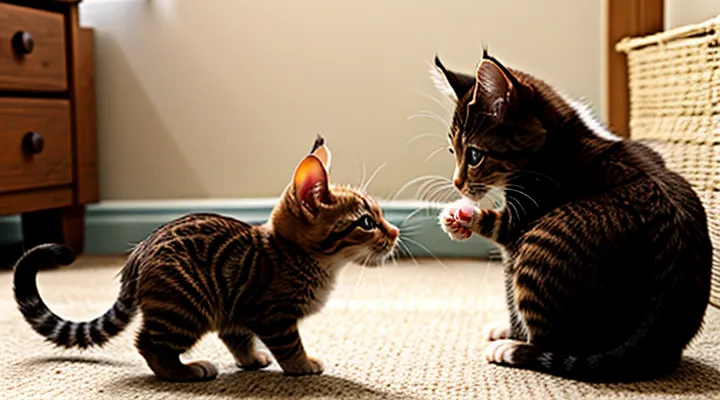
The Instinctive Hunter: Feline Predation Development
Early Stages of Kitten Development
Neonatal Period
The neonatal period in domestic cats spans the first two weeks after birth. During this time kittens are blind, deaf, and completely dependent on the mother for warmth, nutrition, and stimulation. Growth is rapid; body weight typically doubles, and the digestive system begins to mature enough to process milk exclusively.
By the end of the second week, sensory organs develop enough for kittens to respond to light and sound, and motor coordination improves. The following milestones are critical for the emergence of hunting behavior:
- Weeks 3‑4: Eyes open; visual tracking begins.
- Weeks 4‑5: Ear canals fully open; auditory cues become reliable.
- Weeks 5‑6: Muscular strength and coordination allow pouncing and stalking.
- Weeks 6‑8: Introduction of solid food, weaning from mother’s milk, and increased independence.
Predatory competence, including the ability to capture small rodents, typically appears after the fifth week, when sensory input, motor skill, and instinctive drive converge. The neonatal stage therefore provides the physiological foundation that enables kittens to transition from total dependence to the initial stages of hunting.
Socialization and Play
Kittens acquire hunting competence largely through interaction with littermates and structured play. Early motor development enables them to practice stalking, pouncing, and bite control, which later translate into effective mouse capture.
Typical developmental milestones:
- 2‑3 weeks: coordinated movement, gentle wrestling with siblings.
- 4‑5 weeks: deliberate stalking of moving objects, increased focus.
- 6‑8 weeks: accurate pounce, bite precision on soft toys.
- 9‑12 weeks: successful capture of live prey such as rodents in controlled settings.
Human‑provided play reinforces these skills. Feather‑tipped wands, laser pointers, and small moving toys simulate prey motion, prompting the kitten to refine timing and bite strength. Repetitive sessions three times daily, each lasting 5‑10 minutes, accelerate skill acquisition without causing fatigue.
To encourage early mouse‑hunting ability, owners should:
- Offer a variety of textures and speeds in toys to develop adaptability.
- Gradually introduce live, safe prey under supervision after the kitten demonstrates consistent pounce accuracy.
- Maintain a low‑stress environment; anxiety impairs learning and reduces motivation to hunt.
By aligning social play with the kitten’s natural developmental timeline, the transition from playful mock‑hunt to genuine mouse capture typically occurs between the ninth and twelfth week of life.
Mother Cat’s Influence
Mother cats shape the hunting abilities of their offspring from birth. Early exposure to the mother’s behavior determines when kittens begin to pursue prey such as mice.
During the first two weeks, kittens remain dependent on the mother for nutrition and warmth. The mother’s movements, vocalizations, and occasional capture of small rodents provide visual and auditory cues that the kittens observe. By the third week, kittens start to mimic these actions, practicing pouncing on soft objects placed by the mother.
From four to six weeks, the mother intensifies training. She brings live or dead prey to the nest, allows kittens to interact with it, and intermittently demonstrates the kill. This hands‑on experience accelerates skill acquisition. Typical milestones include:
- Week 4: kittens attempt to bat at moving objects.
- Week 5: kittens practice grasping with forepaws.
- Week 6: kittens successfully capture and kill a mouse under maternal supervision.
After eight weeks, most kittens can hunt independently. The mother’s continued presence, occasional correction of technique, and reinforcement of successful attempts solidify competence.
In environments where the mother is absent or provides limited exposure, kittens often delay hunting proficiency, sometimes requiring up to twelve weeks before achieving reliable mouse capture. Therefore, the mother’s direct involvement is the primary factor influencing the onset of effective hunting behavior.
Milestones in Hunting Behavior
Play as Practice: Developing Hunting Skills
Pouncing and Stalking Games
Kittens develop hunting competence through a sequence of motor and sensory milestones that culminate in effective mouse capture. Early play with objects and littermates trains the reflexes required for predation, while sensory sharpening enables precise detection of moving prey.
Pouncing and stalking games serve as the primary rehearsal for real‑world hunting. During a stalk, a kitten learns to minimize visual and auditory cues, align body posture, and gauge distance. The subsequent pounce translates these calculations into a rapid, coordinated leap that mimics the strike on live prey. Repetition of these simulated attacks refines timing, force control, and bite placement, all essential for subduing a mouse.
Typical age progression:
- 3–4 weeks: Coordinated swatting of dangling toys; basic chase reflexes appear.
- 5–6 weeks: Sustained stalking of moving objects; brief pauses before leaping.
- 7–8 weeks: Accurate pounce on small, fast‑moving targets; successful capture of toy mice.
- 9–10 weeks: Transition from toy capture to opportunistic hunting of real rodents in controlled environments.
Owners can encourage skill acquisition by providing safe, interactive toys that require stalking and pouncing, gradually increasing speed and complexity. Introducing live, non‑threatening prey under supervision after eight weeks accelerates the transfer of practiced techniques to effective mouse hunting.
Prey Drive Stimulation
Kittens typically begin to exhibit independent hunting behavior between eight and twelve weeks of age. During this period, the innate prey drive becomes responsive to external stimulation, allowing the animal to transition from play hunting with littermates to actual capture of small rodents.
Key elements that trigger and sharpen the prey drive at this developmental stage include:
- Visual acuity development – sharpens around ten weeks, enabling detection of rapid movements.
- Auditory sensitivity – matures to recognize high‑frequency squeaks produced by mice.
- Motor coordination – improves as the kitten gains balance and precise paw placement.
- Environmental exposure – introduction to safe, realistic prey stimuli (e.g., feather wands, moving toys) reinforces predatory sequences.
- Maternal modeling – observation of the mother’s hunting actions accelerates skill acquisition.
Effective stimulation strategies involve controlled presentations of moving objects that mimic mouse behavior, gradual reduction of human assistance, and provision of safe opportunities for successful capture. Consistent practice during the eight‑to‑twelve‑week window solidifies neural pathways associated with predation, leading to reliable mouse‑catching ability shortly thereafter.
First Encounters with Live Prey
Age of Initial Interest
Kittens develop the drive to pursue rodents shortly after the weaning period. By four weeks of age their eyes and ears function well enough to locate moving prey, and their coordination allows short bursts of chase. Between five and eight weeks they begin to pounce on toys that simulate the movement of a mouse, indicating the emergence of hunting interest.
The transition from play to actual predation depends on several factors:
- Visual acuity reaches adult levels around six weeks, enabling detection of small, fast‑moving objects.
- Auditory sensitivity sharpens by the fifth week, allowing recognition of rustling sounds produced by rodents.
- Motor control improves steadily; by eight weeks kittens can execute coordinated jumps and claws’ extension required for a successful capture.
By ten to twelve weeks most domestic kittens can capture live mice when presented with the opportunity. Early exposure to moving objects, regular feeding schedules, and a safe environment that encourages natural stalking behavior accelerate the onset of genuine hunting activity.
Parental Guidance in Hunting
Kittens develop the motor skills and sensory coordination needed for predation during the first two months of life. Around three to four weeks they practice stalking motions, and by eight to twelve weeks they can successfully capture small rodents when encouraged.
Maternal influence shapes this progression. The mother cat introduces live prey, demonstrates capture techniques, and allows kittens to practice on subdued victims. She regulates exposure, ensuring that each attempt remains within the kitten’s current capability, thereby preventing injury and reinforcing effective tactics.
Guidelines for caregivers:
- Provide age‑appropriate live prey no earlier than eight weeks, using safely restrained rodents.
- Observe each attempt; intervene if the kitten shows signs of distress or inability to subdue the prey.
- Gradually increase prey size and mobility as the kitten’s proficiency improves, typically extending to fully independent hunting by twelve weeks.
- Supplement natural practice with interactive toys that mimic mouse movement to reinforce stalking and pouncing without live prey.
Factors Influencing Early Hunting
Breed Predisposition
Kittens develop the physical coordination and predatory drive needed to capture rodents during the transitional period between weaning and full independence. Genetic background determines how quickly this capability emerges, with some breeds displaying functional hunting behavior earlier than others.
Selective breeding for rodent control has reinforced neural pathways linked to stalking, pouncing and bite precision. Breeds that originated as farm or working cats retain heightened prey‑drive, while ornamental lines often show delayed or reduced interest in live prey. Early motor milestones—such as balance on narrow surfaces and rapid forelimb extension—appear around eight weeks, but the onset of effective mouse capture varies by lineage.
- Bengal, Siamese, Abyssinian: functional hunting observed as early as 8–10 weeks.
- Maine Coon, Norwegian Forest Cat: reliable capture typically by 10–12 weeks.
- Domestic Shorthair (mixed‑breed): average onset 10–14 weeks, with individual variation.
- Persian, Exotic Shorthair: reduced predatory response; effective capture often not until 12–16 weeks or later.
Understanding breed‑specific timelines aids owners and pest‑control programs in setting realistic expectations for a kitten’s contribution to rodent management. Early exposure to safe hunting practice can accelerate skill acquisition in predisposed breeds, while less‑inclined cats may require additional motivation or training.
Environmental Exposure
Kittens typically begin to hunt mice when they reach the developmental stage in which their motor skills, sensory acuity, and predatory instincts are sufficiently mature. Environmental exposure critically determines the timing of this behavior. Early contact with live prey, exposure to a variety of sensory cues (movement, sound, scent), and opportunities to practice stalking in a safe setting accelerate the onset of effective hunting.
Key environmental factors influencing the emergence of mouse‑catching behavior include:
- Presence of small rodents in the household or outdoor area, providing real‑time targets.
- Availability of diverse textures and surfaces that allow kittens to refine grip and pounce techniques.
- Controlled exposure to the sounds and scents associated with prey, which enhances auditory and olfactory discrimination.
- Interaction with adult cats that model hunting sequences, offering observational learning opportunities.
- Gradual reduction of artificial play objects in favor of live or realistic prey simulators, encouraging transition from play to functional hunting.
When these conditions are consistently present, kittens may demonstrate competent mouse capture as early as eight to ten weeks of age. In environments lacking such stimuli, the development of hunting skills can be delayed until the kitten is older and has acquired sufficient experience through deliberate training or accidental encounters.
Individual Temperament
Kittens do not begin hunting mice at a uniform age; their readiness is strongly influenced by individual temperament. A bold, inquisitive kitten typically shows interest in moving objects as early as four to six weeks, while a more cautious sibling may delay engagement until eight to ten weeks. Temperamental confidence determines the speed at which a kitten transitions from play‑chasing to purposeful predation.
Key temperament factors that affect hunting onset include:
- Fearlessness: Reduces hesitation, prompting earlier attempts to capture prey.
- Persistence: Drives repeated effort after initial failures, accelerating skill acquisition.
- Social confidence: Allows kittens raised with active mothers or littermates to model hunting behavior sooner.
Environmental reinforcement interacts with these traits. Kittens raised in households where live prey is occasionally presented develop stronger predatory instincts, especially if their innate boldness aligns with exposure. Conversely, overly protective environments may suppress even naturally assertive kittens, postponing mouse‑catching behavior.
Veterinarians and feline behavior specialists advise monitoring each kitten’s personal disposition rather than relying on a fixed age benchmark. Assessing confidence levels, response to moving stimuli, and willingness to explore can predict when an individual kitten will start to hunt mice effectively.
The Transition to Proficient Hunting
Fine-tuning Hunting Techniques
Coordination and Agility
Kittens acquire the motor skills needed to pursue and capture small prey during the early weeks of life. By the end of the third week, muscle tone improves and basic balance emerges, allowing tentative jumps and short sprints. Around four weeks, reflexes sharpen; the righting reflex and paw‑placement accuracy enable more precise stalking movements.
From five to six weeks, coordination reaches a level where kittens can coordinate fore‑ and hind‑limb actions during rapid bursts. Visual tracking aligns with limb timing, permitting successful pounces on moving targets. At this stage, the nervous system integrates sensory input and motor output sufficiently for effective hunting.
Typical developmental milestones related to coordination and agility include:
- Week 3: Stable gait, low‑height jumps.
- Week 4: Enhanced reflexes, coordinated paw strikes.
- Week 5‑6: Synchronized limb movement, accurate depth perception.
- Week 7 onward: Consistent capture of live rodents in a controlled environment.
By the seventh week, most domestic kittens possess the agility required to catch mice reliably, assuming adequate exposure to prey‑like stimuli and normal health conditions.
Patience and Observation
Kittens typically begin to exhibit hunting behavior between eight and twelve weeks of age. At this stage, motor coordination, visual acuity, and predatory instincts converge, allowing the young cat to stalk and capture small prey such as mice. Observers who track developmental milestones can pinpoint the onset of effective hunting by noting increased pouncing attempts, successful captures, and sustained interest in moving targets.
Patience proves essential for accurate assessment. Early attempts often result in missed strikes or abandoned pursuits; consistent monitoring over several weeks distinguishes fleeting curiosity from genuine predatory competence. Recording each interaction—time of day, environmental conditions, and outcome—creates a data set that reveals patterns and eliminates anecdotal bias.
Key indicators to watch for include:
- Repeated stalking sequences lasting more than a few seconds
- Precise timing of paw extension during a pounce
- Successful immobilization of prey without excessive struggle
- Return to the nest with captured mouse for consumption
By applying systematic observation and allowing sufficient time for natural development, caregivers and researchers can determine the precise age range when kittens reliably transition from playful mimicry to effective mouse hunters.
When Hunting Becomes Consistent
Age of Regular Prey Capture
Kittens typically begin to hunt small rodents between 8 and 12 weeks of age. By the end of the third month, their motor coordination, vision, and depth perception have developed sufficiently for successful pounce and capture.
- 8 weeks: exploratory play includes swatting at moving objects; attempts at catching are clumsy and rarely result in capture.
- 10 weeks: improved balance and timing allow occasional successful grabs of stationary prey.
- 12 weeks: refined ambush technique, coordinated fore‑paw strike, and bite force enable regular capture of live mice.
The transition from play to functional hunting correlates with the weaning process. As maternal milk declines, kittens increase protein intake from solid food, which supports muscle growth and stamina needed for sustained pursuit.
Environmental exposure accelerates skill acquisition. Kittens raised in households with limited outdoor access may delay effective hunting until 4–5 months, whereas those with regular outdoor exposure often master prey capture by the end of the second month.
Genetic predisposition influences timing as well. Breeds selected for high predatory drive, such as the Maine Coon or Bengal, tend to demonstrate competent mouse capture closer to 8 weeks, while less active breeds may require an additional 2–3 weeks.
In summary, regular rodent capture emerges reliably between eight and twelve weeks, contingent on developmental milestones, nutrition, and environmental experience.
Importance of Continued Practice
Kittens typically begin to capture mice around four to six weeks of age, when their motor coordination and reflexes have developed sufficiently. Success at this stage depends heavily on repeated exposure to live prey, because each encounter refines timing, bite precision, and stalking technique. Without ongoing practice, early attempts remain sporadic and the animal fails to transition from instinctive pouncing to purposeful hunting.
Continued practice delivers measurable improvements:
- Faster reaction times to sudden movements.
- Enhanced accuracy in bite placement, reducing injury risk.
- Increased stamina for prolonged chases.
- Strengthened confidence, leading to independent foraging.
Veterinary observations confirm that kittens allowed regular, supervised hunting sessions achieve mastery earlier than those confined to passive play. Structured repetition accelerates neural pathways associated with predatory behavior, solidifying the skill set required for reliable mouse capture.