
«Understanding Rat Tracks: Key Characteristics»
«Size and Shape of Rat Paw Prints»
«Front Paws vs. Hind Paws»
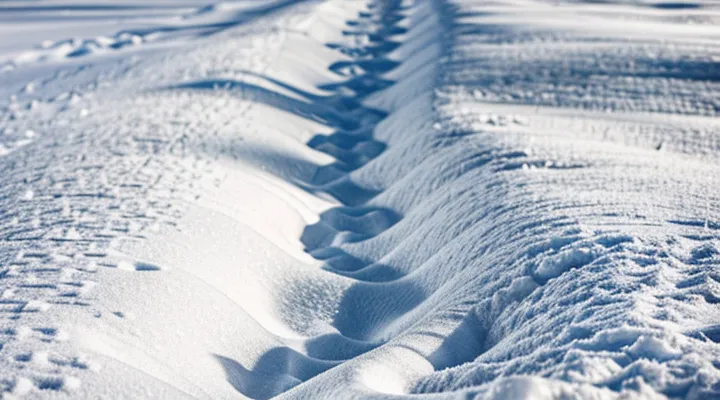
Rats leave a distinctive pattern in fresh snow that can be separated into front‑paw and hind‑paw impressions. Front paws produce a compact, rounded print about 1 cm wide, showing four toe marks close together with shallow claw impressions at the rear edge. Hind paws are slightly larger, roughly 1.2 cm wide, and display a broader, more oval shape with five toe marks; the central toe is often more pronounced, and claw marks appear deeper and more angled toward the center of the track.
Key differences useful for identification:
- Size: hind‑paw prints exceed front‑paw prints by 0.2–0.3 cm in width.
- Toe count: front paws show four toes, hind paws show five.
- Shape: front paws are circular; hind paws are oval.
- Claw marks: hind paws produce deeper, more angled claw impressions.
- Spacing: the distance between successive front‑paw prints is shorter than the distance between hind‑paw prints, reflecting the animal’s gait.
When evaluating a trackway, locate the alternating sequence of smaller, four‑toed prints followed by larger, five‑toed prints. Consistent alternation confirms rat activity and distinguishes it from other small mammals that may leave only uniform prints.
«Number of Toes Visible»
Rats leave distinct footprints in snow that reveal the count of visible toes. The front foot imprint typically shows four toes; the hind foot can display five, but deep snow often hides the hind toes, leaving only the front four visible. This pattern differs from larger mammals, whose tracks usually expose more than four toes per imprint.
Key observations for accurate identification:
- Front imprint: exactly four toe marks, evenly spaced, with a clear central pad impression.
- Hind imprint: five toe marks may appear when snow depth is shallow; otherwise, only the central pad and occasional toe impressions are visible.
- Toe length: rat toe marks are short, about 1 – 2 cm, reflecting the animal’s small size.
- Spacing: front‑to‑hind distance averages 4 – 6 cm, consistent with a rat’s stride.
When evaluating snow tracks, count the toe marks in each imprint. Presence of four distinct front toes, combined with a possible but not mandatory five‑toe hind imprint, strongly indicates rat activity. Absence of additional toe marks, such as the extra toe seen in some other rodents, further confirms the identification.
«Gait and Track Patterns»
«Direct Register vs. Indirect Register»
When analyzing fresh rodent prints on a snow‑covered surface, the method used to capture positional data determines the reliability of the interpretation. Two approaches dominate: direct register and indirect register.
A direct register records the exact coordinates of each footprint at the moment it is observed. Sensors placed on the ground, laser scanners, or high‑resolution photography linked to geolocation software store the data without intermediary processing. The result is a precise map of track patterns, allowing immediate measurement of stride length, gait, and direction.
An indirect register stores observations through an intermediate step. Footprints are first marked on a transparent overlay, traced on paper, or entered manually into a database after field collection. The data undergoes translation before becoming usable, introducing potential distortion from human error or conversion algorithms.
Key distinctions:
- Accuracy – Direct register delivers sub‑centimeter precision; indirect register typically yields centimeter‑level variation.
- Speed – Direct register provides real‑time output; indirect register requires post‑field transcription.
- Equipment – Direct register demands specialized hardware; indirect register relies on basic tools and manual effort.
- Error sources – Direct register errors stem mainly from sensor calibration; indirect register errors arise from transcription and scaling.
Choosing between the two depends on project constraints. If immediate, high‑resolution mapping of snow‑bound tracks is required, a direct register system is preferable. When resources are limited and a post‑field analysis suffices, an indirect register approach remains viable.
«Straddle Width and Stride Length»
When examining rat footprints in snow, two measurements provide the most reliable clues: the distance between the left and right impressions (straddle width) and the distance from the rear of one foot to the front of the next (stride length).
Straddle width reflects the animal’s pelvic breadth. In fresh snow, a typical rat leaves impressions spaced 2–3 cm apart. Measurements consistently larger than 4 cm usually indicate a larger rodent, such as a mouse or a squirrel, while a width under 2 cm suggests a juvenile rat.
Stride length indicates the animal’s step size and gait. Adult rats produce a stride of 4–6 cm on level snow. A shorter stride, around 2–3 cm, often corresponds to a cautious or startled individual; a longer stride, exceeding 7 cm, may signal a running rat or a different species altogether.
Key points for field identification:
- Measure the gap between left‑right tracks; compare to the 2–3 cm baseline.
- Measure the distance from the rear edge of one track to the front edge of the next; compare to the 4–6 cm baseline.
- Consistent values within these ranges strongly support rat identification.
- Significant deviations suggest a different animal or an atypical behavior.
Accurate recording of straddle width and stride length, combined with track depth and pattern, enables precise differentiation of rat tracks from other small‑mammal prints in snowy environments.
«Tail Drag Marks»
Tail drag marks appear as faint, linear impressions extending from the rear of a rat’s footprint. In fresh snow they manifest as a shallow groove, often half the length of the paw print, aligned with the direction of travel. The groove is usually narrower than the paw pad, with edges that may be slightly raised where the tail brushed the surface.
Characteristics that differentiate tail drags from other linear marks include:
- Consistent spacing between the drag and the adjacent paw prints, matching the animal’s stride.
- Absence of claw impressions in the drag itself, indicating a smooth, hair‑covered tail rather than a clawed appendage.
- Alignment with the long axis of the track, suggesting the tail followed the body’s motion rather than a separate movement.
Tail drag marks provide insight into the animal’s posture and speed. A continuous, well‑defined drag implies the rat moved slowly enough for the tail to maintain contact with the snow. Intermittent or broken drags suggest rapid movement or occasional lifting of the tail.
When documenting rat activity in snow, record the length of the drag, its distance from the nearest paw print, and any variation in depth. Measuring tools such as a calibrated ruler or a digital photogrammetry app improve accuracy. Photographs should be taken from directly above, with a scale bar placed beside the track to preserve proportion.
Distinguishing tail drags from other wildlife traces prevents misidentification. Beaver or otter tail marks are broader and deeper, often accompanied by large, webbed footprints. Bird scratches lack the regular spacing and are generally more erratic. By focusing on the specific dimensions and alignment described above, investigators can reliably attribute the marks to rat movement.
«Distinguishing Rat Tracks from Other Animals»
«Comparing with Mice and Voles»
«Size Differences»
Rat footprints left in snow vary noticeably in size, providing a primary clue for species identification. Adult Norway rats (Rattus norvegicus) typically produce tracks 12–15 mm long and 9–12 mm wide, with a distinct triangular shape formed by the three toes. House rats (Rattus rattus) leave slightly smaller impressions, averaging 10–13 mm in length and 8–10 mm in width, often exhibiting a more tapered toe arrangement.
Juvenile rats create tracks that are at least 30 % smaller than those of mature individuals. A juvenile Norway rat may leave marks 8–10 mm long and 6–8 mm wide, while a juvenile house rat can produce prints as small as 7–9 mm long and 5–7 mm wide. These reduced dimensions reflect the animal’s growth stage and can help distinguish between adult and young specimens.
When comparing multiple tracks in a single snowfield, observe the consistency of size. Uniform dimensions suggest a single adult rat, whereas a mixture of larger and smaller prints indicates the presence of both adult and juvenile individuals. Size variation also assists in separating rat tracks from those of similar-sized wildlife, such as mice (5–8 mm long) or small mammals like voles (7–10 mm long but with a different toe arrangement).
Key size ranges for quick reference:
- Adult Norway rat: 12–15 mm × 9–12 mm
- Adult house rat: 10–13 mm × 8–10 mm
- Juvenile Norway rat: 8–10 mm × 6–8 mm
- Juvenile house rat: 7–9 mm × 5–7 mm
Accurate measurement of track dimensions, combined with shape analysis, enables reliable identification of rat activity in snowy environments.
«Foot Structure Variations»
Rodent footprints in snow reveal distinctive foot morphology that separates species and indicates behavior. The most reliable identifiers are toe count, pad configuration, claw impression depth, and overall track shape.
- Toe number: Rats display four forward‑pointing toes and a small, reduced fifth toe positioned laterally. The fourth toe is often the longest, creating an asymmetrical toe spread.
- Pad layout: A broad, triangular plantar pad occupies the central area, bordered by two smaller heel pads. The pad surface leaves a faint, smooth imprint contrasting with the sharper toe marks.
- Claw marks: Rats possess blunt, curved claws that produce shallow, rounded indentations at the toe tips. The claw impressions rarely extend beyond the toe tips, unlike the deeper, linear marks of larger rodents.
- Track outline: The overall silhouette forms a compact oval, approximately 15–20 mm long, with the toe spread extending slightly beyond the pad width. Front and hind tracks are similar in size, reflecting the animal’s quadrupedal gait.
Variations arise from age, substrate consistency, and locomotion speed. Juvenile rats exhibit smaller pads and less pronounced claws, resulting in lighter, less defined tracks. Wet or powdery snow compresses pads more fully, producing broader, smoother impressions, whereas compact snow preserves sharper toe and claw details. Recognizing these structural nuances enables accurate differentiation of rat tracks from those of mice, voles, or larger wildlife.
«Differentiating from Squirrels and Weasels»
«Hopping vs. Walking/Running Patterns»
Rat tracks left in snow reveal distinct locomotion styles that can be distinguished without ambiguity. Hopping produces a series of isolated impressions, each consisting of a single, rounded pad set separated from the next by a clear gap. The depth of these prints is generally uniform, reflecting the rat’s rear legs landing simultaneously while the front feet remain elevated. Because the animal’s body briefly leaves the surface, the track line appears discontinuous, with occasional overlapping prints where the rear and front paws touch the ground at the same moment.
Walking or running generates a continuous pattern of paired prints. Each step shows a clear left‑right arrangement: a front paw impression followed closely by a rear paw impression, often overlapping slightly. The spacing between successive pairs is regular, with the distance decreasing as speed increases. In a running gait, the rear prints may be deeper due to greater thrust, and the overall track line becomes a steady, unbroken series of footprints.
Key visual cues for differentiation:
- Print isolation – hopping: single, spaced pads; walking/running: paired, overlapping pads.
- Spacing regularity – hopping: irregular gaps; walking/running: consistent stride length.
- Depth variation – hopping: uniform depth; running: deeper rear prints, walking: moderate, even depth.
- Track continuity – hopping: intermittent line; walking/running: continuous line.
Recognizing these patterns enables precise identification of rat activity in snowy environments, supporting accurate wildlife monitoring and effective pest management decisions.
«Claw Mark Characteristics»
Claw marks left by rats in fresh snow differ markedly from those of larger rodents. Each imprint consists of a short, shallow groove that follows the direction of the animal’s stride. The groove typically measures 2‑4 mm in length and 0.5‑1 mm in width, with a V‑shaped cross‑section that tapers toward the center. The depth rarely exceeds 2 mm, causing only a subtle depression in the snow surface.
Key visual cues include:
- Parallel grooves spaced approximately 20‑30 mm apart, reflecting the narrow width of a rat’s hind feet.
- A faint, double‑track pattern where the left and right footprints intersect slightly, producing a shallow “X” at the point of crossover.
- Absence of pronounced toe splay; the toes remain tightly clustered, creating a compact, rounded impression.
- Uniform spacing between successive marks, indicating a steady, low‑speed gait typical of small mammals navigating soft snow.
When evaluating a track series, compare these traits to the broader, more widely spaced prints of mice or the deeper, more defined claw marks of squirrels. Consistency with the dimensions and patterns described above confirms rat presence.
«Considering Environmental Factors»
«Snow Depth and Consistency»
Snow depth directly influences the clarity of rodent impressions. A layer thinner than 2 cm often collapses under a rat’s weight, producing shallow, indistinct marks that merge with surrounding surface irregularities. Conversely, a depth of 5 cm or more preserves the full contour of the footpad, allowing precise measurement of stride length and track width.
Consistency determines how a track registers in the snow. Three primary states are encountered:
- Powdery snow – low density, high porosity; tracks appear as faint depressions filled with loose grains, requiring careful lighting to discern edges.
- Crusted snow – surface layer hardened by temperature fluctuations; footprints cut through the crust, leaving crisp outlines that contrast sharply with the surrounding slab.
- Packed snow – compacted by wind or prior traffic; impressions remain shallow but retain shape, facilitating measurement of toe spread.
When evaluating tracks, assess the following parameters:
- Depth of imprint – measured from the surrounding surface to the deepest point of the track; deeper imprints correlate with softer, deeper snow.
- Edge definition – sharpness indicates a crusted or packed surface; blurred edges suggest powder.
- Retention of detail – visibility of individual toe marks confirms sufficient depth and appropriate consistency for species identification.
Accurate interpretation of snow depth and consistency reduces misidentification risk and supports reliable field documentation of rat activity in winter environments.
«Age of Tracks»
The “age of tracks” refers to the elapsed time since a rat’s paw imprint was made in fresh snow. Accurate estimation of this interval narrows the search window for active individuals and informs decisions about pest‑control timing.
Several physical changes indicate track age. Fresh impressions retain sharp edges, deep depressions, and a bright, undisturbed surface. As time passes, wind, temperature fluctuations, and sublimation smooth edges, reduce depth, and darken the surrounding snow. The presence of meltwater channels, crust formation, or partial refreezing also signals older tracks.
Practical steps for age assessment:
- Observe edge definition: crisp, angular outlines = recent; rounded, blurred edges = older.
- Measure depth: deeper than 1 cm usually indicates a track less than 12 hours old; shallower impressions suggest greater age.
- Check surrounding snow texture: undisturbed powder around the track points to a recent passage; compacted or crusted snow implies exposure to wind or temperature cycles for several hours.
- Look for secondary markings: footprints of other animals crossing the same path erase or modify earlier rat tracks, indicating a longer interval.
Combining these indicators yields a reliable estimate of track age, enabling targeted monitoring of rat activity in snowy environments.
«Practical Tips for Track Identification»
«Tools for Examination»
«Measuring Tape»
A measuring tape provides a reliable means of quantifying rat footprints preserved in snow. By recording dimensions directly on the ground, investigators obtain objective data that support species identification and activity assessment.
When evaluating a track, follow these steps:
- Lay the tape along the longest visible impression; note the length in centimeters.
- Position the tape perpendicular to the same impression; record the width.
- Measure the distance between successive prints to determine stride length.
- Capture the depth of the impression by comparing tape elevation against a flat reference surface, if possible.
Accurate measurements require a stable tape that resists bending in cold conditions. Use a tape with a reinforced backing or a fiberglass core to maintain straightness. Ensure the tape lies flat on the snow surface; avoid compressing the snow, which can distort dimensions. Record each value immediately to prevent melting or wind alteration.
Interpreting the data involves comparing measured values with known rat morphometrics. Typical Norway rat prints range from 6 mm to 10 mm in length with a stride of 30 mm to 45 mm, while roof rats produce shorter prints, generally under 6 mm, and a tighter stride. Consistent measurements across multiple tracks reinforce identification confidence and help infer movement direction and speed.
«Camera for Documentation»
A reliable camera is essential for recording rat footprints in snow, providing visual evidence that supports field observations and subsequent analysis. Photographic documentation captures subtle variations in track shape, depth, and surrounding snow conditions that may be missed during a brief visual inspection.
When choosing equipment, prioritize the following specifications:
- Resolution: Minimum 12 MP ensures clear detail of track edges and surrounding texture.
- Weather sealing: IP‑66 or higher rating protects the body from moisture, snow, and temperature fluctuations.
- Macro capability: Minimum 1:1 magnification or a dedicated close‑up lens enables focus on individual footprints without distortion.
- Shutter speed control: Ability to select fast speeds (≥ 1/2000 s) prevents motion blur caused by wind‑driven snow particles.
- Manual exposure: Full control over ISO, aperture, and exposure compensation allows adaptation to bright, reflective snow surfaces.
- Battery endurance: Cold temperatures reduce capacity; opt for lithium‑ion cells rated for sub‑zero operation or carry spare batteries insulated in a pocket.
Operational guidelines improve image quality:
- Position the camera at a low angle, parallel to the ground, to minimize perspective distortion and capture the true outline of each track.
- Use a tripod or a sturdy mount to stabilize the camera on uneven, icy terrain; a rubber footpad prevents slipping.
- Apply a polarizing filter to reduce glare from sunlight reflecting off the snow, enhancing contrast between the furrow and the surrounding surface.
- Set white balance to “snow” or manually adjust Kelvin temperature to 6000–6500 K, ensuring accurate color reproduction of the snow and any surrounding debris.
- Shoot in RAW format; this preserves maximum data for post‑processing, allowing adjustments to exposure and contrast without loss of detail.
After capture, organize files with metadata that includes location coordinates, date, time, and camera settings. This systematic approach facilitates comparison across multiple sites and dates, supporting rigorous identification of rat tracks and contributing to reliable field records.
«Optimal Conditions for Tracking»
«Fresh Snowfall»
Fresh snowfall creates a uniform, undisturbed surface that preserves animal impressions with high fidelity. The lack of prior compaction means each footfall remains distinct, allowing precise measurement of track dimensions and spacing.
When examining recent snow, focus on the following characteristics to confirm rat activity:
- Track length typically 1.5–2 cm, width 0.5–0.7 cm.
- Four toe marks arranged in a tight cluster, often with a small central pad impression.
- Tail drag may appear as a faint line extending from the rear of the track.
- Stride length ranges from 6 to 9 cm; a consistent pattern indicates a single individual.
The depth of fresh snow—usually 2–5 cm—prevents deep sinking, so tracks retain crisp edges. Light, powdery snow reflects ambient light, enhancing contrast between the dark fur imprint and the surrounding white. This contrast simplifies identification without additional tools.
Environmental factors influence track clarity. Wind can flatten or erode impressions, while temperature fluctuations may cause surface melt, blurring edges. Record observations promptly after snowfall to avoid degradation.
In practice, measure track dimensions with a ruler, photograph the impression from a low angle, and compare the data to known rodent morphology. Consistent measurements across multiple tracks confirm rat presence, while deviations suggest other species or disturbances.
«Quiet Observation Times»
Quiet observation periods are essential for reliable detection of rat footprints in fresh snow. During these intervals, ambient noise and movement are minimized, allowing subtle tracks to remain visible and undisturbed.
Ideal times occur shortly after a snowfall when the surface is undisturbed and before wind or additional precipitation can alter the imprint. Early morning hours provide low light conditions that reduce glare, while the cold air remains stable, preserving track depth.
Rats are primarily nocturnal; therefore, observation after sunset, when activity peaks, increases the chance of encountering fresh prints. However, human presence must remain silent and motionless to avoid causing rats to retreat and cover their own tracks.
Key practices for quiet observation include:
- Selecting a sheltered location that blocks wind and limits sunlight exposure.
- Standing still for several minutes to allow eyes to adapt to the low‑contrast environment.
- Using binoculars or a low‑magnification scope to examine track patterns without stepping on the snow.
- Recording track dimensions and spacing immediately, as melting can obscure details within minutes.
By adhering to these guidelines, observers maximize the likelihood of accurately identifying rat tracks and distinguishing them from other wildlife marks.