
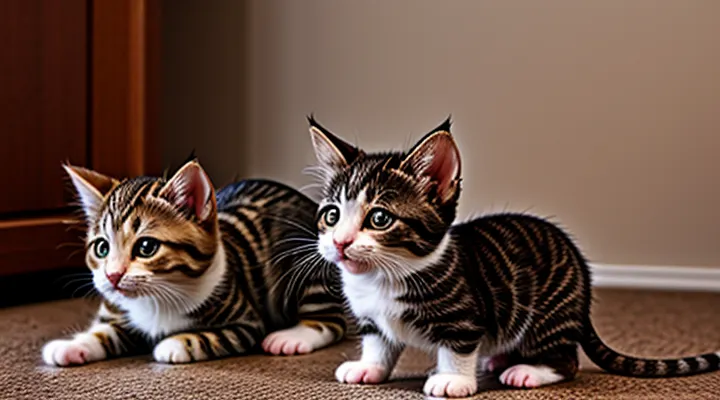
The Miracle of Transformation: From Kitten to Cat
Early Stages of Development
Birth and Neonatal Period
Kittens and mouse pups experience rapid physiological changes from birth to the end of the neonatal stage. In the first 24 hours, both species rely on maternal warmth and colostrum, which supplies antibodies and essential nutrients. Neonatal kittens possess closed eyes and limited motor coordination; they begin to open their eyes between days 7 and 10, while mouse pups start to develop whisker sensitivity around day 4.
During the first week, body weight increases by approximately 10–15 % per day in kittens and 8–12 % per day in mouse pups. This growth is driven by high protein intake from milk, efficient gastrointestinal absorption, and a surge in growth‑hormone secretion. Thermoregulation improves as brown‑fat stores are mobilized; kittens achieve stable body temperature by day 5, whereas mouse pups reach comparable stability by day 3.
Key developmental milestones:
-
Sensory maturation:
• Kitten eyes open, auditory cortex responds to sounds.
• Mouse pup eyes open at day 12–14; auditory startle reflex emerges earlier. -
Motor development:
• Kittens crawl, stand, and attempt pouncing by day 14.
• Mouse pups exhibit coordinated locomotion and climbing by day 10. -
Weaning transition:
• Kitten begins solid food intake at 4–5 weeks; complete weaning by 8 weeks.
• Mouse pup starts nibbling solid diet at 2 weeks; fully weaned by 3 weeks.
Survival rates correlate with maternal care quality. Adequate nursing, temperature regulation, and prompt cleaning of the birth site reduce early mortality. In both species, the neonatal period sets the foundation for later growth, behavior, and reproductive capacity.
Infancy and Socialization
Kittens and mouse pups experience rapid physical growth during the first weeks of life. Their bodies increase in size, fur or whisker development becomes noticeable, and sensory systems mature enough to navigate their surroundings. By the end of the neonatal period, both species can regulate body temperature independently and show coordinated movement.
Social interaction begins almost immediately after birth. Mother mammals provide warmth, nutrition, and protection, while littermates offer tactile stimulation that shapes neural pathways. Early contact promotes recognition of species‑specific vocalizations and scent cues, establishing the foundation for group cohesion.
Key developmental milestones include:
- Day 1‑3: Reliance on maternal milk; limited eye opening.
- Day 4‑7: First attempts at locomotion; vocalizations intensify.
- Day 8‑14: Eyes fully open; exploratory play with siblings.
- Day 15‑21: Independent feeding trials; grooming behaviors emerge.
These stages illustrate how infancy facilitates the transition from a helpless newborn to a self‑sufficient cat or mouse, while simultaneously embedding the social skills required for survival within their respective colonies.
Physical and Behavioral Changes
Growth and Maturation
Kittens undergo rapid physiological transformation during the first twelve months. Neonates weigh 85–115 g, open their eyes at 7–10 days, and achieve coordinated walking by three weeks. Muscle mass triples between weeks four and eight, while dental eruption progresses from deciduous incisors to permanent canines by month six. By the end of the first year, skeletal growth plate closure marks the transition to adult size, typically 3.5–5 kg for domestic breeds.
Mouse pups experience accelerated maturation within a six‑week window. Birth weight averages 1.5 g; fur appears within 48 hours, and ear pinna separation occurs by day three. The first litter of milk is replaced by solid food at postnatal day 14, triggering a surge in growth‑hormone secretion. By week four, testes or ovaries reach functional capacity, and by week six, individuals display full adult locomotor agility and reproductive competence.
Key developmental milestones:
- Vision onset: kitten – day 7–10; mouse – day 12–14.
- Locomotion: kitten – week 3; mouse – day 5.
- Weaning: kitten – week 8; mouse – week 2.
- Sexual maturity: kitten – month 5–6; mouse – week 5–6.
These timelines illustrate the distinct strategies mammals employ to achieve functional adulthood, reflecting species‑specific evolutionary pressures on growth rate and reproductive timing.
Instincts and Learned Behaviors
The development of a young feline and a juvenile rodent illustrates the interaction between innate drives and acquired skills. At birth, kittens possess reflexes that secure nourishment: a rooting response directs them toward the mother’s nipple, and a grasping reflex enables attachment to the dam’s fur. Similarly, mouse pups exhibit a suckling reflex and a rapid, involuntary startle response that protects them from sudden stimuli.
As they mature, both species integrate environmental feedback to refine behavior. Kittens begin to practice coordinated locomotion through play, learning to balance, pounce, and manipulate objects. This practice modifies the basic predatory instinct, allowing precise targeting of moving prey. Mouse juveniles engage in exploratory tunneling, gradually mastering the spatial layout of the nest and the timing of foraging trips. Their early attempts at navigation are guided by scent cues, but successful routes become reinforced through repeated exposure.
Key distinctions between innate and acquired actions include:
- Trigger: Instincts activate automatically in response to specific stimuli; learned behaviors require repeated interaction with the environment.
- Flexibility: Innate patterns remain relatively fixed across individuals; learned skills vary according to experience and can adapt to changing conditions.
- Neural basis: Genetic programming establishes neural circuits for reflexes; synaptic plasticity underlies the formation of new connections during practice.
The transition from dependent offspring to autonomous adult involves a gradual shift in reliance from hard‑wired responses to adaptive techniques. In felines, the hunting sequence evolves from instinctual stalking to sophisticated ambush strategies honed through trial and error. In rodents, escape routes and food‑storage tactics develop from simple avoidance reflexes to complex, memory‑driven patterns.
Understanding this progression provides insight into how species balance evolutionary heritage with individual experience, ensuring survival from the earliest stages of life to full maturity.
The Unseen World of Rodent Development: From Pup to Mouse
The Lifecycle of a Mouse
Gestation and Birth
Kittens develop within a relatively long prenatal phase. The domestic cat’s gestation lasts approximately 63 days, with slight variation of ± 2 days depending on breed and maternal health. During this period, embryos undergo rapid organogenesis, and by day 30 the fetal skeleton begins ossifying. Near term, the uterus contracts in a coordinated sequence that facilitates the delivery of each of the usually three to five offspring. The neonates are altricial: eyes remain closed, ears folded, and they rely entirely on maternal care for thermoregulation and nutrition.
Mice experience a markedly shorter prenatal interval. The common house mouse carries its young for about 19–21 days. Embryonic development proceeds swiftly; by day 10 the major organ systems are functional, and by day 15 the limbs are fully formed. Parturition occurs in a single, brief event, typically delivering a litter of 5–12 pups. Newborn mice are also altricial, born hairless, blind, and unable to thermoregulate, necessitating immediate maternal attention.
Key comparative points:
- Gestation length: cat ≈ 63 days, mouse ≈ 20 days.
- Litter size: cat 3–5, mouse 5–12.
- Birth timing: feline delivery spans several hours, murine delivery completes within minutes.
- Neonatal development: both species produce altricial young, but mouse pups reach independence faster due to shorter developmental schedule.
These differences illustrate how reproductive strategies adapt to species‑specific ecological pressures, balancing offspring number, developmental maturity, and parental investment.
Rapid Growth and Weaning
Kittens double their birth weight within the first week and reach approximately 75 % of adult size by eight weeks. By the tenth week, most have attained the skeletal structure of a mature cat, though muscle mass continues to develop for several months. Weaning typically begins at three weeks, with solid food introduced gradually; by six weeks the young feline relies almost exclusively on solid diet.
Mouse pups exhibit even faster development. Within 48 hours after birth, they gain 50 % of their initial mass. By day 12, they achieve near‑adult body weight, and by day 21 they are fully weaned. Solid food replaces maternal milk between days 14 and 18, after which the mother reduces nursing frequency dramatically.
Key comparative metrics:
- Birth‑to‑adult weight ratio: kitten ≈ 1:5; mouse ≈ 1:2.5.
- Onset of weaning: kitten ≈ 21 days; mouse ≈ 14 days.
- Completion of weaning: kitten ≈ 42 days; mouse ≈ 21 days.
- Growth velocity (percent of adult size per day): kitten ≈ 0.5 %; mouse ≈ 1.2 %.
These figures illustrate the accelerated maturation strategies that enable both species to transition from dependent offspring to self‑sufficient juveniles within a short developmental window.
Unique Aspects of Mouse Development
Sensory Development and Survival Skills
Kittens emerge from the womb with a rudimentary visual system; within the first two weeks, retinal cells mature, allowing them to detect motion and differentiate light from dark. This visual sharpening coincides with the development of whisker sensitivity, which provides spatial awareness in low‑light environments. By the fourth week, auditory receptors reach adult thresholds, enabling the detection of high‑frequency rodent sounds that predators emit.
Mouse pups experience a parallel trajectory. At birth, their ears are sealed and eyes remain closed. Around day ten, ear canals open, and the cochlea begins to respond to ultrasonic frequencies typical of adult conspecifics. Simultaneously, tactile receptors on the forepaws become capable of discerning substrate texture, essential for nest construction and foraging.
Both species rely on these sensory milestones to acquire survival competencies:
- Hunting and predation avoidance – sharpened vision and hearing allow kittens to track moving prey and recognize predator cues; mouse pups use ultrasonic hearing to locate insects and evade aerial threats.
- Social communication – whisker and paw signals convey hierarchy and mating readiness in cats; ultrasonic vocalizations coordinate group movement among mice.
- Motor coordination – integration of visual, auditory, and tactile input refines the timing of pounce in felines and the rapid escape leaps of juvenile mice.
The convergence of sensory refinement and behavioral adaptation illustrates a tightly regulated developmental schedule that maximizes the likelihood of reaching reproductive maturity.
Reproductive Maturity and Lifespan
Kittens reach sexual maturity between four and twelve months, with most domestic cats capable of breeding by eight months. Average lifespan for indoor cats ranges from twelve to fifteen years, while outdoor cats typically live five to seven years due to environmental hazards. Reproductive cycles begin with the first estrus, after which females can produce two to three litters annually, each litter containing two to five kittens.
Mouse pups achieve reproductive competence rapidly; females are fertile as early as five weeks of age, and males mature within six weeks. The species’ natural lifespan rarely exceeds two years, with laboratory strains averaging ten to twelve months. Breeding frequency is high: a single female can produce a new litter every three to four weeks, each litter comprising three to eight offspring.
Key comparative data:
- Onset of fertility
- Cats: 4–12 months
- Mice: 5–6 weeks
- Typical lifespan
- Cats (indoor): 12–15 years
- Cats (outdoor): 5–7 years
- Mice (wild): ≤2 years
- Mice (lab): 10–12 months
- Reproductive output
- Cats: 2–3 litters/year, 2–5 kittens/litter
- Mice: 1 litter/3–4 weeks, 3–8 pups/litter
These figures illustrate the stark contrast between the prolonged development and longevity of felines and the accelerated maturation and brief life cycle of rodents.
Comparative Insights: Mammalian Development
Similarities in Growth Patterns
Early Dependence
Newborn kittens and mouse pups rely almost entirely on their mothers for survival. At birth, kittens lack the ability to regulate body temperature, locate food, or eliminate waste, while mouse pups are blind, deaf, and immobile. This initial phase establishes a critical window in which maternal care determines developmental trajectory.
Key aspects of early dependence include:
- Nutritional provision: Milk supplies essential antibodies, calories, and growth factors.
- Thermoregulation: Maternal warmth offsets the infants’ limited heat production.
- Protection: Physical shelter guards against predators and environmental hazards.
- Stimulation: Tactile contact and vocal cues promote neural maturation and sensory development.
As the young animals mature, physiological systems mature rapidly. Kittens acquire coordinated locomotion and weaning ability within weeks, while mouse pups develop sight and hearing by the third postnatal week, enabling independent foraging. The shift from maternal reliance to self‑sufficiency marks the transition from infant to adult form, illustrating the profound impact of early dependence on subsequent growth.
Developmental Milestones
Kittens progress through a series of observable stages that mark physical and behavioral growth. Within the first week, they open their eyes, develop coordinated paw movements, and begin to crawl. By the third week, whisker sensitivity increases, allowing precise navigation of the litter environment. At four to six weeks, teeth erupt, solid food intake replaces nursing, and social play with littermates intensifies. Between eight and twelve weeks, muscle development supports independent jumping, climbing, and pouncing, while vocalization patterns mature for communication with humans and other cats. The final milestone before adulthood occurs around six months, when reproductive organs fully mature and the animal exhibits territorial marking and mating behaviors.
Mouse pups follow a comparable trajectory of rapid development. Birth marks a hairless, blind state; within two days, ear pinnae become visible and sensory reflexes emerge. By day five, the first set of incisors break through the gum, enabling the intake of solid food. At ten days, locomotor coordination allows the pup to explore the nest and interact with siblings. By the third week, fur density reaches adult levels, and the pup demonstrates foraging instincts, including rapid whisker-driven navigation of narrow passages. Sexual maturity is typically reached at six to eight weeks, characterized by increased activity, scent marking, and the onset of breeding cycles.
Differences in Life Strategies
Predation and Survival
Kittens emerge from birth with limited coordination, soft fur, and reflexes that protect them only briefly. Within weeks they develop sharper claws, improved vision, and muscular strength, enabling them to chase and evade small prey. These changes reduce vulnerability to larger predators and increase the likelihood of successful hunting, directly influencing survival rates.
Mouse pups are born hairless, blind, and dependent on the nest for warmth and nourishment. Rapid growth of whiskers, fur, and auditory sensitivity occurs within the first three weeks, allowing them to detect predators and locate food. Early independence minimizes exposure to nest predators such as snakes, birds of prey, and adult cats.
Key adaptations that facilitate the transition from juvenile to adult in both species include:
- Accelerated musculoskeletal development for swift escape and capture.
- Enhanced sensory organs (vision, hearing, tactile hairs) for early threat detection.
- Behavioral shifts toward solitary hunting and territorial awareness.
The predator‑prey relationship creates selective pressure that shapes each stage of development. Kittens must acquire hunting proficiency before they become targets themselves, while mouse pups must achieve enough mobility to avoid becoming easy meals. This dynamic drives the rapid maturation observed in both animals, ensuring that each generation can sustain its role within the ecosystem.
Social Structures and Adaptation
The development of a young feline into an adult cat and the maturation of a mouse pup into a mature mouse provide clear examples of how social organization and environmental adaptation are intertwined with growth. From birth, kittens depend on maternal care, learn hunting techniques, and gradually assume territorial responsibilities. Adult cats maintain largely solitary ranges but exhibit defined communication patterns—scent marking, vocalizations, and body language—that regulate interactions with neighbors and offspring.
Mouse pups experience a contrasting social framework. Early life occurs in communal nests where multiple mothers rear their young together, establishing a hierarchy that persists into adulthood. Adult mice form fluid groups, share foraging sites, and employ pheromonal cues to coordinate reproductive cycles and predator avoidance. These structures enable rapid population turnover and resilience in variable habitats.
Both species demonstrate adaptive strategies linked to their developmental stages:
- Rapid motor skill acquisition in kittens supports independent hunting and territory defense.
- Early exposure to communal nesting in mice fosters cooperative brood care and efficient resource use.
- Seasonal hormonal shifts trigger behavioral changes that align with reproductive timing and environmental conditions.
- Sensory development—visual acuity in cats, whisker sensitivity in mice—enhances predator detection and prey capture.
The juxtaposition of solitary feline maturation and cooperative rodent development illustrates how species-specific social systems evolve to maximize survival as individuals progress from dependent offspring to self‑sufficient adults.