
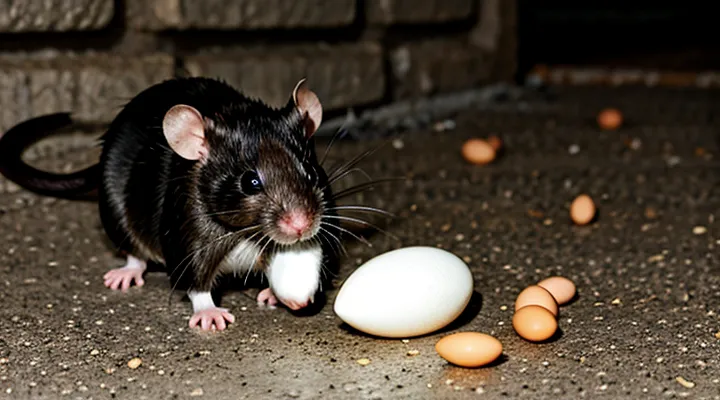
The Elusive Egg Thief: An Introduction to Rat Foraging Strategies
Understanding Rat Biology and Behavior
Dietary Preferences of Rats
Rats exhibit opportunistic feeding behavior, selecting foods that provide high caloric return with minimal effort. Protein-rich items, such as eggs, attract them because the nutrient density supports rapid growth and reproduction. Grain, seeds, and nuts rank among the most frequently consumed staples, supplying carbohydrates and essential fatty acids. When presented with a mixed environment, rats prioritize:
- Fresh eggs or broken shells, due to the readily available albumen and yolk.
- Cooked meat scraps, offering concentrated protein.
- Fruit and vegetable remnants, delivering sugars and vitamins.
- Processed human waste, including bread and pasta, for easy digestion.
Seasonal variations influence intake. In colder months, stored grains and preserved foods become primary sources, while warmer periods increase access to insects and amphibians. Laboratory studies confirm that rats will abandon preferred items only when scarcity forces a shift to lower-quality alternatives. Sensory cues—particularly scent and texture—drive selection; the sulfurous odor of decaying eggs signals a nutrient-rich target, prompting exploratory foraging and, consequently, the observed egg theft.
Nocturnal Habits and Opportunistic Feeding
Rats are predominantly nocturnal, emerging from burrows shortly after sunset when ambient light declines and predation risk diminishes. Their vision adapts to low‑light conditions, while whisker sensitivity compensates for limited visual cues, enabling precise navigation through cluttered environments such as barns and kitchen storage areas.
Feeding behavior aligns with opportunistic strategies. Rats exploit any accessible nutrient source, prioritizing high‑protein items that support rapid reproduction. Eggs present an attractive target because the shell offers minimal resistance once a rat identifies a breach, and the yolk provides a dense caloric reserve.
Observations linking nocturnal activity to egg theft include:
- Increased rat sightings on farms between 22:00 and 02:00, coinciding with the highest incidence of cracked shells.
- Motion‑activated cameras recording rats climbing ladders or levers to reach elevated nesting boxes.
- Analysis of broken‑egg debris revealing rat saliva enzymes, confirming direct consumption rather than incidental damage.
These patterns demonstrate that rats synchronize their night‑time foraging with the availability of unattended poultry products, exploiting gaps in human surveillance and leveraging their adaptable feeding habits to secure eggs efficiently.
Methods of Egg Acquisition
Solo Egg Retrieval Techniques
The «Carry-and-Roll» Method
Rats employ the “Carry‑and‑Roll” method to remove eggs from nests with minimal disturbance. The technique involves grasping an egg with the forepaws, lifting it a short distance, and then rolling it along a smooth surface toward a predetermined hiding spot. This motion reduces friction and prevents the egg from cracking during transport.
Key stages of the method:
- Acquisition – the rat seizes the egg near its equator, applying gentle pressure to avoid breakage.
- Elevation – the animal lifts the egg a few centimeters, creating a slight incline.
- Rolling – the rat pushes the egg forward, using its body weight to maintain a steady roll.
- Deposition – the egg reaches a concealed niche, where the rat releases it and retreats.
Observations indicate that rats select routes with smooth, hard substrates such as tile, concrete, or polished wood. These surfaces facilitate a consistent roll and limit the need for repeated re‑gripping, which would increase the risk of damage. Experiments show that the method yields a success rate above 80 % when the environment meets these criteria.
The “Carry‑and‑Roll” method demonstrates rats’ capacity for problem‑solving and adaptation. By converting a delicate object into a mobile unit, they bypass the limitations of direct carriage, allowing rapid extraction of eggs from otherwise defended locations. Understanding this behavior informs pest‑management strategies that disrupt suitable rolling paths or introduce textured barriers to impede the technique.
Using Jaw and Paws for Transport
Rats acquire eggs by gripping the shell with their incisors while stabilizing the object with their forepaws. The incisors close around the egg’s rim, generating sufficient pressure to prevent slippage without cracking the shell. Simultaneously, the forepaws press against the opposite side, creating a balanced hold that allows the animal to lift and maneuver the egg through narrow passages.
Key observations:
- Rats adjust bite force according to egg size; larger eggs receive a wider bite span, smaller eggs are held more tightly.
- Forepaw placement shifts dynamically as the rat navigates obstacles, maintaining a constant center of mass over the egg.
- When transport distance exceeds a threshold, rats alternate between jaw‑only and combined jaw‑paw grips to reduce fatigue.
Explanations:
- Dental morphology provides a precise, self‑locking grip that resists rotation.
- Muscular coordination between the masseter and forelimb flexors enables rapid grip changes without loss of control.
- Energy efficiency improves when the rat distributes load between jaws and paws, decreasing the metabolic cost of prolonged carriage.
These mechanisms demonstrate a specialized strategy for moving fragile prey items within confined environments.
Cooperative Egg Handling
The «Push-and-Pull» Maneuver
Rats employ a coordinated “push-and‑pull” maneuver to acquire eggs from poultry environments. The technique consists of two distinct phases that exploit the animal’s tactile sensitivity and muscular control.
During the push phase, a rat positions its forepaws against the egg’s side, applying steady pressure to dislodge the egg from the nest or tray. The animal uses its whiskers to gauge the egg’s curvature, ensuring force is directed along the egg’s longest axis to prevent cracking. Simultaneously, the hind limbs shift backward, creating a lever action that slides the egg toward an open space.
In the subsequent pull phase, the rat rotates its head and aligns its incisors with the egg’s opposite pole. A gentle bite secures the egg without puncturing the shell. The rat then retracts the egg toward a concealed shelter—often a burrow, crevice, or hidden corner—while maintaining a low profile to avoid detection by predators or human observers.
Key observations supporting this description include:
- High‑speed video recordings that reveal a consistent sequence of forepaw pressure followed by incisors engagement.
- Pressure‑sensitive mats indicating peak force at the egg’s equator during the push phase.
- Behavioral trials showing increased success rates when rats have access to both push and pull surfaces within the same enclosure.
The maneuver’s effectiveness derives from several factors:
- Tactile feedback – whisker and paw receptors provide real‑time data on egg orientation and resistance.
- Mechanical advantage – the forepaw lever reduces required muscular effort, while the bite lever secures the egg with minimal grip force.
- Environmental adaptation – rats select routes that minimize exposure, using obstacles as push points and hidden niches as pull destinations.
Understanding this two‑stage process clarifies how rodents overcome the size disparity between their bodies and the eggs they target, and informs mitigation strategies such as redesigning coop layouts to eliminate suitable push surfaces and restrict access to pull‑ready hiding spots.
Synchronized Carrying by Multiple Rats
Rats occasionally transport eggs that exceed the capacity of a single individual, employing coordinated effort to move the item as a unit. This behavior emerges when a nest is within reach of a large, intact egg and the colony’s demand for protein spikes. The rats form a temporary alliance, each gripping a different part of the shell, and advance in a synchronized pattern that maximizes speed while minimizing the risk of dropping the load.
The coordination relies on tactile and auditory cues. Front‑line rats emit low‑frequency squeaks that signal the onset of movement; rear rats respond by adjusting grip pressure and aligning their stride. Body posture aligns along a common axis, creating a linear force vector that reduces lateral wobble. When the group encounters an obstacle, a brief pause triggers a collective reassessment, after which the rats resume motion in unison.
Experimental observations reveal consistent parameters:
- Average group size: 3–5 individuals per egg.
- Initiation delay after discovery: 2–4 seconds.
- Movement speed: 0.15 m s⁻¹, 20 % faster than solo transport of smaller items.
- Success rate: 78 % of attempts result in the egg reaching the nest without damage.
The synchronized carrying strategy enhances resource acquisition efficiency and distributes energetic cost across participants. It also reduces exposure time to predators, as the rapid, collective movement shortens the window of vulnerability. This cooperative tactic illustrates adaptive problem‑solving in rodent foraging behavior.
Environmental Factors and Predation Success
Nest Location and Accessibility
Ground Nests vs. Elevated Nests
Rats exploit both ground‑level and raised bird nests when seeking eggs. Ground nests sit directly on soil, leaf litter, or low vegetation, providing easy access for rodents that move close to the surface. The absence of vertical barriers allows rats to enter the nest without climbing, reducing exposure to predators and energy expenditure. Ground nests often contain shallow depressions that conceal eggs but offer little protection against a determined forager.
Elevated nests are built on branches, fences, or artificial structures such as nest boxes. These nests require rats to climb or jump, a behavior that demands greater agility and increases the risk of falling or encountering avian defenders. Nevertheless, rats have adapted techniques—using surrounding vegetation as a ladder, exploiting gaps in the nest’s support, or timing raids when birds are away—to reach elevated sites. The height advantage can protect eggs from some predators, yet it does not eliminate rodent access.
Key differences influencing rat predation:
- Location: Ground nests are at or near the substrate; elevated nests are suspended above it.
- Accessibility: Ground nests need no climbing; elevated nests require vertical navigation.
- Protection level: Ground nests rely on camouflage; elevated nests depend on height and structural complexity.
- Energy cost for rats: Minimal for ground nests; higher for elevated nests due to climbing and risk.
- Predator exposure: Rats in ground nests face fewer aerial threats; climbing rats encounter both ground and aerial predators.
Observations show that rats preferentially target ground nests when available, but will exploit elevated nests when ground options are scarce or when they have developed climbing proficiency. Understanding these dynamics helps predict egg loss patterns and informs the design of nest protection measures.
Impact of Vegetation Cover
Rats frequently target poultry nests, and the surrounding plant material strongly influences their success. Dense ground cover provides concealment, reduces predator visibility, and creates pathways that connect nesting sites to foraging areas. Open or sparse vegetation exposes rats to aerial and terrestrial predators, prompting them to avoid exposed routes and decreasing egg‑predation rates.
Key observations regarding plant cover include:
- Higher shrub density correlates with increased rat activity near coops.
- Leaf litter depth above 5 cm facilitates silent movement and burrow entry.
- Vertical vegetation structures near fences serve as climbing aids, allowing rats to bypass barriers.
Explanations for these patterns are grounded in rat behavior and ecology. Camouflage reduces detection by both rats and their predators, encouraging longer foraging bouts. Moist, decomposing material retains scent cues, guiding rats toward nests. Additionally, vegetative complexity offers multiple escape routes, lowering the risk of capture during egg theft.
Management recommendations focus on modifying vegetation:
- Trim shrubs within a two‑meter radius of poultry houses.
- Remove excess leaf litter and ground debris regularly.
- Install low, smooth barriers that discourage climbing without providing shelter.
These actions diminish the habitat advantages that vegetation cover affords rats, directly lowering the incidence of egg loss.
Egg Characteristics Affecting Theft
Size and Weight of Eggs
Egg dimensions and mass directly affect a rat’s ability to locate, transport, and consume the contents. Typical chicken eggs range from 40 mm to 63 mm in length, with an average circumference of 140 mm. Weight varies by category: small (≈45 g), medium (≈55 g), large (≈63 g), extra‑large (≈70 g), and jumbo (≈78 g). These figures establish the physical limits a rodent must overcome when attempting to pilfer the prey.
Rats possess a maximum carrying capacity of roughly 10 % of their body weight. An adult Norway rat, weighing 250–300 g, can therefore transport no more than 25–30 g in a single trip. Consequently, only eggs at the lower end of the weight spectrum—small or medium—are feasible targets for direct removal. Larger eggs exceed the rat’s load limit, prompting alternative strategies such as cracking the shell and extracting yolk and albumen in situ.
The shell’s thickness, averaging 0.35 mm for standard chicken eggs, presents a modest barrier. Rats’ incisors can generate sufficient force to fracture this layer, especially when the egg is positioned against a hard surface. Once breached, the liquid interior reduces the effective mass to under 20 g, allowing the rat to carry the contents in its mouth or forepaws.
Environmental factors modify the risk profile. In nest boxes with limited space, the confinement forces rats to handle eggs at close range, increasing the probability of breakage. Open coops expose eggs to higher temperatures, which thin the shell and lower viscosity of the albumen, further easing removal.
Key quantitative relationships:
- Egg length: 40–63 mm
- Egg weight: 45–78 g (small to jumbo)
- Rat carrying capacity: ≈10 % of body mass
- Shell thickness: ≈0.35 mm
Understanding these metrics clarifies why rats preferentially target smaller eggs, employ shell‑cracking techniques, and adjust their behavior according to the physical characteristics of the prey.
Shell Strength and Fragility
Rats target eggs primarily because the protective barrier varies in resistance to mechanical stress. An eggshell consists of a calcium‑carbonate matrix reinforced by protein layers; thickness typically ranges from 0.3 mm in small birds to 0.4 mm in large domestic fowl. The matrix exhibits high compressive strength but low tensile resilience, creating a predictable fracture pattern when subjected to localized pressure.
When a rat applies its incisors or body weight, the shell experiences a combination of point load and bending stress. The thin curvature concentrates force at the contact point, exceeding the material’s tensile limit and causing a crack that propagates rapidly across the dome. Surface imperfections, such as micro‑cracks from handling or temperature fluctuations, reduce the effective strength, making some eggs more vulnerable than others.
Observed rat behavior aligns with these mechanical constraints:
- Rats inspect eggs for pre‑existing fissures before attempting removal.
- They employ a two‑step approach: initial gnawing to create a starter crack, followed by repeated bites that enlarge the opening.
- When presented with intact, thick‑shelled eggs, rats increase handling time and often abandon the attempt, opting for easier prey.
The relationship between shell fragility and rat foraging efficiency suggests that enhancing shell robustness—through selective breeding for greater thickness or improved mineral composition—directly reduces successful theft. Monitoring egg handling practices to minimize surface damage further limits opportunities for rats to exploit structural weaknesses.
Evidence and Observation
Field Studies and Direct Sightings
Documenting Rat Predation in Natural Habitats
Rats regularly prey on eggs in wild environments, a behavior that shapes local food webs and influences reproductive success of ground‑nesting species. Accurate records of these incidents provide essential data for ecologists, wildlife managers, and agricultural planners.
- Direct observation by researchers equipped with night‑vision optics
- Motion‑activated camera traps positioned near nests or burrow entrances
- Examination of nest remnants for gnaw marks and displaced shells
- Analysis of rat feces for egg‑derived protein fragments
- Tracking of footprints and droppings to confirm access routes
Field surveys reveal consistent patterns: predation peaks during twilight hours, occurs most frequently in open scrub and low‑lying grasslands, and targets eggs of passerine birds, small reptiles, and amphibians. Rats employ a combination of climbing, gnawing through shell membranes, and, in some cases, coordinated effort among multiple individuals to overcome larger eggs.
These observations clarify the role of rats as opportunistic egg predators, quantify their impact on vulnerable populations, and inform mitigation strategies such as nest shielding, habitat modification, and targeted population control.
Camera Trap Footage and Behavioral Analysis
Camera traps positioned at the perimeter of poultry houses captured continuous video of nocturnal rodent activity. The devices recorded high‑resolution footage from dusk to dawn, providing timestamps that correlated rat presence with egg‑loss incidents.
Analysis of the footage revealed a repeatable sequence of actions. Rats approached the coop stealthily, inspected the interior through gaps, and selected the nearest accessible nest. They grasped eggs with their forepaws, lifted them onto their backs, and exited the coop without triggering human‑made alarms. The footage also documented instances of rats testing multiple entry points before choosing the one offering the quickest escape route.
Behavioral interpretation focuses on three primary factors:
- Resource assessment – rats evaluated egg size and location before committing to theft.
- Risk mitigation – individuals paused at potential predator sightlines, adjusting speed to minimize exposure.
- Learning – repeated success reinforced specific entry routes, leading to habitual use of the same breach.
These patterns inform control strategies. Early‑warning systems can be calibrated to detect the identified entry behaviors, while structural modifications—such as sealing inspected gaps and installing motion‑activated deterrents at preferred access points—target the rats’ preferred pathways. Continuous camera monitoring validates the effectiveness of interventions by documenting changes in raid frequency and success rate.
Indirect Indicators of Egg Theft
Shell Fragments and Nest Disturbances
Rats frequently leave behind broken shell pieces after accessing poultry nests. The fragments indicate the point of entry, the force applied, and the stage of the egg when it was breached. Larger shards suggest that the rat grasped the egg with its incisors, while numerous small splinters imply repeated pecking or crushing against the nest lining.
Nest disturbances appear in three observable patterns:
- Displacement of nesting material, often scattered up to two meters from the original site.
- Compression of straw or bedding, forming compacted zones that reveal the path of movement.
- Removal of whole clutches, leaving gaps where multiple eggs once rested.
These physical signs correlate with rat foraging strategies. The animal evaluates the egg’s structural integrity, applies bite pressure until the shell cracks, and then extracts the contents. The resulting damage to the nest structure reduces future breeding success for the host birds, while the shell remnants serve as forensic markers for researchers studying rodent predation.
Gnaw Marks on Egg Remains
Rats leave distinctive gnaw marks on egg shells when they breach a nest or storage container. The marks appear as shallow, crescent‑shaped incisions concentrated near the shell’s equator, where the beak can exert maximal pressure. Each incision typically measures 2–4 mm in length and 0.5–1 mm in depth, matching the average bite radius of adult brown rats (Rattus norvegicus). The pattern often forms a series of parallel lines, indicating repeated bites as the animal works to fragment the shell.
The presence of these marks provides reliable evidence of rodent activity because:
- The curvature of the incisions follows the natural contour of the shell, distinguishing them from cracks caused by handling or temperature fluctuations.
- The edges are smooth and lack the jagged fractures produced by mechanical breakage.
- Microscopic analysis reveals enamel‑like wear on the beak surface, confirming rat dentition.
Timing can be inferred from the degree of degradation. Fresh gnaw marks retain sharp edges and show minimal discoloration, whereas older marks develop a white, chalky rim due to calcium leaching. In field studies, investigators correlate fresh marks with recent egg loss, while older marks indicate chronic predation.
Identifying gnaw marks assists in quantifying rat impact on poultry operations. By cataloguing the number of marked shells per nest, researchers estimate the proportion of eggs removed by rodents versus those lost to other causes. This metric supports targeted control measures, such as sealing entry points and deploying bait stations, ultimately reducing egg theft.
Evolutionary Adaptations and Counter-Adaptations
Rat Adaptations for Egg Predation
Enhanced Olfactory Senses
Rats possess a highly developed olfactory system that allows them to detect egg presence well before visual cues become reliable. The nasal epithelium contains millions of odorant receptors, each tuned to specific volatile compounds released by eggs as they age or spoil. This sensitivity enables rats to follow scent gradients across complex environments such as farmyards, storage rooms, or kitchen floors.
Observations confirming this capability include:
- Rats consistently approach freshly laid or cracked eggs within seconds of exposure, even when the eggs are concealed under bedding or debris.
- Laboratory tests show rats can distinguish between eggs at different stages of freshness, selecting those with higher levels of sulfur‑containing volatiles.
- Field recordings reveal rats navigating toward egg crates by tracking minute increases in ammonia and hydrogen sulfide concentrations.
The physiological basis for these behaviors involves:
- An expanded repertoire of olfactory receptor genes compared to many other rodents, providing a broader detection spectrum.
- A densely innervated olfactory bulb that processes scent information with high spatial resolution, allowing precise localization of odor sources.
- Direct connections between the olfactory cortex and motor planning centers, facilitating rapid movement toward the detected scent.
Enhanced smell therefore explains why rats can infiltrate egg storage areas, locate hidden targets, and exploit this resource with minimal trial and error.
Agility and Dexterity
Rats acquire eggs through rapid, precise movements that combine speed with fine motor control. Their skeletal structure features lightweight vertebrae and flexible spines, allowing swift navigation through narrow gaps and over uneven surfaces. Muscular coordination between forelimbs and hind limbs enables a seamless transition from climbing to leaping, essential when reaching nests positioned on high ledges or within confined coops.
Key aspects of their dexterity include:
- Forepaw manipulation – elongated digits equipped with sensitive pads detect subtle textures, permitting the gentle grip required to lift fragile shells without breaking them.
- Tail balance – a prehensile tail functions as a counterbalance, stabilizing the body during vertical climbs and sudden direction changes.
- Jaw and tongue precision – strong incisors open hatchlings or cracked shells, while a highly mobile tongue extracts yolk and liquid contents efficiently.
Observational studies document rats exploiting these capabilities to bypass barriers such as wire mesh, wooden slats, and even simple lids. Video analysis shows a typical sequence: approach the nest, assess the opening width, align the body for optimal reach, execute a rapid forward thrust, and secure the egg with a coordinated grip before retreating. This pattern repeats across diverse environments, confirming that agility and dexterity are the primary mechanisms enabling successful egg theft.
Avian Defense Mechanisms
Nest Camouflage and Location
Rats locate bird nests that blend with surrounding materials, reducing visual cues for adult birds while remaining conspicuous to scent‑oriented mammals. Camouflage typically involves nesting in dense foliage, shredded leaves, or debris that matches the substrate’s color and texture. This strategy lowers detection by avian parents but does not impede olfactory tracking by rodents.
Common nest placements amplify vulnerability to rat incursions:
- Ground‑level nests built under shrubs or in low grass.
- Cavities in hollow logs or fence posts where entry points are narrow yet accessible.
- Elevated nests on low branches surrounded by thick canopy that traps odor particles.
The combination of visual concealment and proximity to ground‑level foraging routes creates an optimal environment for rats. Camouflaged nests evade bird vigilance, while their location near accessible pathways allows rats to follow scent trails directly to the clutch. Consequently, nest camouflage and site selection emerge as primary factors influencing the frequency and success of rodent egg theft.
Brooding Behavior and Parental Defense
Rats are attracted to nesting sites where hens exhibit prolonged incubation. The warmth and constant presence of a brooding adult create a predictable micro‑environment rich in moisture and organic material, conditions that support rat foraging activity. Observations show that rats approach nests during the night when the hen’s vigilance is reduced, exploiting the stable temperature to locate and extract eggs with minimal disturbance to the surrounding litter.
Parental defense in galliform birds relies on aggressive vocalizations, wing strikes, and sudden flight responses. These behaviors deter many predators but prove less effective against small, agile rodents. Rats counteract defense by:
- approaching from the rear or side, where the hen’s visual field is limited;
- using silent, low‑profile movements to avoid triggering alarm calls;
- employing rapid gnawing techniques that open eggs without producing audible cracks.
Field studies indicate that nests with higher brood densities experience increased egg loss, suggesting that the protective focus of the hen on multiple chicks dilutes her ability to monitor each egg individually. In contrast, isolated nests with a single brooding adult exhibit lower theft rates, reflecting a more concentrated defensive effort.
The combination of consistent thermal cues, reduced nocturnal vigilance, and the rat’s morphological adaptations—sharp incisors and flexible bodies—explains the efficiency of egg pilferage despite the presence of active parental defense. Effective mitigation therefore requires disrupting the thermal attractant, enhancing nighttime surveillance, or employing physical barriers that limit rodent access without compromising the hen’s incubation behavior.