
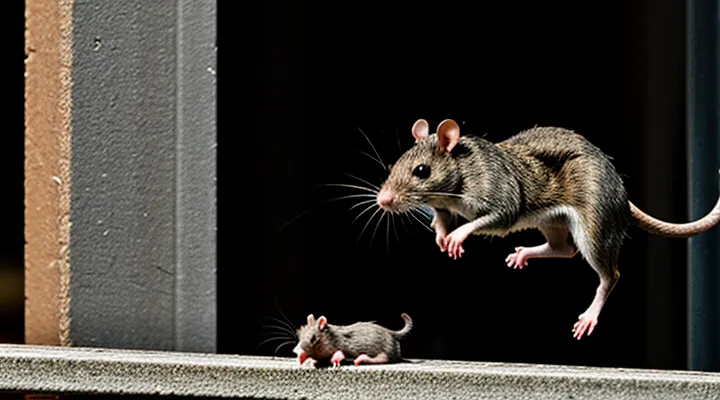
«Factors Influencing Jump Height»
«Species and Size»
Rats differ markedly in morphology, and these differences determine the vertical distances they can achieve. The most common species examined for locomotor performance are the Norway (brown) rat (Rattus norvegicus) and the black rat (Rattus rattus). Their body masses range from 150 g to 300 g for the larger Norway rat and from 80 g to 150 g for the smaller black rat. Muscle fiber composition, limb length, and tail balance all scale with size, influencing the maximum leap.
- Norway rat – average mass ≈ 250 g; hind‑limb length ≈ 5 cm; recorded vertical jumps up to 60 cm.
- Black rat – average mass ≈ 120 g; hind‑limb length ≈ 4 cm; recorded vertical jumps up to 45 cm.
- Laboratory rat (specific strains) – mass ≈ 200 g; hind‑limb length ≈ 4.5 cm; vertical jumps typically 50–55 cm.
- Wild dwarf rats (e.g., Rattus nitidus) – mass ≈ 80 g; hind‑limb length ≈ 3.5 cm; vertical jumps recorded around 30 cm.
Size reduction correlates with decreased absolute jump height, yet the ratio of jump height to body length remains relatively constant across species, averaging 1.2 – 1.5 body lengths. Larger rats generate greater absolute force, enabling higher leaps, while smaller rats compensate with higher relative power output.
Understanding the interplay between species taxonomy and body dimensions provides a reliable framework for predicting vertical performance in any rat population.
«Motivation and Environment»
Rats initiate vertical leaps primarily to escape predators, reach elevated food sources, and navigate complex burrow systems. The behavior reflects an innate drive to maximize survival opportunities, triggered by sudden stimuli such as shadows, vibrations, or sudden changes in airflow. Laboratory observations show that motivational intensity correlates with the distance and speed of approaching threats, prompting higher jumps when escape routes are limited.
Environmental conditions exert measurable influence on the height achieved during a leap. Factors include:
- Substrate firmness: softer surfaces absorb kinetic energy, reducing peak elevation.
- Ambient temperature: lower temperatures decrease muscle contractility, limiting jump power.
- Light intensity: dim environments heighten alertness, often resulting in more vigorous jumps.
- Spatial constraints: confined spaces encourage rapid, higher jumps to overcome obstacles.
- Stress hormones: elevated cortisol levels can either enhance or suppress performance depending on the duration of exposure.
Understanding the interaction between motivational triggers and environmental variables enables accurate prediction of a rat’s maximal vertical displacement under varying experimental or natural settings.
«Physical Condition»
Rats possess a muscular and skeletal structure optimized for rapid, vertical movement. Their hind‑limb muscles—primarily the gastrocnemius and soleus—generate the force required to propel the body upward. The proportion of fast‑twitch fibers in these muscles enables short, powerful bursts, allowing a typical laboratory rat to clear a vertical distance of approximately 30–45 cm from a standing start.
Key physiological attributes influencing jump height include:
- Muscle mass and fiber composition: Greater hind‑limb muscle volume and a higher ratio of fast‑twitch fibers increase explosive power.
- Joint flexibility: Extended ankle and knee articulation permits a larger range of motion during the take‑off phase.
- Neuromuscular coordination: Precise timing of muscle activation maximizes force transfer and minimizes energy loss.
- Body weight: Lower mass reduces the gravitational load that must be overcome, enhancing achievable height.
Environmental factors such as surface traction and the presence of a launch platform can alter performance, but the intrinsic physical condition remains the primary determinant of a rat’s vertical leap.
«Typical Jumping Ranges»
«Vertical Jump Capabilities»
Rats demonstrate remarkable vertical leap performance relative to body size. Laboratory measurements indicate that common brown rats (Rattus norvegicus) can clear obstacles up to 30 cm (≈ 12 in) when propelled from a stationary stance, equivalent to roughly 1.5 times their torso length. Muscular power output in the hindlimbs, combined with rapid limb extension, accounts for this capability.
Key physiological determinants of rat vertical jump include:
- Muscle fiber composition – predominance of fast‑twitch fibers in the gastrocnemius and quadriceps.
- Tendon elasticity – storage and release of elastic energy during the crouch‑stretch cycle.
- Neuromuscular coordination – precise timing of motor unit recruitment to maximize impulse.
- Body mass distribution – low center of gravity and lightweight torso reduce required lift force.
Experimental protocols typically involve a transparent platform equipped with motion‑capture markers. Rats are encouraged to jump onto a raised platform by a food incentive, while high‑speed cameras record take‑off velocity and angle. Data analysis yields take‑off speed around 2.5 m s⁻¹ and launch angles near 45°, optimal for maximizing height.
Comparative observations show that larger rodent species, such as guinea pigs, achieve lower relative heights, whereas smaller mice reach heights exceeding 40 cm. The disparity underscores the influence of scaling laws on muscular power and limb mechanics.
«Horizontal Jump Capabilities»
Rats display remarkable horizontal propulsion, often exceeding their body length in a single leap. Laboratory measurements on adult Norway rats (Rattus norvegicus) report average distances of 0.8 m to 1.2 m when launched from a static start on a smooth surface. Exceptional individuals reach up to 1.5 m under optimal conditions.
Key determinants of horizontal performance include:
- Limb musculature: fast‑twitch fibers in the hind limbs generate peak forces of 6–8 N kg⁻¹, enabling rapid acceleration.
- Tail posture: upward tail extension stabilizes the center of mass, reducing rotational drift.
- Substrate friction: high‑traction surfaces increase push‑off efficiency, while low‑friction planes reduce achievable distance by 15–30 %.
- Motivation level: escape or food‑driven stimuli produce longer jumps than passive trials.
- Age and health: mature, healthy rats achieve peak distances; juveniles and geriatric specimens show 20–40 % reductions.
Biomechanically, the horizontal leap relies on a crouch‑then‑extension sequence that stores elastic energy in the Achilles tendon and releases it within 120 ms. Stride length during the launch phase reaches 0.35 m, and take‑off velocity averages 2.5 m s⁻¹. Airborne time, typically 0.25 s, allows a flight distance that matches the observed measurements.
Comparative data indicate that rats outperform many small mammals in planar jump distance relative to body length. For instance, house mice achieve 0.6–0.9 m, while squirrels exceed 2 m but possess longer limbs and lower body mass. The rat’s balance of muscular power and compact morphology makes it a model organism for studying locomotor optimization in confined environments.
«Comparing with Other Rodents»
Rats can achieve vertical leaps of approximately 30 cm (12 in) when motivated by escape or pursuit. This capability exceeds that of many similarly sized mammals but falls short of some larger rodents.
- House mouse (Mus musculus): maximum jump around 15 cm (6 in), limited by lower body mass and shorter hind‑limb proportion.
- Norway rat (Rattus norvegicus): typical vertical reach 30 cm (12 in), with occasional bursts up to 45 cm (18 in) under extreme stimulus.
- Capybara (Hydrochoerus hydrochaeris): can clear obstacles up to 60 cm (24 in) due to powerful hind limbs and greater muscle mass.
- Guinea pig (Cavia porcellus): jumps rarely exceed 10 cm (4 in), reflecting a more sedentary locomotor pattern.
- Squirrel (Sciurus spp., non‑rodent but comparable): exploits vertical jumps of 70 cm (28 in) or more, aided by elongated tail for balance.
The rat’s jump height positions it between small murine species and larger, more muscular rodents. Muscular composition, hind‑limb length, and behavioral urgency are primary determinants of the observed differences.
«Implications for Pest Control»
«Preventative Measures»
Rats possess remarkable vertical ability, allowing them to clear obstacles that exceed a foot in height. When this capability threatens laboratory safety, structural integrity, or containment protocols, targeted preventative actions become essential.
Physical barriers provide the most reliable control. Mesh screens with apertures no larger than ¼ inch, installed above cages and ventilation openings, stop upward movement. Reinforced lids and snap‑fit covers on equipment prevent accidental escape. Slip‑resistant flooring reduces foothold strength, limiting the launch surface available to the animal.
Environmental adjustments diminish the incentive to jump. Maintaining stable temperature and humidity lowers metabolic drive for exploratory leaps. Removing elevated objects such as food trays or enrichment platforms that serve as launch pads eliminates convenient take‑off points. Lighting schedules aligned with the rat’s circadian rhythm reduce nocturnal activity spikes that often precede jumping attempts.
Health monitoring supports prevention indirectly. Regular veterinary checks detect musculoskeletal issues that might cause compensatory over‑jumping. Prompt treatment of injuries curtails abnormal behavior that could increase vertical excursions.
Procedural safeguards reinforce the physical and environmental layers. Staff training on proper cage handling ensures lids are secured before transport. Routine inspections of barrier integrity identify wear before failure. Documentation of any breach, followed by immediate corrective action, maintains a closed feedback loop.
Key preventative measures
- Install fine‑mesh screens and secure lids on all enclosures.
- Apply non‑slip flooring beneath cages and workstations.
- Eliminate elevated objects that serve as launch platforms.
- Regulate ambient conditions to match species‑specific comfort zones.
- Conduct scheduled veterinary examinations for musculoskeletal health.
- Train personnel in proper handling and barrier verification.
- Perform weekly integrity audits of containment structures.
Implementing these steps reduces the likelihood of rats achieving heights that compromise safety or experimental validity.
«Designing Rat-Proof Barriers»
Rats can clear vertical gaps of up to 12 inches (30 cm) when motivated, a capability that must be accounted for in any barrier design intended to prevent entry. Effective rat-proofing therefore requires sealing openings larger than this threshold and incorporating materials that resist gnawing and climbing.
Key design elements include:
- Overlap joints by at least 2 inches (5 cm) to eliminate gaps.
- Use stainless steel mesh with apertures no larger than ¼ inch (6 mm); this size prevents both passage and chewing.
- Install flashing or metal skirts that extend outward and downward at least 6 inches (15 cm) to block upward jumps.
- Apply rigid, non‑flexible sealants around pipe penetrations and conduit entries to maintain a continuous barrier.
- Incorporate smooth, non‑porous surfaces on the exterior of the barrier to reduce foothold opportunities.
Materials such as galvanized steel, hardened aluminum, or reinforced concrete provide the durability required to withstand repeated attempts. Fasteners should be corrosion‑resistant and secured with tamper‑proof screws to avoid loosening over time.
Regular inspection is essential. Verify that all seams remain intact, that mesh is free of damage, and that no vegetation or debris creates new climbing aids. Prompt repair of any compromise restores the barrier’s integrity and maintains protection against rodents capable of significant vertical leaps.
«Understanding Rat Behavior for Effective Control»
Rats possess a muscular hind‑limb structure that allows rapid, powerful thrusts capable of overcoming vertical obstacles. Measurements of laboratory specimens indicate maximum vertical displacements ranging from 18 cm to 30 cm, depending on body condition and motivation. The jump height directly reflects the animal’s ability to escape low‑lying barriers and to access elevated food sources.
Muscle fiber composition, tendon elasticity, and a highly flexible spine create a spring‑like mechanism. When a rat crouches, the hind limbs store elastic energy; release of this energy generates acceleration sufficient to clear obstacles up to a foot high. Younger, lighter individuals achieve greater heights, while heavier adults exhibit reduced vertical reach but maintain sufficient force to breach modest barriers.
Environmental variables modulate performance. Moisture on surfaces reduces traction, limiting take‑off efficiency. Temperature influences muscle contractility; cooler conditions depress power output, lowering jump height. Lighting conditions affect risk assessment, prompting more vigorous jumps in low‑light scenarios when escape urgency rises.
Effective control programs must account for these capabilities. Strategies include:
- Installing vertical barriers at least 45 cm high, exceeding the documented maximum jump range.
- Using smooth, non‑slippery materials for barrier surfaces to preserve traction.
- Placing traps below the barrier level to intercept rats that attempt to climb rather than jump.
- Implementing temperature‑controlled environments to reduce muscular performance during peak activity periods.
By integrating knowledge of rat locomotion into exclusion design, pest managers can reduce escape incidents, improve trap success rates, and achieve sustained population suppression.