
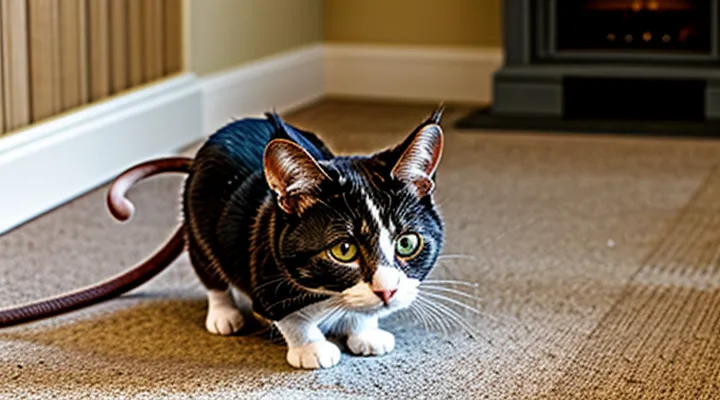
«The Feline Auditory System: An Overview»
«Anatomy of the Cat Ear»
«Outer Ear Structures»
The external auditory system of a cat is optimized for detecting high‑frequency sounds such as the rapid vocalizations of a small rodent. The pinna captures sound waves and can rotate up to 180 degrees, directing them into the external auditory canal. The canal’s conical shape amplifies frequencies between 8 kHz and 30 kHz, a range that encompasses the typical squeak of a mouse.
Sound pressure reaches the tympanic membrane, which vibrates proportionally to the incoming signal. The membrane’s thin, flexible structure transmits these vibrations efficiently, preserving the temporal precision required for the cat to locate the source. Behind the membrane, the ossicular chain (malleus, incus, stapes) relays the motion to the inner ear, but the outer ear’s geometry remains the primary factor that boosts the initial acoustic energy.
Key functional aspects of the outer ear include:
- Pinna orientation: adjustable musculature enables rapid alignment with the sound source.
- Canal resonance: length and diameter create a natural amplification peak for ultrasonic components.
- Tympanic membrane tension: maintains optimal compliance for high‑frequency vibration.
These structural features collectively enhance the feline ability to perceive and react to the brief, high‑pitched emissions produced by a mouse, allowing precise spatial discrimination and swift predatory response.
«Middle Ear Mechanisms»
The cat’s auditory perception of a rodent’s high‑frequency vocalization relies on the efficiency of its middle‑ear apparatus. Sound waves entering the external auditory canal strike the tympanic membrane, which converts acoustic energy into mechanical vibration. This vibration is transmitted through the ossicular chain—malleus, incus and stapes—to the oval window of the cochlea. The lever action of the ossicles amplifies pressure, allowing detection of frequencies above 20 kHz, typical of a mouse squeak.
Key functional elements of the middle ear include:
- Tympanic membrane tension, optimized for rapid response to brief, high‑pitch sounds.
- Ossicular lever ratio (approximately 1.3 : 1), providing gain that compensates for the small size of the feline cochlea.
- Acoustic reflex, mediated by the tensor tympani and stapedius muscles, which modulates transmission to protect inner‑ear structures while preserving sensitivity to sudden, brief noises.
The stapedial footplate’s movement at the oval window generates fluid displacement within the scala vestibuli, initiating a traveling wave along the basilar membrane. The resulting pattern of hair‑cell activation encodes the frequency and intensity of the squeak, enabling the cat to locate and react to the source with millisecond precision.
«Inner Ear Components»
The feline auditory system detects rapid acoustic signals through a specialized structure located within the skull. Sound waves enter the external ear, travel through the ear canal, and reach the tympanic membrane, whose vibrations are transmitted to the middle ear ossicles. The resulting mechanical energy reaches the inner ear, where the «Inner Ear Components» convert it into neural impulses.
Key elements of the inner ear include:
- Cochlea – a fluid‑filled, spiral organ housing rows of hair cells that respond to specific frequencies. High‑frequency components of a mouse’s squeak stimulate hair cells near the base of the cochlea, producing rapid firing patterns in auditory nerve fibers.
- Organ of Corti – the sensory epithelium within the cochlea containing inner and outer hair cells. Outer hair cells amplify the incoming signal, while inner hair cells generate the primary neural output.
- Auditory nerve (VIII cranial nerve) – carries encoded frequency and intensity information from the cochlea to the brainstem. The temporal precision of the nerve’s discharge enables the cat to discriminate brief, high‑pitched squeaks.
- Vestibular apparatus – although primarily responsible for balance, its proximity to the cochlea influences the mechanical environment of the inner ear, contributing to the overall sensitivity of auditory transduction.
The interaction of these components produces a high‑resolution acoustic map in the cat’s auditory cortex. The map allows rapid identification of the squeak’s pitch, duration, and direction, supporting the animal’s predatory response.
«Frequency Range and Sensitivity in Cats»
«Comparison to Human Hearing»
Cats possess an auditory spectrum extending to approximately 64 kHz, whereas human hearing typically caps near 20 kHz. Mouse vocalizations occupy a range from 20 kHz to 100 kHz, with a pronounced ultrasonic component beyond the human threshold. Consequently, felines detect both the audible and ultrasonic portions of a rodent’s cry, while humans perceive only the lower‑frequency fragment, if any.
The feline ear exhibits heightened sensitivity to rapid pressure changes, enabling detection of sounds as faint as 0 dB SPL at frequencies around 30 kHz. Human thresholds rise sharply above 15 kHz, rendering ultrasonic elements effectively silent. Decibel levels of a mouse squeak often exceed 70 dB SPL, well within the cat’s optimal detection range, yet remain marginal for human perception.
Key comparative points:
- Frequency coverage: cats ≈ 64 kHz; humans ≈ 20 kHz.
- Sensitivity peak: feline auditory system peaks near 30–40 kHz; human peak near 2–5 kHz.
- Ultrasonic detection: present in cats, absent in humans.
- Behavioral relevance: feline hunting relies on ultrasonic cues; human response limited to audible portion.
Thus, the feline auditory apparatus processes mouse vocalizations with far greater fidelity and breadth than the human ear, providing a decisive advantage in predator‑prey interactions.
«Detecting High Frequencies»
Cats possess an auditory system tuned to frequencies well above the human hearing range. The organ of Corti contains hair cells that respond to vibrations from roughly 48 kHz to 85 kHz, a band that encompasses the ultrasonic components of many rodent vocalizations. When a mouse emits a high‑pitched squeak, the rapid oscillations stimulate the basal region of the cochlea, generating neural impulses that travel via the auditory nerve to the brainstem. The superior olivary complex evaluates interaural time differences, enabling precise localization of the source.
Key mechanisms involved in «Detecting High Frequencies» include:
- Basal cochlear specialization – hair cells with short stereocilia and stiff tectorial membranes produce fast transduction currents.
- High‑frequency tuning of auditory nerve fibers – fibers fire at rates exceeding 200 spikes · s⁻¹, preserving temporal fidelity.
- Enhanced phase locking – neurons synchronize firing to the waveform peaks, preserving fine‑structure information essential for distinguishing squeak patterns.
- Cortical amplification – the auditory cortex exhibits heightened responsiveness to ultrasonic stimuli, facilitating rapid behavioral responses.
The combined effect of these adaptations allows a cat to detect, localize, and react to mouse squeaks with millisecond precision, supporting predatory efficiency.
«A Mouse Squeak: Acoustic Properties»
«Typical Frequency Range of Mouse Vocalizations»
Mouse vocalizations cover a broad spectrum, but the most common squeaks fall between 10 kHz and 50 kHz. Within this interval, peak energy typically concentrates around 20 kHz to 30 kHz, reflecting the species’ primary communication band. Higher‑frequency components, extending up to 80 kHz, appear in distress calls and ultrasonic chirps.
Felines possess acute auditory sensitivity that overlaps the mouse squeak band. The cat’s cochlear region tuned to 20 kHz – 40 kHz registers maximal amplitude, enabling detection of subtle tonal variations. Consequently, a cat can localize a mouse’s squeak with high spatial precision, even when the source emits brief, high‑frequency bursts.
- Primary squeak range: 10 kHz – 50 kHz
- Peak energy zone: 20 kHz – 30 kHz
- Ultrasonic tail: up to 80 kHz
- Cat hearing peak: 20 kHz – 40 kHz
«Intensity and Duration of Squeaks»
The feline auditory system detects high‑frequency rodent vocalizations with a sensitivity that exceeds many other mammals. Sound pressure levels typical of mouse squeaks range from 40 dB to 80 dB at a distance of 30 cm, a range within the cat’s optimal hearing window. Increased intensity shortens the latency of the startle reflex, enhances the probability of orienting movements, and triggers a more pronounced activation of the auditory cortex.
Duration influences temporal integration in the cat’s brain. Squeaks lasting less than 100 ms are processed as discrete events, prompting rapid head‑turn responses. Longer emissions, up to 300 ms, allow the auditory system to accumulate acoustic energy, resulting in sustained attention and a higher likelihood of pursuit behavior. Temporal patterns also affect the perception of urgency; brief, sharp bursts are interpreted as alarm signals, whereas extended tones convey ongoing activity.
Key relationships between acoustic parameters and feline perception:
- Higher amplitude → faster orienting response, greater cortical activation.
- Short duration (< 100 ms) → discrete detection, immediate motor response.
- Extended duration (≥ 200 ms) → prolonged attention, increased likelihood of tracking.
- Combined high intensity and brief duration → strongest predatory trigger.
Understanding these dynamics clarifies how variations in «Intensity and Duration of Squeaks» shape the cat’s behavioral and neural response to rodent sounds.
«Acoustic Signature for Predators»
The acoustic profile of a rodent’s distress call contains distinct frequency bands, rapid onset, and brief duration. These parameters form a predator‑relevant acoustic signature that can be isolated by a feline auditory system.
A cat’s ear canal and cochlear hair cells are tuned to frequencies between 1 kHz and 64 kHz, with peak sensitivity near 8 kHz. The mouse squeak typically peaks around 5–10 kHz, overlapping the feline auditory window. Temporal resolution allows discrimination of the squeak’s rise time, which is shorter than that of ambient sounds. This physiological match enables rapid extraction of the predator‑specific acoustic signature.
Consequences for hunting behavior include:
- Immediate head orientation toward the sound source.
- Activation of the auditory‑motor pathway within 20 ms.
- Initiation of a stalking sequence when the signature exceeds a threshold amplitude.
The acoustic signature for predators thus serves as a reliable cue that drives predatory attention, localization, and motor preparation in felines.
«Processing Mouse Squeaks: The Cat's Brain»
«Auditory Pathways to the Brain»
«Cochlear Nucleus Role»
The cochlear nucleus serves as the initial brainstem hub that receives acoustic signals from the auditory nerve. In the feline auditory pathway, this structure separates incoming frequencies and extracts temporal patterns essential for distinguishing brief, high‑frequency sounds produced by small prey.
Neural processing within the cochlear nucleus includes:
- Frequency discrimination – bushy and stellate cells generate precise timing cues that preserve the spectral content of a squeak.
- Phase locking – neurons fire in synchrony with the waveform, maintaining the rapid oscillations characteristic of rodent vocalizations.
- Signal amplification – excitatory and inhibitory circuits enhance the signal‑to‑noise ratio, allowing the cat to detect faint squeaks amid environmental sounds.
Outputs from the cochlear nucleus project to higher auditory centers such as the superior olivary complex and the inferior colliculus. These downstream stations integrate binaural information, refine spatial localization, and contribute to the rapid orienting response observed when a cat hears a mouse’s distress call.
Overall, the cochlear nucleus provides the foundational analysis that transforms raw acoustic energy into a neural representation capable of guiding predatory behavior. Its specialized circuitry ensures that the feline auditory system can resolve the brief, high‑frequency components of a squeak and generate appropriate motor responses.
«Superior Olivary Complex and Sound Localization»
The feline auditory system extracts spatial cues from the brief, high‑frequency burst emitted by a small rodent. Initial transduction occurs in the cochlea, where frequency‑specific hair cells generate neural spikes that travel via the auditory nerve to brainstem nuclei.
The first brainstem hub that integrates binaural information is the «Superior Olivary Complex». This structure contains two main subdivisions.
- The medial superior olive (MSO) computes interaural time differences, providing precise timing data for low‑frequency components of the squeak.
- The lateral superior olive (LSO) evaluates interaural level differences, delivering intensity‑based localization for higher frequencies.
Both nuclei project to the inferior colliculus, where the combined temporal and intensity cues are refined into a directional map. In cats, the SOC processes microsecond‑scale disparities, enabling rapid orientation toward the source of the squeak.
The SOC’s output reaches the auditory cortex, where the spatial representation guides motor responses such as head turning and pouncing. The tight coupling between SOC processing and cortical planning explains the cat’s ability to locate a moving prey item within milliseconds of the sound’s onset.
«Inferior Colliculus Integration»
The auditory system of a feline species processes high‑frequency sounds with exceptional precision. Sound waves generated by a small rodent are transmitted through the outer ear, converted into neural signals by the cochlea, and relayed via the auditory nerve to brainstem nuclei. Early processing occurs in the cochlear nucleus, where temporal patterns of the squeak are extracted and forwarded to the midbrain.
The inferior colliculus functions as a hub for multimodal integration of acoustic information. Within this structure, excitatory and inhibitory circuits shape the representation of rapid, broadband squeaks. Neurons exhibit short latency responses, allowing discrimination between conspecific vocalizations and prey sounds. Synaptic convergence from the lateral lemniscus and the contralateral inferior colliculus enhances spatial localization, enabling a cat to pinpoint the source of a squeak with millimetric accuracy.
Key mechanisms of integration include:
- Temporal sharpening of onset cues through feed‑forward inhibition.
- Frequency‑specific tuning that aligns with the spectral peak of rodent squeaks.
- Cross‑modal modulation by visual and somatosensory inputs, refining behavioral relevance.
Experimental data demonstrate that disruption of inferior colliculus activity attenu «cat’s hunting efficiency», confirming the structure’s essential contribution to the detection and interpretation of minute prey vocalizations.
«Cortical Processing of Auditory Stimuli»
«Identifying Specific Sounds»
Cats possess a highly tuned auditory system that isolates minute acoustic variations. The high‑frequency range of a typical mouse squeak falls within the feline hearing envelope, allowing precise detection of rapid tonal shifts. Neural pathways in the auditory cortex translate these shifts into distinct perceptual categories, enabling the animal to differentiate between distress calls, exploratory chirps, and incidental noises.
Key acoustic parameters that facilitate identification include:
- Frequency peak (typically 20–80 kHz for rodent vocalizations)
- Temporal pattern (burst duration, inter‑burst interval)
- Harmonic structure (presence of overtones versus pure tones)
- Amplitude modulation (gradual rise/fall versus abrupt onset)
These parameters are processed by the cat’s cochlear hair cells, which exhibit heightened sensitivity to rapid onsets. The resulting neural firing pattern triggers motor responses, such as ear orientation, whisker positioning, and predatory lunges. Behavioral experiments demonstrate that cats respond more vigorously to squeaks with higher harmonic richness, suggesting an innate preference for complex acoustic signatures.
The identification process relies on a combination of peripheral frequency discrimination and central pattern recognition. Evolutionary pressures have refined this system, allowing felines to locate prey with minimal visual cues. Consequently, specific sound attributes serve as reliable indicators of prey proximity and intent, guiding the cat’s hunting strategy.
«Associating Sound with Prey»
Feline auditory systems detect ultrasonic components of a rodent’s squeak with exceptional sensitivity. The cochlear hair cells tuned to frequencies above 20 kHz transmit signals to the auditory cortex, where temporal patterns are distinguished from ambient noise.
Neural circuitry links auditory input to motor output through the inferior colliculus, the periaqueductal gray, and the motor cortex. Activation of these pathways triggers orienting movements, pouncing sequences, and jaw‑closing reflexes. The association between the squeak and prey is reinforced by dopaminergic release in the nucleus accumbens whenever capture succeeds.
Experience refines the connection. Repeated exposure to prey vocalizations strengthens synaptic weights in the auditory‑predatory circuit, while failure to capture reduces responsiveness. The process can be summarized as:
- Detection of high‑frequency squeak →
- Rapid transmission to auditory cortex →
- Integration with predatory motor centers →
- Execution of capture behavior →
- Reward feedback consolidates the link.
Behavioral studies show that cats trained with artificial squeaks develop anticipatory stalking even in the absence of visual cues, confirming that the sound alone can evoke the full predatory sequence. The mechanism described under «Associating Sound with Prey» demonstrates how auditory cues become integral to hunting efficiency.
«Behavioral Response to Mouse Squeaks»
«Orienting Reflex and Pinna Movement»
The orienting reflex initiates a rapid shift of attention toward unexpected sounds. When a small rodent emits a high‑frequency squeak, the acoustic signal reaches the cat’s tympanic membrane and activates the auditory nerve. The brainstem integrates this input, prompting the reflex that aligns the head and eyes with the source.
Pinna movement enhances the reflex by altering the shape of the external ear. Muscles attached to the pinna contract, rotating the ear toward the sound. This adjustment improves sound localization by modifying the acoustic shadow and increasing sensitivity to the specific frequency band of the squeak. The combined action of reflexive head turning and pinna repositioning reduces reaction latency and optimizes the cat’s ability to locate the prey.
Key neural components:
- Cochlear nucleus: first relay for auditory information.
- Superior colliculus: coordinates head and eye orientation.
- Facial nucleus: controls stapedius and parotid muscles that adjust pinna position.
Behavioral outcome includes a brief pause in ongoing activity, followed by a directed saccade and a low‑frequency ear twitch. The sequence ensures that the cat can rapidly assess the threat or opportunity presented by the rodent’s vocalization.
«The orienting response is triggered by sudden acoustic stimuli, and pinna motility refines spatial accuracy», a finding reported in feline auditory research, illustrates the functional link between these mechanisms.
«Hunting Stance and Stalking Behavior»
The cat’s auditory system translates the high‑frequency murmur of a rodent into a rapid motor response. When the sound reaches the cochlea, neural pathways trigger a shift from rest to a predatory configuration, preparing the animal for capture.
«Hunting Stance and Stalking Behavior» consists of two tightly linked phases:
- Crouch – hind legs bend, forelegs flex, spine arches to lower the center of gravity.
- Ear orientation – pinnae swivel toward the source, maximizing directional hearing.
- Tail adjustment – tail lifts slightly, providing balance for sudden bursts.
- Pupil dilation – iris expands, enhancing visual sensitivity for the imminent approach.
During the stalking phase, the cat advances in a series of controlled, silent steps. Muscles maintain a constant state of tension, allowing instantaneous acceleration. Paw pads remain in contact with the substrate, minimizing vibration that could alert the prey. The animal’s gaze locks onto the rodent, and any deviation from the sound’s direction prompts a rapid recalibration of the stance. This coordinated sequence transforms the initial acoustic cue into a precise, physical pursuit.
«Influence on Predatory Instincts»
Cats possess auditory receptors tuned to frequencies between 45 Hz and 64 kHz, a range that encompasses the high‑pitched squeaks emitted by small rodents. When a squeak enters this band, the sound reaches the cochlea, where hair cells transduce vibrations into neural impulses. These impulses travel via the auditory nerve to the brainstem’s inferior colliculus, a hub for rapid threat detection. From there, signals ascend to the auditory cortex and converge on the amygdala and hypothalamus, structures that orchestrate instinctual predatory responses.
The neural cascade triggers motor programs in the midbrain periaqueductal gray, preparing the feline for orientation, stalking, and capture. Activation of these circuits occurs within milliseconds, allowing the cat to lock onto the source of the squeak and initiate a sequence of precise movements. The intensity of the response correlates with acoustic parameters: louder, higher‑frequency squeaks produce stronger activation, while prolonged sounds sustain attention longer.
Behavioral manifestations include:
- Head rotation toward the sound origin
- Ear pinning to enhance directional hearing
- Low‑crouch posture aligning body for a stealthy approach
- Rapid acceleration and pounce when the target is within striking distance
Several variables modulate the strength of the predatory drive:
- Frequency: peaks around 20–30 kHz elicit maximal responsiveness
- Amplitude: signals exceeding 50 dB SPL at the cat’s ear generate robust activation
- Duration: brief bursts (< 0.2 s) trigger immediate reaction; longer calls sustain focus
- Background noise: high ambient levels raise the detection threshold, reducing responsiveness
- Prior experience: exposure to live prey or recorded squeaks refines the cat’s discrimination and timing
Research indicates that the acoustic signature of a mouse squeak directly engages the feline predatory circuitry, converting a simple sound into a cascade of neural and muscular events that culminate in hunting behavior. «The squeak functions as a biologically salient cue, unlocking innate attack patterns without requiring visual confirmation.»