
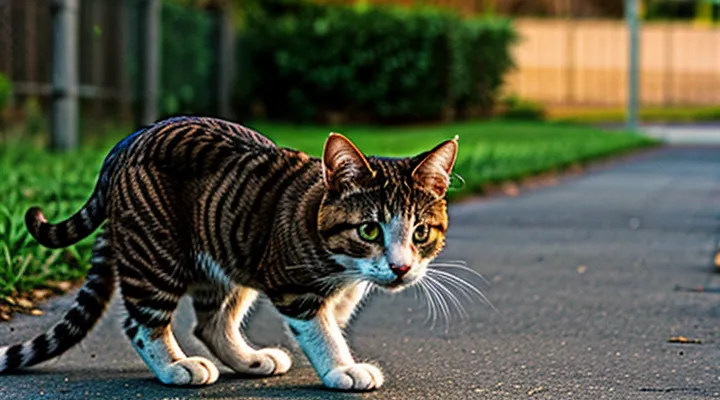
The Instinctive Hunter: Feline Predation
Evolutionary Roots of the Hunt
The Wild Ancestors
The domestic cat descends from wild ancestors that perfected ambush hunting long before domestication. Those progenitors, primarily the African wildcat (Felis lybica) and the European wildcat (Felis silvestris), relied on stealth, acute hearing, and retractable claws to capture small mammals.
Key evolutionary traits inherited from these ancestors include:
- Highly flexible spine enabling rapid acceleration during the final strike.
- Night‑vision retina cells that amplify low‑light signals, allowing effective pursuit after dusk.
- Vibrissae that detect minute air currents, revealing the presence of hidden prey.
Fossil records indicate that early felids developed a hunting sequence of stalk, pounce, and bite, a pattern still observable in modern cats. The bite targets the neck vertebrae, delivering a swift, lethal compression that immobilizes the mouse instantly. Muscular development in the forelimbs, inherited from the wild lineage, provides the force needed to overcome the prey’s escape reflexes.
Behavioral studies of feral populations reveal that solitary hunting remains predominant, with occasional cooperative tactics observed only when prey density is exceptionally high. This solitary approach mirrors the ancestral strategy that minimized competition and maximized individual success.
The transition from wild to companion animal preserved these predatory mechanisms. Even in indoor environments, cats exhibit the same sequence of crouch, pause, and explosive launch, demonstrating the durability of ancestral hunting instincts.
Domestication and Retained Instincts
Domestication has not eliminated the feline hunting drive; centuries of co‑habitation with humans preserve the neural circuits that trigger pursuit, stalk, and pounce behaviors. Genetic studies show that domestic cats share over 95 % of their genome with wild ancestors, including the brain regions governing predatory sequences.
Key instinctual components remain active:
- Visual acuity tuned to motion detection, especially at low light levels.
- Auditory sensitivity to high‑frequency rustles produced by small rodents.
- Muscular coordination enabling rapid acceleration and precise bite placement.
- Behavioral pattern of crouching, tail flicking, and sudden lunges that mimic wild hunting tactics.
Environmental enrichment that simulates prey (e.g., feather toys, laser pointers) activates these retained circuits, reinforcing natural skill sets while providing mental stimulation. Failure to engage these instincts can result in redirected aggression or stress‑related behaviors.
Comparative observations confirm that feral cats and pet cats employ identical capture techniques: silent approach, calculated pause, and swift claw strike. The persistence of these actions demonstrates that domestication reshapes social tolerance and feeding dependence but does not erase the fundamental predatory blueprint.
Sensory Superiority for Tracking Prey
Olfactory Prowess: Scenting the Mouse
Cats possess a highly developed olfactory system that allows them to locate prey concealed within complex environments. The nasal epithelium contains millions of scent receptors, each capable of detecting volatile compounds emitted by rodents. These chemical cues travel through air currents and persist on fur, urine, and skin cells, creating a trace that a cat can follow even when visual contact is impossible.
Key aspects of feline scent detection include:
- Sensitivity to mouse pheromones, which signal presence and reproductive status.
- Ability to discriminate between fresh and aged odor trails, enabling pursuit of the most recent activity.
- Integration of olfactory input with whisker feedback and auditory cues, forming a multimodal hunting strategy.
When a mouse moves, it releases a unique blend of fatty acids and aldehydes. Cats inhale this mixture, and the olfactory bulb processes it within milliseconds, generating a neural map that guides the cat’s approach. The resulting behavior—low, silent stalking followed by a rapid pounce—relies on precise interpretation of the scent gradient.
Environmental factors such as humidity and temperature influence odor dispersion. Higher humidity enhances molecule solubility, extending the detectable range, while cooler temperatures slow diffusion, preserving trail integrity. Cats adjust their hunting tactics accordingly, often pausing to re‑sample the air when conditions shift.
Overall, the feline sense of smell provides a decisive advantage in locating hidden rodents, complementing visual acuity and auditory precision to ensure successful capture.
Auditory Acuity: Pinpointing Movement
Cats possess an auditory system tuned for detecting minute rustles produced by small prey. The ear canal funnels sound toward a highly mobile pinna, which can rotate up to 180° to capture acoustic cues from any direction. This rapid adjustment creates a precise spatial map of vibrations, allowing the feline brain to isolate the source of a mouse’s movement within fractions of a second.
The inner ear contains an expanded cochlear region specialized for high‑frequency detection. Frequencies between 45 kHz and 64 kHz, well beyond human hearing, correspond to the squeaks and footfalls of rodents. Neural pathways transmit these signals to the auditory cortex, where timing differences between the two ears are analyzed to calculate azimuth and elevation of the sound source.
Key auditory mechanisms that enable pinpoint accuracy include:
- Asymmetrical ear positioning for triangulation of sound origin
- Superior temporal resolution allowing detection of brief, high‑frequency bursts
- Integration of auditory data with whisker‑derived tactile information for cross‑modal confirmation
Together, these capabilities form a rapid, non‑visual hunting strategy. When a mouse scurries across a floorboard, the cat registers the faint, high‑frequency rustle, aligns its head toward the precise location, and initiates a silent, calculated pounce. The result is a predator that can locate concealed prey without reliance on sight alone.
Vision in Low Light: Nighttime Dominance
Cats possess a specialized retinal structure that maximizes photon capture in dim conditions. The reflective layer behind the retina, known as «tapetum lucidum», redirects unabsorbed light back through photoreceptors, effectively doubling the chance of detection. This adaptation enables felines to discern movement and outline of prey at light levels where humans see only silhouettes.
Rod cells dominate the feline retina, comprising roughly 85 % of photoreceptors. Their high sensitivity to single photons allows cats to detect subtle contrasts between a mouse’s fur and the surrounding environment. The lack of cone dominance reduces color discrimination but enhances luminance resolution, a trade‑off that favors nocturnal predation.
Key physiological advantages include:
- Wide pupils that dilate rapidly, increasing retinal illumination by up to 20 times.
- A high density of retinal ganglion cells that transmit motion signals with minimal latency.
- Superior binocular overlap, providing precise depth perception even under low‑light glare.
Combined, these features grant cats a decisive advantage during twilight and night hours, allowing them to locate, track, and ambush rodents with minimal visual cues.
The Art of the Stalk: Cat Hunting Techniques
Patience and Stealth: The Initial Approach
Body Language of the Hunter
Cats rely on a precise set of visual and tactile cues to coordinate a hunt. The hunter’s body language conveys intent, readiness, and timing, allowing the predator to transition from observation to capture without alerting the prey.
A low crouch signals the initial commitment to the chase. Muscles contract, the spine arches slightly, and the hindquarters lower to the ground. Ears rotate forward, aligning the auditory axis with the target’s location. The tail may twitch subtly, providing balance while the cat gauges distance.
Eyes lock onto the mouse, pupils dilating to maximize light intake. Whiskers spread outward, detecting minute air currents generated by the rodent’s movement. This tactile feedback refines the predator’s spatial map, ensuring accurate distance estimation.
Movement proceeds in incremental, silent steps. The forepaws lift minimally, the pads contacting the surface without generating noise. A brief tail flick often precedes the final advance, serving as a proprioceptive cue that stabilizes the body’s trajectory.
When the moment arrives, the cat adopts a compact, explosive posture:
- Front legs coil, storing kinetic energy.
- Claws retract slightly, ready for rapid extension.
- Hind legs flex, preparing a powerful thrust.
- The body arches, aligning the spine for maximal acceleration.
The sudden release propels the feline forward, claws extending at the instant of contact. The mouse’s escape route is blocked by the cat’s outstretched forelimbs, and the predator secures the prey with a firm bite.
Each element of the hunter’s body language functions as a coordinated signal, optimizing the transition from stealth to strike. The seamless integration of posture, sensory orientation, and micro‑movements defines the cat’s efficiency as a small‑animal predator.
Utilizing Cover and Concealment
Cats rely on environmental features to approach prey without detection. Dense foliage, furniture legs, and shadowed floor sections serve as natural barriers that interrupt the mouse’s line of sight. By positioning themselves behind such obstacles, felines reduce visual cues that would otherwise trigger escape behavior.
Movement remains deliberate while concealed. A cat pauses behind cover, aligns its body with the mouse’s typical travel routes, then advances in short, silent bursts. The brief exposure of only the head and forepaws minimizes the silhouette visible to the rodent, increasing the likelihood of a successful capture.
Typical concealment tactics include:
- Selecting perch points that mask the torso while offering a clear view of the target area.
- Utilizing low‑light zones to blend the cat’s coat with surrounding shadows.
- Aligning body posture with structural lines (e.g., the edge of a countertop) to break the outline.
- Timing advances with the mouse’s moments of reduced vigilance, such as during foraging pauses.
The Pounce: Precision and Power
Calculating Distance and Trajectory
The pursuit of a mouse requires a cat to estimate the spatial separation between its position and the prey’s location. Accurate distance assessment enables the predator to time the leap, conserve energy, and increase capture probability.
Distance calculation relies on Cartesian coordinates. If the cat is at point (x₁, y₁) and the mouse at point (x₂, y₂), the straight‑line separation equals √((x₂‑x₁)² + (y₂‑y₁)²). This metric represents the minimum path the cat must cover before contact.
Trajectory determination combines distance with launch angle. The angle θ relative to the horizontal follows arctan((y₂‑y₁)/(x₂‑x₁)). When the cat jumps, the motion follows a parabolic arc described by the equations of projectile physics:
- horizontal displacement = v₀ cos θ · t
- vertical displacement = v₀ sin θ · t − ½ g t²
where v₀ denotes initial speed, t the flight time, and g the acceleration due to gravity. Solving these equations for t and θ yields the exact flight path required to intersect the mouse’s position.
Practical steps for field observation:
- Record the cat’s and mouse’s coordinates at the moment of attack initiation.
- Compute straight‑line distance using the Pythagorean formula.
- Determine launch angle with the arctangent function.
- Measure or estimate initial velocity; apply projectile equations to predict flight time and apex height.
- Compare predicted landing point with actual capture location to evaluate accuracy.
Precise measurement of «distance» and «trajectory» clarifies how feline hunters translate visual cues into biomechanical actions, revealing the underlying physics of a successful chase.
The Killing Bite: A Swift End
The killing bite delivers a rapid, decisive termination of a mouse’s life. A domestic cat targets the cervical region, applying pressure with its incisors and canine teeth to sever the spinal cord or crush the trachea. Muscular contraction of the jaw generates forces exceeding 30 newtons, sufficient to fracture vertebrae within fractions of a second. Immediate loss of neural transmission induces instant paralysis, preventing any chance of escape.
Key physiological effects of the bite include:
- Disruption of the spinal cord, causing immediate loss of motor control.
- Compression of the airway, leading to rapid asphyxiation.
- Stimulation of nociceptors, producing a brief, intense shock that accelerates cessation of movement.
The combination of precise targeting, high bite force, and swift execution ensures that the prey is immobilized and killed before it can mount a defensive response. This efficiency reflects the cat’s evolution as a specialized predator, optimizing energy expenditure while minimizing the risk of injury.
Play and Practice: Developing Skills
Mother Cat's Teaching Methods
Mother cats employ a structured series of instructional behaviors that shape kitten predatory competence. Initial exposure occurs through passive observation; kittens watch the adult capture, subdue, and dispatch prey, internalizing timing, bite placement, and body positioning. This visual learning phase establishes a mental template for future attempts.
Active participation follows the observational stage. The mother introduces live or dead prey within a controlled environment, encouraging kittens to approach, pounce, and manipulate the target. Repeated attempts refine motor skills and reinforce successful tactics. Each successful capture is followed by a brief pause, allowing the kitten to assess the outcome before the next trial.
Key teaching methods include:
- Demonstration of precise jaw grip and neck bite to immobilize prey.
- Gradual reduction of assistance, shifting responsibility from mother to kitten.
- Use of varied prey sizes to develop adaptability.
- Immediate correction of misdirected strikes through gentle repositioning.
Through these mechanisms, mother cats transmit essential hunting knowledge, ensuring offspring acquire the proficiency required for autonomous predation. «Effective training integrates observation, practice, and incremental challenge», a principle observed across felid species.
Solitary Training Through Play
Feline predation on rodents relies on repeated, self‑directed practice during play sessions. «Solitary training through play» provides a controlled environment where a cat can rehearse essential hunting components without external interference.
During solitary play, a cat refines the sequence of actions required for successful capture:
- Stalk: low‑profile movement, precise alignment with imagined prey.
- Pounce: rapid acceleration, coordinated fore‑limb extension.
- Bite: targeted grip on the neck region, mimicking the killing bite.
- Retrieval: handling and transport of the prey analog, reinforcing grip strength.
Each repetition sharpens motor patterns, enhances sensory acuity, and reinforces the neural pathways governing timing and force. The absence of conspecific participants eliminates competition, allowing the individual to focus exclusively on skill acquisition.
Consequences of this method include heightened accuracy in strike distance, improved depth perception for judging prey movement, and increased confidence when confronting live rodents. The cumulative effect translates into higher capture rates in natural hunting scenarios, confirming the functional value of self‑initiated play as a training mechanism for solitary predators.
Beyond Survival: The Complexities of Cat Hunting
Instinct vs. Hunger: Why Cats Hunt When Not Hungry
The Thrill of the Chase
The pursuit of a mouse engages a cat’s acute sensory system. Vision detects minute movements; whiskers gauge proximity; ears locate rustling sounds. These inputs converge to trigger a rapid cascade of muscular activation, preparing the animal for a burst of speed.
The chase proceeds through distinct phases:
- Stalk – low‑profile movement minimizes visual cues, while the cat aligns its body for optimal launch angle.
- Pounce – hind‑leg extension generates force exceeding the animal’s body weight, delivering a swift, directed strike.
- Capture – claws clamp onto the prey, and the bite secures the neck, preventing escape.
During pursuit, a cat’s heart rate can increase threefold, delivering oxygen‑rich blood to muscles. Elevated adrenaline sharpens reflexes, reduces reaction time, and heightens focus on the target’s trajectory. Simultaneously, the mouse employs erratic zigzag patterns, sudden accelerations, and use of cover to evade capture, creating a dynamic feedback loop between predator and prey.
Success rates rise when environmental factors favor stealth: low lighting, cluttered terrain, and limited auditory interference. Conversely, open spaces and bright illumination diminish the element of surprise, often leading to aborted attempts.
The physiological and behavioral interplay that defines the chase illustrates a finely tuned predatory system, where each sensory cue and motor response contributes to the decisive moment of capture.
Behavioral Enrichment
Behavioral enrichment supplies domestic felines with stimuli that mimic natural hunting scenarios, encouraging the development and maintenance of predatory skills.
Enrichment activities stimulate the sensory and motor pathways involved in stalking, pouncing, and capturing prey, thereby preserving the instinctual sequence required for successful mouse capture.
Practical enrichment methods include:
- Rotating puzzle feeders that require manipulation to release food.
- Interactive toys that move unpredictably, prompting chase and ambush behaviors.
- Structured play sessions with feather wands or laser pointers that simulate the erratic flight of small rodents.
- Habitat modifications such as elevated perches, narrow tunnels, and textured surfaces that replicate a mouse’s hiding places.
Consistent application of these strategies promotes muscular coordination, sharpens focus, and reduces stress‑induced behaviors. Enhanced predatory competence translates into more efficient mouse hunting, while mental stimulation contributes to overall feline well‑being.
The Impact of Domestic Cats on Wildlife
Predation on Local Ecosystems
Cats, as solitary hunters, locate prey through acute auditory and visual cues, then employ a rapid pounce to capture small rodents. This predatory behavior directly influences the abundance of mouse populations within neighborhoods, parks, and agricultural fields.
Reduced rodent numbers affect several ecological processes. Lowered seed predation can increase plant regeneration, while diminished competition among herbivores may alter vegetation structure. Additionally, fewer rodents lessen the transmission risk of zoonotic diseases such as hantavirus and leptospirosis.
Key consequences of feline predation on local ecosystems include:
- Decrease in invertebrate populations that rely on rodents for food.
- Modification of soil nutrient cycles through altered waste deposition patterns.
- Shifts in predator–prey dynamics that may favor opportunistic scavengers.
Understanding these interactions assists wildlife managers in balancing domestic animal ownership with biodiversity conservation, ensuring that urban and rural habitats maintain functional ecological networks.
Mitigation Strategies for Pet Owners
Domestic cats retain instinctual predation toward small rodents, resulting in frequent captures of mice in residential environments. Uncontrolled hunting poses risks to wildlife populations and may expose cats to disease and injury. Pet owners can implement concrete measures to reduce these outcomes while preserving feline welfare.
- Provide scheduled indoor play sessions that mimic hunting motions; interactive toys, feather wands, and laser pointers satisfy chase drives without live prey.
- Install secure outdoor enclosures or “catios” that grant access to fresh air and visual stimulation while preventing escape.
- Apply feline‑safe deterrent collars containing scent or vibration cues that interrupt predatory focus when a mouse is detected.
- Offer nutritionally balanced diets rich in protein and taurine; adequate feeding diminishes the motivation to seek additional prey.
- Conduct regular veterinary examinations to identify health issues that could intensify hunting behavior, such as hyperthyroidism.
- Employ environmental enrichment, including climbing structures and scratching posts, to channel energy toward constructive activities.
Consistent application of these strategies curtails predation incidents, protects local ecosystems, and promotes responsible pet ownership.
Learning from the Feline Predator
Understanding Animal Behavior
Cats exhibit precise predatory sequences that illustrate fundamental principles of animal behavior. The process begins with sensory detection; whiskers, auditory acuity, and visual contrast enable the feline to locate a moving rodent. Once identified, the predator initiates a covert approach, reducing body silhouette and synchronizing breath to avoid alerting the prey.
Key elements of the hunting routine include:
- Stalk phase: Incremental steps, low to the ground, maintain visual lock while minimizing noise.
- Pounce execution: Rapid acceleration of hind limbs generates a burst of force, allowing the cat to cover the remaining distance in milliseconds.
- Capture technique: Front paws clamp securely, while claws engage to prevent escape; the bite targets the neck to incapacitate swiftly.
- Post‑capture handling: The predator may manipulate the prey to ensure a clean kill before consumption.
The mouse’s defensive repertoire activates concurrently. Escape responses rely on erratic zig‑zag locomotion, ultrasonic vocalizations, and sudden directional changes. These tactics exploit the predator’s limited peripheral vision and reaction time, creating a dynamic feedback loop that shapes both species’ evolutionary adaptations.
Observations of this interaction reveal broader behavioral concepts such as predator–prey coevolution, risk assessment, and energy optimization. Understanding these mechanisms provides insight into how carnivores balance hunting efficiency with energy expenditure, while prey species refine evasion strategies to enhance survival. «The interplay of detection, decision, and action defines the essence of predatory behavior.»
Respecting Nature's Design
Cats illustrate the precision of evolutionary engineering. Their hunting strategy demonstrates how form follows function, offering a model for respectful interaction with natural systems.
Muscular hind limbs generate rapid acceleration, while retractable claws provide controlled contact. Whisker arrays detect minute air currents, enabling detection of concealed prey. Visual receptors prioritize motion at low light levels, allowing pursuit during dawn and dusk. These traits combine to produce a self‑sufficient predatory cycle that minimizes energy expenditure while ensuring successful capture.
Human influence can honor this design by preserving environments that support the full expression of feline behavior. Protecting dense vegetation, maintaining rodent populations, and limiting artificial lighting reduce disruption of the cat’s sensory framework. Conservation policies that recognize the interdependence of predator and prey reinforce the integrity of the ecosystem.
Key design elements to respect:
- Stealth mechanisms: camouflage and silent movement.
- Sensory integration: whisker feedback, low‑light vision, acute hearing.
- Energy efficiency: short, explosive bursts rather than prolonged chase.
- Reproductive balance: natural regulation of prey populations through predation.
«Nature designs efficient hunters; respecting that design sustains ecological stability».