
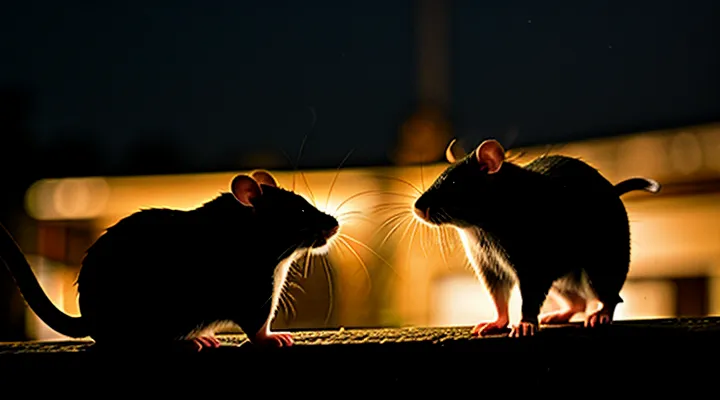
Rat Vision Basics
The Rod-Dominated Retina
Photoreceptors and Low Light
Rats rely on a visual system adapted to scotopic (low‑light) conditions. Their retinas contain a high proportion of rod photoreceptors, which are highly sensitive to photons and function without color discrimination. Rods contain the photopigment rhodopsin; a single photon can trigger a cascade that amplifies the signal, allowing detection of light levels far below those perceivable by humans.
Key characteristics of rod‑mediated vision in rats:
- Density: Approximately 85 % of retinal photoreceptors are rods, providing extensive coverage of the visual field.
- Sensitivity: Rods respond to luminance as low as 10⁻⁶ cd/m², enabling navigation in near‑total darkness.
- Temporal resolution: Rods integrate signals over longer periods, sacrificing motion acuity for heightened sensitivity.
- Spectral range: Peak absorption around 500 nm matches the prevalent wavelengths in dim environments.
Cone photoreceptors, though present, constitute only about 15 % of rat photoreceptors. They support photopic (bright‑light) vision and limited color discrimination but contribute minimally to performance in darkness.
The retinal circuitry channels rod signals through bipolar cells to ganglion cells specialized for low‑light detection. These ganglion cells exhibit large receptive fields and high convergence, further amplifying weak inputs.
Consequently, rats can navigate, locate food, and avoid predators under illumination levels that are effectively invisible to humans. Their visual capacity in dim settings originates from the predominance of rods, the efficiency of rhodopsin signaling, and retinal pathways optimized for photon scarcity.
Nocturnal Adaptation
Large Pupils and Light Gathering
Rats possess exceptionally large pupils relative to their eye size, a structural adaptation that maximizes the amount of photons reaching the retina. The dilated aperture expands the optical entry point, allowing the eye to capture light under dim conditions that would render many mammals visually ineffective.
The enlarged pupil works in concert with a high rod density in the retinal periphery. Rod photoreceptors are highly sensitive to low-intensity illumination and dominate the rat’s visual field, providing motion detection and spatial orientation when ambient light is scarce. This combination yields a visual system optimized for scotopic (night) vision.
Key physiological factors that enhance rats’ low‑light perception:
- Wide pupil dilation (up to 90 % of the iris surface) reduces diffraction losses.
- Abundant rod cells (≈ 85 % of retinal photoreceptors) increase photon capture efficiency.
- Tapetum lucidum‑like reflective layers in the retinal pigment epithelium redirect unabsorbed photons back through the photoreceptor layer, effectively doubling light utilization.
- Rapid pupil constriction and dilation cycles adjust quickly to fluctuating light levels, preserving image clarity without sacrificing sensitivity.
Collectively, these traits enable rats to navigate, forage, and avoid predators in environments where illumination is minimal, confirming that their visual apparatus is purpose‑built for effective sight in near‑darkness.
Tapetum Lucidum Absence
Rats lack the reflective layer known as the tapetum lucidum, a structure that enhances photon capture in many nocturnal mammals. Without this layer, light that reaches the retina is not redirected for a second pass, reducing overall retinal illumination. Consequently, rats depend on alternative ocular and sensory adaptations to operate in low‑light conditions.
Key consequences of tapetum lucidum absence in rats:
- Rod‑rich retina – Over 80 % of photoreceptors are rods, maximizing sensitivity to scarce photons.
- Large, dilatable pupils – Pupils expand dramatically, allowing maximal light entry during dim periods.
- High retinal ganglion cell density – Enhances signal processing efficiency for weak visual inputs.
- Integration with whisker (vibrissal) system – Tactile information compensates for limited visual acuity, providing spatial awareness in darkness.
These features collectively enable rats to navigate and forage at night despite the missing reflective interface. Their visual performance remains inferior to species possessing a tapetum lucidum, but the combination of retinal specialization and multimodal sensory input sustains functional nocturnal behavior.
How Rats Navigate in Darkness
Olfactory Senses
Scent Trails and Memory
Rats compensate for weak visual input by relying on a sophisticated olfactory system. Their nasal epithelium contains millions of receptors that detect minute concentrations of volatile compounds, allowing detection of scent cues at distances far beyond the reach of dim light.
When a rat moves, it deposits odorants through glandular secretions, urine, and feces. These deposits create continuous chemical pathways that persist for hours. Other individuals can follow the same route by detecting the gradient of odor concentration, which guides them around obstacles and toward food sources without needing visual confirmation.
Memory integrates with these scent trails. The hippocampus records the spatial relationship between odor landmarks and the animal’s position, forming a map that can be reactivated when the same scents are encountered later. This map enables rapid route selection even when the environment is completely dark.
Together, olfactory tracking and mnemonic mapping provide a reliable navigation system that functions independently of sight. The combination allows rats to explore complex burrow networks, locate conspecifics, and locate resources in conditions where visual cues are unavailable.
Auditory Cues
Echolocation-like Abilities
Rats compensate for limited vision in dim environments with sensory systems that resemble echolocation. Their ultrasonic vocalizations, emitted at frequencies between 40 kHz and 80 kHz, produce brief sound bursts that reflect off nearby surfaces. The returning echoes are processed by the auditory cortex, allowing rats to gauge distance, shape, and texture of obstacles.
Key characteristics of this acoustic navigation include:
- Emission of short, high‑frequency clicks during exploratory behavior.
- Precise timing of echo reception, measured in microseconds, to calculate range.
- Integration of echo data with tactile input from whiskers for enhanced spatial resolution.
Neurophysiological studies reveal that specific neurons in the auditory pathway fire selectively to echo delays, mirroring mechanisms found in true echolocators. Behavioral experiments demonstrate that rats can locate hidden food, avoid predators, and negotiate complex mazes when visual cues are unavailable, relying primarily on these sound‑based cues.
Consequently, while rats do not possess true night vision, their echolocation‑like abilities provide an effective alternative for navigating and foraging in low‑light conditions.
High-Frequency Hearing
Rats compensate for limited visual input in dim environments with an auditory system tuned to ultrasonic frequencies. Their cochlea detects sounds up to 80 kHz, far beyond the human hearing ceiling of 20 kHz. This high‑frequency sensitivity enables precise localization of prey, predators, and conspecifics through minute acoustic cues that are invisible to the eye.
Key characteristics of rat ultrasonic hearing include:
- Peak sensitivity around 20–40 kHz, aligning with the frequency of many rodent vocalizations.
- Detectable thresholds as low as 10 dB SPL at 30 kHz, allowing perception of faint echoes.
- Rapid temporal resolution, supporting discrimination of brief ultrasonic pulses lasting under a millisecond.
The auditory advantage is especially relevant when ambient light is insufficient for reliable visual processing. Ultrasonic emissions generated by the rat’s vocal apparatus produce echoes that return from nearby surfaces, providing spatial information comparable to echolocation in bats. Neural pathways from the cochlear nucleus to the auditory cortex integrate these echoes, constructing a real‑time map of obstacles and resources.
Consequently, high‑frequency hearing constitutes a primary sensory mechanism that mitigates the constraints of low‑light vision, allowing rats to navigate, forage, and avoid danger with accuracy comparable to species that rely predominantly on sight.
Tactile Exploration
Vibrissae (Whiskers) Function
Rats rely on vibrissae—specialized facial hairs equipped with dense mechanoreceptor innervation—to acquire detailed tactile information when visual cues are limited. Each whisker is anchored in a follicle-sinus complex that transduces minute deflections into neural signals, enabling precise detection of surface texture, airflow, and object proximity.
In darkness, vibrissae support locomotion and foraging by:
- Mapping spatial layout through active whisking cycles, generating a three‑dimensional representation of obstacles.
- Detecting prey or food items via contact‑induced vibrations transmitted to the somatosensory cortex.
- Guiding head and body movements by synchronizing whisker feedback with motor commands, reducing collision risk.
- Complementing limited retinal input, allowing rats to maintain orientation and escape predators despite low illumination.
The integration of whisker‑derived data with residual visual and auditory signals creates a multimodal perception system that compensates for the reduced efficacy of sight in nocturnal settings.
Mapping the Environment
Rats navigate complex habitats despite limited illumination. Their sensory repertoire compensates for reduced visual input, enabling precise spatial mapping.
Vision contributes minimally under low-light conditions; retinal rods detect photons at levels far below human thresholds, providing coarse luminance cues. Primary reliance shifts to whisker (vibrissal) mechanoreception, olfactory gradients, and auditory localization. Each modality feeds the hippocampal formation, where place cells encode specific locations, and entorhinal grid cells generate metric representations of space.
Key mechanisms of environmental mapping include:
- Vibrissal exploration: active whisking samples surface texture and distance, generating high‑resolution tactile maps.
- Olfactory tracing: volatile compounds create chemical landmarks that rats memorize and recall.
- Auditory scene analysis: binaural cues resolve object position and motion, supporting navigation around obstacles.
- Low‑light vision: rod‑mediated detection supplies ambient light levels for orientation, though spatial resolution remains low.
- Neural integration: convergence of multimodal inputs in the hippocampus produces a unified cognitive map, adaptable to changes in lighting.
Behavioral experiments demonstrate rapid acquisition of spatial layouts after brief exposure, even when visual cues are absent. Lesion studies confirm that disruption of whisker input or olfactory pathways impairs maze performance, whereas restoration of any single modality partially rescues navigation. Consequently, rats achieve reliable environmental mapping through a redundant, multimodal system that compensates for darkness.
Comparing Rat and Human Vision
Color Perception Differences
Dichromatic Vision in Rats
Rats possess two functional cone types, each tuned to distinct regions of the visible spectrum. The short‑wavelength (S) cones peak near 360 nm, while the medium‑wavelength (M) cones peak around 509 nm. This dichromatic arrangement enables discrimination of color in photopic conditions, but it also influences how visual information is processed under scotopic illumination.
Rod photoreceptors dominate rat retinas, providing high sensitivity to low light levels. Rod signals converge with cone inputs in the retinal ganglion cells, allowing the visual system to integrate chromatic and achromatic cues. The presence of S‑cones, which retain some responsiveness at dim intensities, extends the spectral range available to the rod‑cone network, thereby enhancing contrast detection when ambient light is scarce.
Experimental evidence supports the functional relevance of dichromacy for nocturnal tasks:
- Behavioral assays show rats can distinguish objects based on spectral differences even at luminances near the rod threshold.
- Electroretinography records combined rod‑cone responses that retain a modest S‑cone component under mesopic conditions.
- Lesion studies that selectively impair M‑cone pathways reduce performance in low‑light discrimination tasks, indicating reliance on both cone types.
Overall, dichromatic vision does not replace rod‑mediated scotopic perception but supplements it, providing additional spectral information that improves object recognition and navigation in dim environments. This integration explains how rats achieve effective visual performance despite the limited illumination typical of their natural habitats.
Visual Acuity
Blurred Vision at Distance
Rats possess a retina dominated by rod cells, which maximizes sensitivity to low light but sacrifices sharpness at a distance. The scarcity of cone photoreceptors limits the ability to resolve fine details beyond a few centimeters, resulting in a consistently blurred image for far objects.
The optical structure of the rat eye contributes to this limitation. A relatively small corneal diameter and a short focal length produce a narrow visual field. Combined with a low density of retinal ganglion cells, the visual cortex receives only coarse spatial information from distant sources.
Consequences for nocturnal activity include:
- Reliance on tactile cues from vibrissae to detect obstacles beyond immediate reach.
- Dependence on olfactory and auditory signals for locating food and predators.
- Preference for close‑range visual tasks such as navigating tight burrows, where blurred distant vision is less detrimental.
Overall, the rat’s visual system prioritizes low‑light sensitivity over long‑range acuity, making blurred distant vision a characteristic feature of its nocturnal adaptations.
Implications for Rat Behavior
Foraging in Low Light
Rats rely on a combination of sensory modalities to locate food when ambient illumination drops below the threshold for color vision. Their retinas contain a high density of rod photoreceptors, which amplify single‑photon signals and enable detection of movement and contrast in scotopic conditions. The rod‑mediated pathway projects to the superior colliculus, a midbrain structure that coordinates orienting responses toward potential prey or seed sources.
Key physiological and behavioral adaptations that support low‑light foraging include:
- Enlarged pupils that expand to maximize photon capture.
- A reflective tapetum lucidum layer behind the retina, which redirects unabsorbed light back through photoreceptors.
- Whisker‑driven tactile exploration that supplements visual input when darkness becomes absolute.
- Olfactory discrimination of food odors, enhanced by a larger olfactory epithelium and increased sniffing frequency.
Experimental studies using infrared video tracking demonstrate that rats maintain consistent foraging efficiency at illumination levels as low as 0.1 lux, comparable to moonlight. Performance declines only when light intensity falls below 0.01 lux, at which point tactile and olfactory cues dominate decision‑making. Electrophysiological recordings confirm that rod‑driven retinal ganglion cells sustain firing rates sufficient to encode spatial gradients of food‑related stimuli under these conditions.
Ecologically, the ability to forage in dim environments expands the temporal niche of rats, allowing them to exploit food resources while avoiding diurnal predators. This nocturnal foraging strategy also reduces competition with other granivores that depend on brighter light levels. Consequently, low‑light foraging is a decisive factor in the success of rat populations across urban, agricultural, and wild habitats.
Predator Avoidance
Rats rely on a combination of sensory systems to detect and evade predators in dim environments. Their retinal structure includes a high density of rod cells, which enhances sensitivity to low‑light illumination. This adaptation allows them to discern movement and shapes at luminance levels far below those required by many other mammals.
In addition to visual cues, rats integrate whisker‑mediated mechanoreception and acute olfactory detection. When a predator approaches, rapid changes in ambient light, subtle air currents, and scent gradients trigger escape responses. The integration of these modalities occurs within milliseconds, enabling swift direction changes and sprint bursts.
Key aspects of predator avoidance under low‑light conditions include:
- Immediate cessation of foraging activity upon detection of shadows or sudden movements.
- Execution of a zigzag sprint to disrupt a predator’s pursuit trajectory.
- Utilization of narrow, cluttered pathways where tactile feedback from whiskers provides precise navigation.
- Emission of alarm pheromones that alert conspecifics to danger, prompting group dispersal.
These strategies collectively compensate for the limitations of rat vision in near‑darkness, ensuring survival despite the reduced visual information available.
Social Interactions
Rats rely on a combination of tactile, auditory, and visual cues to coordinate group activities. Their capacity to detect dim illumination enables them to maintain contact with conspecifics during nocturnal foraging and nest construction.
When ambient light falls below the threshold of human perception, rats still perceive sufficient contrast to identify the silhouettes of nearby individuals. This visual input supports several social functions:
- Locating and approaching mates or rivals without direct contact.
- Aligning body orientation during communal grooming, reducing the risk of accidental bites.
- Detecting movement of peers in shared burrows, facilitating coordinated escape responses.
The visual system of rats is adapted to scotopic conditions; rod-dominated retinas amplify photon capture, while the optic nerve projects to brain regions that integrate motion and shape information. Consequently, rats can differentiate between a moving conspecific and static objects even in near‑total darkness.
Social hierarchies are reinforced through brief visual displays such as head‑bobbing and flank‑rubbing. These gestures remain recognizable under low‑light scenarios, allowing dominant individuals to assert status while subordinate rats adjust behavior without prolonged physical confrontation.
Overall, the ability to perceive limited light levels underpins essential aspects of rat social organization, from cooperative nest building to hierarchical communication.
Understanding Rat Vision for Pest Control
Light-Based Deterrents
Rats possess a visual system adapted to dim environments; they can detect movement at low light levels but are highly sensitive to sudden bright illumination. Light‑based deterrents exploit this sensitivity by introducing visual stimuli that disrupt normal activity patterns.
Bright steady light placed near entry points creates a hostile zone that rats avoid. Strobe or flashing LEDs generate rapid changes in intensity, causing disorientation and increasing perceived risk. Motion‑activated units conserve energy by activating only when movement is detected, delivering a brief burst of high‑intensity light that interrupts foraging. Ultraviolet (UV) lamps emit wavelengths outside the rat’s optimal visual range, producing a deterrent effect without excessive glare for humans. Infrared (IR) devices, while invisible to humans, can be paired with motion sensors to trigger auxiliary lights that rats perceive as threats.
Common light‑based deterrent devices
- High‑wattage white LED floodlights
- Strobe lamps with adjustable frequency
- Motion‑activated spotlights (white or UV)
- Solar‑powered LED units for outdoor placement
- Integrated systems combining light with ultrasonic emission
Effectiveness depends on intensity, placement, and exposure duration. Studies show a reduction of 30‑60 % in rat activity when lights exceed 1,000 lux at ground level and are positioned within 1 meter of known pathways. Over time, rodents may habituate to constant illumination; rotating light patterns or intermittent operation mitigates adaptation.
Implementation guidelines
- Install devices at known entry points, nesting sites, and along travel corridors.
- Maintain a minimum intensity of 800–1,200 lux to ensure aversive impact.
- Use motion sensors to limit continuous exposure and reduce energy consumption.
- Combine light deterrents with physical barriers, traps, or sanitation measures for comprehensive control.
- Verify that illumination levels comply with local safety regulations to protect humans and non‑target wildlife.
When properly configured, light‑based deterrents provide a non‑chemical, observable method to limit rat presence in indoor and outdoor settings. Their success hinges on strategic deployment and periodic variation to prevent habituation.
Trapping Strategies
Rats possess a visual system adapted for low‑light environments, allowing them to navigate and locate food in darkness. Their eyes detect movement rather than fine detail, which influences the design of effective capture methods.
- Snap traps with high‑contrast bait: Use dark‑colored bait against a light background to create a visual contrast that rats can discern. The sudden motion of the trigger mechanism triggers their reflexive strike response.
- Live‑catch cages with illuminated entrances: Install a dim red LED at the entry point. Rats’ sensitivity to red wavelengths is reduced, minimizing avoidance while still providing enough light for the trap’s sensor to activate.
- Glue boards placed near walls: Rats travel close to edges where shadows are minimal. Position boards in low‑light corners to exploit their tendency to follow wall‑adjacent paths.
- Electronic traps with infrared sensors: Infrared beams are invisible to rats but detect their passage. The sensor triggers a high‑voltage shock, capitalizing on their limited perception of infrared wavelengths.
Placement strategies must consider rats’ nocturnal activity patterns. Set traps along established runways, near food sources, and in areas where ambient light is scarce. Regular inspection, prompt disposal of captured rodents, and sanitation to remove attractants enhance trap efficacy and reduce reinfestation.