
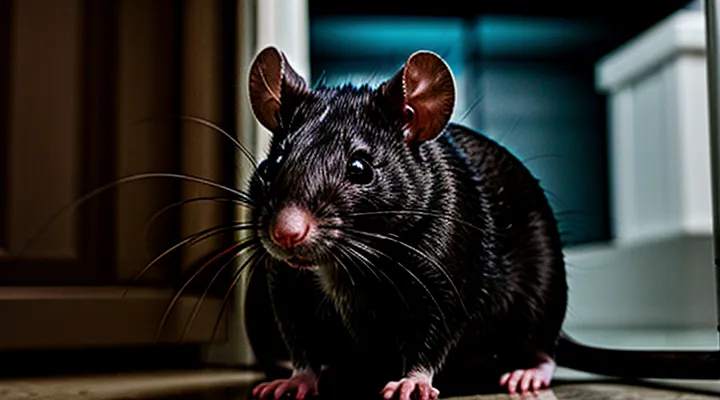
Understanding Rat Vision
The Rod-Dominant Retina
Rats possess a retina in which rods outnumber cones by a factor of roughly 10 : 1. This rod‑dominant composition determines the visual capabilities of pet rats under scotopic (low‑light) conditions.
Rods contain the photopigment rhodopsin, which is highly sensitive to single photons. In rats, the high density of rods allows detection of luminance levels far below the threshold of human cone‑mediated vision. Consequently, pet rats can navigate and locate objects in environments that appear virtually black to humans.
Key functional attributes of the rod‑dominant retina include:
- High quantum efficiency: Each rod can trigger a neural response after absorbing a single photon, providing a signal-to-noise ratio suitable for dim illumination.
- Broad spatial summation: Overlapping receptive fields of adjacent rods integrate signals, enhancing sensitivity at the expense of fine spatial resolution.
- Rapid dark adaptation: After exposure to bright light, retinal photoreceptors recover sensitivity within minutes, restoring scotopic vision more quickly than in species with cone‑rich retinas.
Comparative anatomy shows that the rat’s visual streak—a region of elevated rod density—covers a larger portion of the visual field than the human fovea, granting a wide peripheral field of night vision. The limited cone population supplies color discrimination only under photopic conditions, which are rarely encountered by nocturnal rodents.
Behavioral studies confirm that pet rats exhibit reliable performance in maze navigation and object discrimination when illumination falls below 0.1 lux, a level at which human cone vision is ineffective. This performance directly reflects the physiological properties of their rod‑dominant retina.
In summary, the predominance of rods equips pet rats with robust visual function in darkness, enabling activities that rely on low‑light perception and differentiating their sensory experience from that of humans.
Poor Acuity and Color Perception
Pet rats possess visual systems optimized for low‑light environments, yet their spatial resolution remains limited. The retinal architecture contains a high proportion of rod photoreceptors, which enhance photon capture but provide only coarse image detail. Consequently, rats cannot resolve fine patterns or read small text under any illumination level, including twilight or artificial dimness.
Color discrimination in rats is markedly reduced. Their cones express only two opsins, sensitive to short‑wave (ultraviolet) and medium‑wave (green) light, eliminating perception of longer wavelengths such as red. This dichromatic vision yields a muted color palette, and the ability to distinguish hues diminishes further as ambient light wanes. Under scotopic conditions, rod activity dominates, rendering color cues virtually absent.
Key functional consequences:
- Reduced acuity – inability to detect fine spatial features regardless of illumination intensity.
- Limited chromatic range – perception confined to UV and green spectra; red wavelengths are effectively invisible.
- Scotopic dominance – in dim settings, rod‑driven vision replaces cone‑mediated color detection, resulting in monochrome perception.
These visual constraints define the extent to which pet rats can navigate and recognize objects in darkness.
Nocturnal Adaptations of Rats
Enhanced Sensitivity to Low Light
Pet rats possess a visual system optimized for dim environments. Their retinas contain a high proportion of rod cells—approximately 90 % of photoreceptors—providing exceptional scotopic sensitivity. Rods respond to wavelengths around 500 nm and can detect luminance as low as 0.001 cd/m², far below human threshold.
The absence of a tapetum lucidum is compensated by dense rod distribution and large pupil dilation, which together increase photon capture. Phototransduction in rat rods exhibits a rapid response time, allowing motion detection at light levels comparable to moonlight.
Behavioral studies confirm functional low‑light vision. In maze trials conducted under 0.5 lux illumination, rats locate food rewards with success rates exceeding 85 %. When illumination drops to 0.05 lux—equivalent to starlight—performance declines modestly but remains above chance, indicating reliable perception.
Key characteristics of rat low‑light vision:
- Rod density: ~300,000 rods/mm²
- Threshold luminance: ≈0.001 cd/m²
- Peak spectral sensitivity: 500 nm
- Pupil diameter expansion up to 6 mm in darkness
- Navigation accuracy in ≤0.5 lux environments: >85 %
For owners, providing minimal ambient lighting or red‑filtered illumination supports natural visual capabilities without disrupting circadian rhythms. Rats readily explore and forage under these conditions, confirming that enhanced sensitivity to low light enables effective nocturnal activity.
Peripheral Vision and Motion Detection
Rats possess a visual system adapted for dim environments, with peripheral fields that extend far beyond the central focus. The retina contains a high density of rod photoreceptors, which dominate the outer retina and enhance sensitivity to low‑level illumination. Consequently, rats can detect changes in light intensity across a wide angular range, even when central acuity is limited.
Motion detection relies on specialized retinal ganglion cells that respond preferentially to moving stimuli. These cells integrate signals from rods and from the surrounding visual field, allowing rats to register swift alterations in contrast without requiring detailed form perception. The combination of broad peripheral coverage and rapid motion‑sensitive pathways enables effective navigation and predator avoidance in near‑dark conditions.
Key functional aspects:
- Rod‑rich peripheral retina supplies high photon capture at the edges of the visual field.
- Wide‑field ganglion cells generate transient responses to motion, supporting early warning mechanisms.
- Low spatial resolution is compensated by heightened temporal resolution, allowing detection of brief luminance shifts.
Overall, the peripheral vision and motion‑sensitive circuitry of domesticated rats provide sufficient visual input to operate in environments where ambient light is minimal, ensuring survival‑critical behaviors such as foraging and escape remain feasible.
Beyond Vision: Other Senses
The Role of Whiskers «Vibrissae»
Tactile Exploration
Pet rats compensate for limited vision in dim environments by relying heavily on tactile exploration. Their whiskers (vibrissae) serve as high‑resolution sensors that detect airflow, surface texture, and object proximity, allowing navigation when ambient light is insufficient.
The somatosensory cortex processes whisker input with millisecond precision, generating spatial maps that guide movement. Studies show that rats can locate food pellets and avoid obstacles in near‑total darkness solely through whisker‑mediated feedback. When whisker input is temporarily blocked, performance in low‑light mazes declines sharply, confirming the primary role of tactile cues.
Key observations supporting tactile dominance in low‑light conditions:
- Whisker trimming reduces success rates in darkness by up to 70 %.
- Electrophysiological recordings reveal heightened neuronal firing in barrel cortex during nocturnal exploration.
- Behavioral trials indicate that rats prioritize whisker contact over visual cues when both are available.
Thus, while pet rats retain some rod‑driven visual capacity, their ability to operate in the dark depends principally on the sophisticated tactile system provided by vibrissae and associated neural pathways.
Air Current Detection
Pet rats compensate for limited visual input in dim environments by relying on mechanosensory cues, especially the detection of subtle air movements. Specialized facial whiskers (vibrissae) act as high‑sensitivity airflow sensors. When air passes over the whiskers, tiny deflections generate neural signals that the somatosensory cortex interprets as directional information.
Key aspects of airflow detection include:
- Whisker morphology: Long, thin shafts with a tapered tip maximize displacement under low‑velocity currents.
- Follicle innervation: Each whisker connects to a dense bundle of mechanoreceptors that transduce mechanical strain into action potentials.
- Neural processing: The barrel cortex organizes inputs from individual whiskers, allowing precise spatial mapping of airflow patterns.
- Behavioral response: Rats orient their heads toward detected currents, adjust locomotion, and locate hidden objects or predators without relying on sight.
Additional sensory systems support this capability. The pinna and ear hairs detect pressure changes, while the skin on the face and body contains low‑threshold mechanoreceptors that respond to gusts. Together, these mechanisms enable pet rats to navigate, forage, and avoid danger in environments where visual cues are scarce.
Olfactory Prowess
Navigating by Scent
Pet rats compensate for limited visual acuity in low‑light environments by relying heavily on olfaction. Their nasal epithelium contains millions of receptors that detect volatile compounds at concentrations as low as a few parts per billion, providing a continuous chemical map of the surroundings.
The olfactory bulb processes incoming scent signals with high temporal resolution, allowing rats to distinguish overlapping odor plumes. This rapid processing supports real‑time navigation when visual cues are insufficient.
Key aspects of scent‑based navigation include:
- Trail following: Rats detect and trace pheromone or urine trails left by conspecifics, using minute concentration gradients to maintain direction.
- Odor landmarks: Familiar scents associated with food sources, nesting material, or cage features serve as reference points for spatial orientation.
- Airflow sampling: Whisker‑linked sniffing cycles synchronize with inhalation, creating a dynamic picture of odor distribution across the environment.
- Memory integration: Learned odor patterns are stored in the hippocampus, enabling rats to reconstruct routes even after prolonged periods in darkness.
Collectively, these mechanisms allow pet rats to move efficiently, locate resources, and avoid hazards without dependence on visual input.
Social Communication
Pet rats maintain group cohesion through a repertoire of signals that function independently of visual input. Auditory emissions, primarily ultrasonic calls, convey alarm, mating readiness, and hierarchical status. These frequencies travel efficiently in the dim environments rats typically inhabit, allowing individuals to locate conspecifics without relying on sight.
Tactile exchange occurs via whisker contact and body brushing. Direct whisker-to-whisker interactions transmit information about proximity and emotional state, while mutual grooming reinforces bonds and reduces stress. Both behaviors persist in low‑light conditions where visual cues are unreliable.
Chemical communication supplements the other modalities. Scent marks deposited on bedding, nesting material, and objects carry individual identity, reproductive condition, and territorial boundaries. Olfactory detection operates effectively regardless of ambient illumination, ensuring continuous social awareness.
For caretakers, ensuring a stable acoustic environment, providing textured substrates for whisker interaction, and maintaining clean but scent‑rich habitats support the natural communication network of domestic rats. These measures compensate for limited nocturnal vision and promote healthy social dynamics.
Auditory Acuity
Ultrasonic Hearing
Rats possess a highly specialized auditory system that operates primarily in the ultrasonic range (approximately 20 kHz to 80 kHz). The cochlear hair cells are tuned to detect frequencies far beyond human hearing, enabling precise localization of sounds that are invisible to the eye. This capability compensates for the limited visual sensitivity rats exhibit under low‑light conditions.
Key characteristics of rat ultrasonic hearing:
- Frequency detection: peak sensitivity around 40–50 kHz, with thresholds as low as 10 dB SPL.
- Anatomical adaptation: elongated pinna and flexible ear canal amplify high‑frequency waves.
- Neural processing: auditory cortex contains dedicated maps for ultrasonic cues, facilitating rapid behavioral responses.
- Behavioral functions: navigation in dim environments, predator avoidance, and social communication through ultrasonic vocalizations.
Because visual acuity drops sharply when illumination falls below 0.1 lux, rats rely on ultrasonic cues to construct a spatial map of their surroundings. Experiments using dark chambers demonstrate that rats can locate obstacles and food sources solely through ultrasonic echoes, confirming that hearing, rather than sight, dominates nocturnal perception.
Locating Sounds
Pet rats compensate for limited visual input in low‑light environments by relying heavily on auditory cues. Their large, mobile pinnae can swivel to capture sound waves from different directions, allowing precise localization of sources. The inner ear contains a well‑developed cochlea with a high density of hair cells, which translate minute pressure changes into neural signals. This sensitivity enables detection of frequencies between 1 kHz and 70 kHz, covering the range of most conspecific vocalizations and environmental noises.
Key auditory mechanisms that support sound localization include:
- Interaural time differences (ITD): The brain compares the arrival time of a sound at each ear, a disparity measured in microseconds, to infer horizontal position.
- Interaural level differences (ILD): Variations in sound intensity between ears, caused by head shadowing, provide additional directional information, especially for higher frequencies.
- Head‑related transfer function (HRTF): The shape of the skull and ear canals filters incoming sounds, creating unique spectral cues that help identify elevation and front‑back orientation.
Neural pathways from the auditory nerve project to the superior olivary complex, where ITD and ILD processing occurs, then to the auditory cortex for integration with other sensory data. In darkness, rats increase whisker movement and ear positioning to enhance acoustic sampling, demonstrating a flexible sensory strategy that maintains spatial awareness when visual cues are scarce.
Practical Implications for Pet Owners
Creating a Rat-Friendly Environment
Low-Light Enrichment
Pet rats possess a visual system adapted to dim environments. Their retinas contain a high proportion of rod cells, which detect motion and shapes at low luminance, though color discrimination and sharp detail decline sharply as light levels fall below roughly 1 lux. Consequently, rats can navigate and locate food in near‑darkness but rely heavily on whisker (vibrissal) input and olfactory cues when illumination approaches true darkness.
Low‑light enrichment addresses the sensory gap that emerges under such conditions. By introducing stimuli that remain perceptible when visual acuity wanes, owners can sustain mental engagement and reduce stress.
- Textured surfaces: Rough, uneven flooring or climbing structures provide tactile feedback that rats can explore without visual cues.
- Scented objects: Small bundles of safe herbs (e.g., mint, rosemary) emit volatile compounds detectable even in near‑darkness, encouraging foraging behavior.
- Auditory puzzles: Miniature, battery‑powered devices that emit intermittent sounds prompt investigative activity and sharpen auditory discrimination.
- Soft illumination: Red or deep‑orange LEDs produce wavelengths that rats perceive as dim while preserving a night‑like atmosphere; such lighting highlights enrichment items without overwhelming the rats’ natural preference for low light.
Implementing these elements during periods of minimal illumination supports the rat’s innate reliance on non‑visual senses, ensuring a stimulating habitat even when visual input is limited. Regular rotation of tactile, olfactory, and auditory components prevents habituation and promotes sustained curiosity.
Textured Surfaces for Navigation
Pet rats possess limited visual acuity in low illumination, relying heavily on tactile information to maintain orientation. Their vibrissae detect minute variations in surface texture, allowing precise movement even when light levels are insufficient for reliable image formation.
When a rat encounters a textured substrate, the whiskers transmit spatial frequency data to the somatosensory cortex. This feedback supports:
- Detection of ridges, grooves, or uneven patterns.
- Real‑time adjustment of gait and head position.
- Discrimination between safe pathways and potential obstacles.
Laboratory studies demonstrate that rats trained on mazes with contrasting floor textures navigate more efficiently under dim lighting than those presented with smooth surfaces. The tactile advantage persists despite reduced retinal input, confirming that surface texture compensates for visual deficits.
In natural settings, textured bedding, cage liners, and climbing structures provide continuous somatosensory cues. These cues enable rats to locate food, avoid hazards, and interact socially without relying on vision alone.
Overall, tactile exploration of textured environments serves as the primary navigational strategy for domestic rats when visual information is scarce.
Observing Rat Behavior in the Dark
Normal Nocturnal Activity
Pet rats are primarily active during the night, with peak movement occurring between dusk and dawn. Their daily cycle includes foraging, social interaction, grooming, and exploration, all concentrated in the dark phase of the light‑dark schedule.
The rat visual system is adapted for low‑light environments. The retina contains a high proportion of rod photoreceptors, providing sensitivity to dim illumination. Unlike many nocturnal mammals, rats lack a tapetum lucidum, so they do not reflect light to enhance vision. Consequently, they can detect shapes and motion in reduced light but cannot see in complete darkness.
Vision in low light is supplemented by other sensory modalities. Whisker (vibrissae) input supplies precise tactile information about nearby objects. Olfactory receptors identify food and conspecifics, while acute hearing detects predators and social calls. Together these systems compensate for the limited visual acuity under very low illumination.
Typical nocturnal behaviors include:
- Exploratory locomotion: rapid movement through tunnels and cages to locate food and nesting material.
- Social play: chasing, wrestling, and vocalizing with cage mates.
- Self‑grooming: meticulous cleaning of fur and whiskers.
- Food handling: manipulating pellets and seeds with forepaws while navigating in dim light.
For owners, providing a dim, consistent light source (e.g., a low‑intensity night lamp) supports the rat’s visual capacity without disrupting its natural rhythm. Ensuring unobstructed pathways and safe climbing structures reduces the risk of injury when the animal relies on its limited night vision combined with tactile cues.
Signs of Disorientation
Pet rats rely on a combination of visual, tactile, and olfactory cues to navigate their environment. When illumination falls below the threshold of their rod‑dominated retina, visual input diminishes and the animals may exhibit observable signs of disorientation.
Typical indicators include:
- Hesitant or erratic movement, such as frequent stops and changes of direction.
- Repeated climbing of the cage wall or attempts to escape from familiar corners.
- Excessive grooming of whiskers or nose, suggesting a heightened reliance on tactile sensing.
- Vocalizations that differ from normal social calls, often short and high‑pitched.
- Failure to locate food or water sources that are normally reached without difficulty.
These behaviors emerge most often during the early phases of darkness, before the rat’s pupils fully dilate and the visual system adapts. Consistent observation of such patterns can help owners assess whether their pets experience visual limitations in low‑light conditions and adjust lighting or enrichment accordingly.