
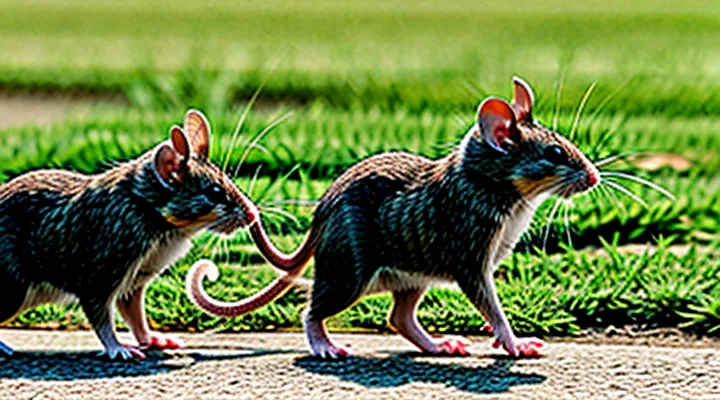
The Biomechanics of Mouse Locomotion
Skeletal and Muscular Adaptations for Running
Spine Flexibility and Movement
Mice achieve rapid locomotion through a highly flexible vertebral column. Each thoracic and lumbar vertebra can rotate up to 30 °, allowing the body to bend laterally and twist during strides. This lateral flexion shortens the distance the hind limbs must travel, increasing stride frequency without sacrificing stability.
The intervertebral joints contain thin, elastic discs that compress and rebound with each step, storing kinetic energy that contributes to forward thrust. Musculature surrounding the spine—primarily the longissimus dorsi and multifidus—contracts rhythmically, controlling curvature and preventing excessive torsion that could lead to injury.
Key functional aspects of spinal mechanics in mice:
- Amplitude of lateral bend: up to 45 ° in high‑speed runs, facilitating rapid turning.
- Segmental coordination: sequential activation from cervical to sacral regions ensures smooth wave-like motion.
- Energy recycling: elastic recoil of intervertebral discs reduces metabolic cost per meter traveled.
- Stability control: dorsal muscles maintain alignment, counteracting centrifugal forces during sharp maneuvers.
These characteristics enable mice to navigate complex environments, accelerate quickly, and maintain agility across varied substrates.
Limb Structure and Gait Mechanics
Mice achieve rapid locomotion through a compact limb architecture that combines lightweight bones with highly specialized musculature. The forelimbs consist of a shortened humerus, radius, and ulna that terminate in a dexterous manus with five digits, each equipped with curved ungual pads for grip. Hindlimbs feature an elongated femur, tibia, and fibula, ending in a robust pes that bears the majority of propulsive force during high‑speed movement. Both fore- and hindlimbs are powered by fast‑twitch muscle fibers, particularly the gastrocnemius, soleus, and extensor digitorum longus, which enable rapid contraction cycles.
Gait patterns in mice are organized into three primary modes:
- Walk: Four‑phase footfall sequence with each limb contacting the substrate once per stride; duty factor exceeds 0.5.
- Trot: Diagonal pairs (left fore‑right hind, right fore‑left hind) contact simultaneously; duty factor drops to approximately 0.5, increasing stride frequency.
- Gallop: Hindlimbs strike in rapid succession followed by forelimbs; duty factor falls below 0.5, maximizing speed and reducing ground contact time.
Transition between these gaits occurs as stride frequency rises and stride length shortens, reflecting adjustments in limb compliance and joint angular velocity. Ground reaction force measurements show peak vertical forces concentrated in the hindlimbs during gallop, while forelimbs provide stabilization during walk and trot.
The mouse’s digitigrade stance positions the metatarsals and metacarpals directly above the ankle and wrist joints, reducing limb moment of inertia and allowing higher angular velocities. Elastic tendons, especially the Achilles equivalent, store energy during stance and release it during push‑off, improving mechanical efficiency. A flexible lumbar spine, capable of alternating lateral flexion, contributes to stride extension and enhances overall propulsion without altering limb length.
Collectively, the integration of lightweight skeletal elements, fast‑twitch musculature, precise footfall timing, and elastic energy storage defines the locomotor performance observed in these rodents.
Neurological Control of Movement
Brain Regions Involved in Locomotion
Mice locomotion relies on a distributed network of neural structures that integrate sensory input, generate motor commands, and fine‑tune movement patterns. The primary motor cortex initiates voluntary stride adjustments, sending descending projections to spinal motor neurons. Activity in this region correlates with changes in speed and direction, reflecting its role in planning and execution of gait.
The cerebellum receives proprioceptive signals from limbs and vestibular inputs, then modulates motor output to maintain balance and timing. Purkinje cell firing patterns synchronize with step cycles, ensuring smooth transitions between stance and swing phases.
Basal ganglia circuits, particularly the striatum and substantia nigra, influence movement initiation and vigor. Dopaminergic modulation within these nuclei adjusts the likelihood of locomotor bursts, shaping exploratory behavior.
Brainstem nuclei constitute the core locomotor command system. The mesencephalic locomotor region (MLR) activates reticulospinal neurons that descend to spinal central pattern generators (CPGs). These CPGs produce rhythmic muscle activation without cortical input, sustaining steady walking once triggered.
Spinal cord segments house interneuronal networks that generate the alternating flexor‑extensor activity characteristic of quadrupedal gait. Sensory feedback through dorsal root afferents refines the CPG output, allowing rapid adaptation to obstacles.
Key regions can be summarized:
- Primary motor cortex: initiates and directs stride modifications.
- Cerebellum: calibrates timing and balance.
- Basal ganglia: regulates initiation and intensity of movement.
- Mesencephalic locomotor region: triggers reticulospinal pathways.
- Reticulospinal nuclei: convey locomotor commands to spinal circuits.
- Spinal central pattern generators: produce rhythmic limb movements.
Understanding the interaction among these structures clarifies how mice achieve rapid, coordinated locomotion across varied environments.
Sensory Feedback and Coordination
Mice rely on rapid integration of tactile, visual, and proprioceptive signals to maintain stable gait during high‑speed locomotion. Whisker follicles detect surface texture and airflow, transmitting high‑frequency bursts to the brainstem and somatosensory cortex. These inputs modulate stride length and foot placement within milliseconds, allowing immediate correction of slip or obstacle contact.
The vestibular apparatus supplies orientation data that synchronizes limb cycling with head movements. Vestibulospinal pathways adjust muscle tone in the hindlimbs, preserving balance on uneven terrain. Simultaneously, muscle spindles and Golgi tendon organs monitor joint angle and load, feeding back to spinal interneurons that fine‑tune motor neuron firing patterns.
Key elements of the feedback loop include:
- Cutaneous receptors on paw pads that sense pressure distribution.
- Mechanoreceptors in the forelimb and hindlimb joints that report limb position.
- Auditory cues from footfall sounds that contribute to spatial awareness in dark environments.
- Central pattern generators in the spinal cord that generate rhythmic output, modulated by ascending sensory streams.
Coordination emerges from the convergence of these streams onto motor circuits that prioritize speed and precision. Synaptic plasticity in the cerebellum refines timing of muscle activation, reducing phase lag between forelimb and hindlimb swings. The resulting locomotor pattern exhibits minimal variability, enabling mice to navigate complex microhabitats with agility.
Diverse Running Behaviors and Contexts
Escape and Evasion Running
Speed and Agility in Response to Threats
Mice exhibit rapid acceleration when a threat is detected, reaching burst speeds of 3–5 m s⁻¹ within milliseconds. This performance relies on a high proportion of fast‑twitch muscle fibers in the hindlimbs, which contract with minimal latency. The neuromuscular pathway is streamlined: visual or auditory cues trigger the superior colliculus, which projects directly to the spinal locomotor circuits, bypassing higher cortical processing.
Agility is maintained through a flexible gait that alternates between trot, gallop and bounding, selected according to obstacle density. Key characteristics include:
- Stride modulation: stride length shortens while stride frequency increases during tight turns, preserving stability.
- Body rotation: the torso rotates up to 45° relative to the direction of travel, allowing swift reorientation without deceleration.
- Tail utilization: the tail acts as a counterbalance, generating torque that aids rapid pivots and prevents overturning.
Escape trajectories are not linear; mice compute optimal paths by integrating spatial memory with real‑time sensory input. This results in zig‑zag patterns that reduce predator interception probability. The decision latency between threat detection and movement onset averages 30–50 ms, indicating a highly efficient sensorimotor loop.
Environmental factors such as substrate compliance influence speed. On loose sand, mice reduce peak velocity by 20 % but increase foot‑placement frequency to maintain traction. Conversely, on hard surfaces they exploit maximal stride length, achieving the highest recorded burst speeds.
Overall, the combination of swift muscular response, adaptable gait mechanics, and precise neural control enables mice to evade predators with exceptional speed and maneuverability.
Directional Changes and Evasive Maneuvers
Mice display rapid, high‑frequency alterations in trajectory when navigating complex environments. Each turn is initiated by vestibular and somatosensory cues that trigger asymmetric activation of hind‑limb muscles, producing angular velocities up to 300 ° s⁻¹. The resulting curvature is tightly coupled to stride length, allowing the animal to maintain forward thrust while reorienting within a single step cycle.
Evasive maneuvers rely on a sequence of coordinated actions:
- Sudden acceleration: Burst speeds of 1.5–2 m s⁻¹ achieved by recruiting fast‑twitch fibers in the gastrocnemius.
- Sharp pivot: Rotation around the central axis within 30–50 ms, facilitated by rapid hip abduction.
- Lateral displacement: Sideways slips of 2–4 cm that reduce the predator’s line of sight.
- Auditory‑visual integration: Real‑time processing of ultrasonic vocalizations and looming shadows to adjust turn direction.
These behaviors are modulated by the mouse’s internal state. Elevated cortisol levels increase turn frequency, while habituation to a stable arena reduces angular variability. Neural recordings show that the dorsal striatum encodes upcoming direction changes, whereas the superior colliculus governs immediate escape responses.
Overall, directional changes and evasive actions constitute a flexible locomotor repertoire that maximizes spatial coverage and predator avoidance while preserving energetic efficiency.
Exploratory Running
Scent Tracking and Navigation
Mice navigate primarily through the detection of volatile compounds released by food, conspecifics, and predators. Their nasal epithelium contains millions of olfactory receptor neurons that bind specific odorants, generating electrical signals transmitted to the olfactory bulb. The bulb organizes these signals into spatial maps, which the piriform cortex interprets as distinct scent signatures.
During movement, mice synchronize sniffing frequency with stride cadence. Rapid sniff cycles (up to 12 Hz) provide continuous sampling of the air column ahead of the body, allowing real‑time updates of the odor gradient. This coupling minimizes lag between sensory input and motor response, enabling swift course corrections toward or away from odor sources.
The integration of olfactory information with locomotor circuits involves several neural pathways:
- Direct projections from the olfactory bulb to the ventral striatum, influencing motivation to pursue attractive odors.
- Connections to the basal ganglia that modulate gait adjustments based on scent intensity.
- Feedback loops through the hippocampus that encode spatial context of odor landmarks for memory‑guided navigation.
Behavioral experiments demonstrate that mice can track a single odor plume over distances exceeding 30 cm, maintaining directional accuracy despite turbulent airflow. When the plume is disrupted, mice increase head‑turning frequency and pause to re‑sample the environment, indicating reliance on active sniffing rather than passive diffusion.
In summary, scent tracking in mice combines high‑resolution olfactory detection, synchronized sniff‑stride dynamics, and specialized neural circuits to produce precise, adaptive navigation.
Environmental Adaptation and Terrain Negotiation
Mice adjust their locomotion to diverse habitats through rapid sensory integration, flexible musculoskeletal structures, and adaptive gait patterns. Their whisker array detects surface texture and obstacles, feeding tactile information to the brain within milliseconds. This input guides foot placement, allowing precise navigation on uneven ground, narrow crevices, and vertical surfaces.
The forelimb and hindlimb joints exhibit a wide range of motion, enabling mice to shift between sprawling, crouched, and semi‑erect postures. Muscle fibers with high oxidative capacity support sustained sprinting, while fast‑twitch fibers provide bursts of acceleration when escaping predators or crossing gaps.
Key mechanisms of terrain negotiation include:
- Dynamic stride modulation – step length and frequency adjust instantly to substrate compliance and incline.
- Rear‑foot grip adaptation – plantar pads expand under load, increasing friction on slick or soft materials.
- Tail balance control – the tail acts as a counter‑weight, stabilizing the body during rapid turns and vertical climbs.
Environmental factors such as humidity, temperature, and lighting influence gait selection. In cold, dry conditions, mice favor shorter, more frequent steps to conserve heat and maintain traction. Under low‑light scenarios, reliance on whisker‑mediated perception intensifies, reducing reliance on visual cues.
Collectively, these adaptations enable mice to traverse complex environments efficiently, maintaining speed and agility across a spectrum of terrains.
Energetics of Mouse Running
Metabolic Costs of Different Gaits
Mice employ three primary gait patterns—walk, trot, and gallop—each associated with a characteristic metabolic expenditure. Energy use rises sharply when speed exceeds the preferred range for a given gait, prompting a transition to a more efficient pattern.
Typical metabolic rates, expressed as oxygen consumption per gram of body mass, are:
- Walk: 0.8 ml O₂ · g⁻¹ · h⁻¹
- Trot: 1.2 ml O₂ · g⁻¹ · h⁻¹
- Gallop: 1.6 ml O₂ · g⁻¹ · h⁻¹
These values derive from treadmill experiments with controlled acceleration and steady‑state measurements. The walk-to-trot transition occurs near 0.3 m · s⁻¹, while the trot-to-gallop shift appears around 0.6 m · s⁻¹. Within each gait, metabolic cost scales linearly with speed, but the slope differs, making the trot the most economical option across a broad intermediate speed range.
Switching gaits reduces the incremental cost of acceleration; the energy saved by adopting a faster gait offsets the higher baseline consumption of that gait. Consequently, mice preferentially select the gait that minimizes the product of baseline cost and speed‑dependent increase.
Experimental protocols that require precise energy budgeting should therefore record gait type and maintain speeds within the gait’s optimal window. Failure to control for gait transitions can introduce systematic errors of up to 30 % in metabolic measurements.
Endurance and Sustained Activity
Mice demonstrate remarkable endurance during prolonged locomotor tasks, an ability rooted in their metabolic efficiency and muscle composition. Aerobic metabolism dominates when mice sustain running for extended periods, relying on oxidative phosphorylation to maintain ATP supply while preserving glycogen reserves. High mitochondrial density in slow‑twitch fibers enables continuous contraction without rapid fatigue, allowing individuals to cover distances far exceeding those achieved during short bursts.
Key physiological contributors to sustained activity include:
- Elevated capillary perfusion that delivers oxygen and nutrients to active muscles.
- Predominance of type I (slow‑oxidative) myofibers in the hindlimb extensors.
- Efficient fatty‑acid oxidation that supplements glucose utilization during long runs.
- Adaptive heart rate and stroke volume adjustments that support increased cardiac output.
Behavioral experiments confirm that mice can maintain a steady running speed on treadmills for up to several hours, exhibiting a gradual decline in velocity rather than abrupt cessation. This endurance reflects both intrinsic muscular traits and central nervous system regulation, where motor patterns are optimized for energy conservation and rhythmic stability.